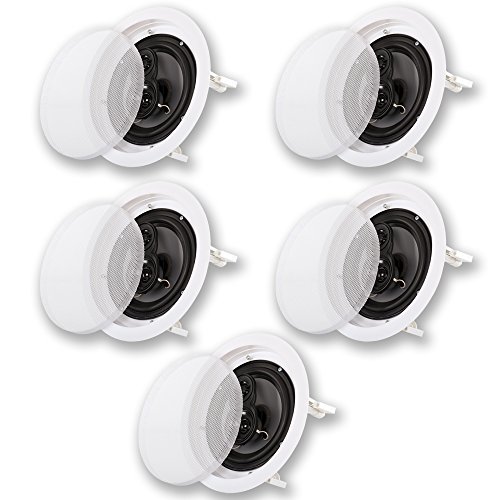
Specs and design
Here's the practical snapshot:
| Spec |
What you get |
| Driver size |
8-inch woofer |
| Tweeter type |
Soft dome tweeter |
| Design |
2-way speaker design |
| Impedance |
Typically 8 ohms |
| Power handling |
Budget receiver-friendly range |
| Sensitivity |
Moderate, enough for normal home listening |
| Mount style |
Flush-mount grille |
| Best use case |
Casual music, secondary rooms, whole-home audio |
The important part isn't the spec sheet by itself. It's what those specs mean in a ceiling.
The 8-inch woofer gives this Acoustic Audio model more bass potential than many smaller options, but don't confuse that with cabinet-speaker punch. A ceiling speaker works in an open mounting environment, so low end usually feels lighter than the woofer size suggests.
The 2-way layout, polypropylene woofer cone, and soft dome tweeter are standard budget home-audio ingredients. That's fine here. This isn't a powered speaker system, and it isn't trying to be a premium hi-fi build.
Setup compatibility for a vinyl system
Use this checklist before you buy:
- Turntable
- Phono preamp, if your deck doesn't have one built in
- Stereo receiver or integrated amp
- Speaker wire for passive speaker wiring
- Ceiling access, correct cutout diameter, and enough mounting depth
The big mistake is assuming the speakers are the whole system. They aren't.
If your turntable has no built-in preamp, you'll need an external phono stage or a receiver with a phono input. If you don't already own amplification, read the turntable setup guide and what a phono preamp does before ordering anything.
Here's the budget trap. Someone buys the CS-IC83 because the pair looks cheap, then realizes they still need a receiver, wire, and a workable install path through the ceiling. The speaker pair wasn't the expensive part. The missing pieces were.
If your setup checklist already looks complicated, a simpler speaker path may be the better buy.
Bookshelf speakers vs the CS-IC83 for vinyl listening
For records, bookshelf speakers usually win. They sit closer to ear level, image better, and give you more placement control.
The ceiling pair wins on aesthetics and room coverage. If you hate visible gear and want music spread through the space, hidden speakers have a real advantage.
| Category |
CS-IC83 |
Bookshelf speakers |
| Stereo imaging |
Fair |
Better |
| Bass perception |
Moderate |
Usually fuller |
| Placement flexibility |
Limited after install |
Much better |
| Visual footprint |
Minimal |
Visible |
| Best use |
Casual room audio |
Dedicated record listening |
In-ceiling speakers don't always sound bad for music. They can sound perfectly enjoyable for casual listening, but they rarely beat bookshelf speakers in a vinyl-first room.
Think about the room, not just the product. In a living room where records are part of daily life but not a sit-down ritual, the ceiling route can be the better compromise. In a room built around a chair, rack, and careful speaker placement, bookshelf speakers are the better tool.
Choose the CS-IC83 if…
- You want hidden speakers and minimal visual clutter
- You already own a stereo receiver or integrated amp
- Your goal is room-filling music, not a locked-in sweet spot
- This is a secondary vinyl room, office, or den
- You understand the install work and wiring requirements
Choose bookshelf speakers if…
- You want your main speakers for serious record listening
- Stereo imaging matters more than a clean ceiling look
- You want easier placement and future upgrades
- You don't want to cut into the ceiling or run speaker wire
- You expect fuller bass and a more natural front soundstage