Review · Updated July 2026
AMPHIFIAUDIO AK45 Pro Amplifier Review
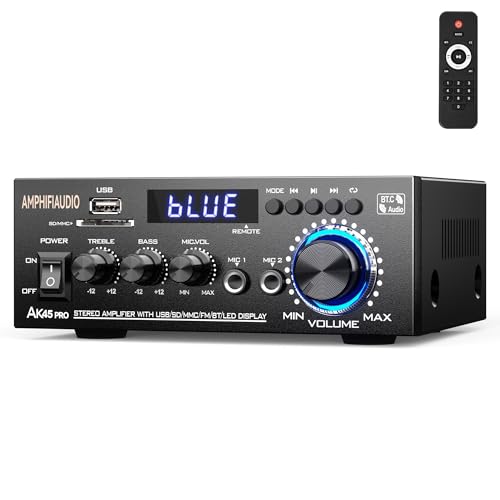
If your turntable already outputs line level, or you’re willing to add a separate phono preamp, I think the AK45 Pro is a sensible ultra-budget way to get passive speakers playing. If you expect receiver-level power, built-in phono support, or room to grow, I’d skip it.
Darkside Vinyl is reader-supported. When you buy through links on our site we may earn an affiliate commission, at no extra cost to you. It never changes our verdict or our score. How we make money.
Darkside Vinyl's verdict
In our listening room
I look at it as a cheap bridge between a beginner turntable setup and a pair of small passive speakers. It's convenient and usable, but it isn't refined, and it won't act like a proper stereo receiver.
Buy if:
Pros
- 400W peak power
- Multiple input options
- Remote control included
- Bass and treble adjustment
Cons
- Limited to passive speakers
- Small size may limit power
- No built-in Bluetooth speaker
At a glance
AMPHIFIAUDIO AK45 Pro Amplifier, by the numbers
The specs and scores that matter most when deciding if this product fits your setup.
How it scored
4.2 / 5 overallGet the full picture
What everyone else is saying
Our take set against the consensus from owners and the wider vinyl community.
From a vinyl-first perspective, I wouldn't treat the AK45 Pro as a complete record-playing solution.
Marketplace feedback on amps like this usually lands in the same places: low price, small size, easy setup, and handy Bluetooth streaming.
Forum conversations usually get to the real question faster: will it power my speakers, can I plug my turntable straight in, or should I just buy powered speakers instead?
Overview
AMPHIFIAUDIO AK45 Pro Amplifier Overview
Specs snapshot and what they mean
Here's the short version of the feature set and why it matters for vinyl.
| Spec | What it means in practice |
|---|---|
| RCA input | Accepts line-level audio, not phono level from many turntables |
| 3.5mm AUX input | Handy for phones, tablets, or other simple wired sources |
| Bluetooth connectivity | Good for casual streaming, not a reason by itself to buy for vinyl |
| Volume control | Basic front-panel control for everyday use |
| Bass and treble controls | Useful for correcting thin or bright budget speakers |
| Speaker connections | Fine for simple passive speaker wiring, not premium hardware |
| Remote control | Convenient if included, especially for desktop or shelf use |
| Best use case | Small-room listening with efficient passive speakers |
The RCA jack is where beginners get tripped up. Seeing RCA on the back makes it look record-player ready, but that input only works properly if the signal has already been brought up to line level.
A true phono input on a stereo receiver or integrated amplifier does that extra work for you. This one doesn't.
How to connect it in a vinyl setup
The clean connection paths are simple:
- Turntable with built-in preamp -> AK45 Pro -> passive speakers
- Turntable without preamp -> external phono preamp -> AK45 Pro -> passive speakers
Here's the quick category split:
| Component | Job |
|---|---|
| Amplifier | Powers passive speakers from a line-level source |
| Phono preamp | Boosts and equalizes the turntable's phono signal |
| Stereo receiver | Amplifies speakers and usually adds more inputs and features |
A Fluance-style turntable without a built-in preamp needs one more box before this amp. An AT-LP60X-style deck with a phono/line switch is a much easier fit, because you can set it to line and connect directly.
If you haven't bought speakers yet, powered speakers are often the simpler path. They remove the separate amp from the equation, which means fewer cables, fewer compatibility mistakes, and less guesswork about power.
Speaker matching still matters. In plain terms, this amp is better with easy small speakers in a bedroom or office than with larger models in an open-plan living room.
If the signal chain above matches your setup, you can check current pricing here:
The full review
How the AMPHIFIAUDIO AK45 Pro Amplifier performs, point by point
The details that matter when you're deciding — tested in our room, explained in plain language.
Why trust this review
How we tested the AMPHIFIAUDIO AK45 Pro Amplifier
No spec-sheet guesswork. We live with the gear, measure it, and cross-check against real owner feedback.
Our review process
-
1
Buy it ourselves
We purchase products through normal retail channels — never accept free units for review.
-
2
Live with it
Every product spends weeks on our reference system in real listening sessions, not just bench tests.
-
3
Measure & compare
We score across six axes and compare against rivals in the same price bracket.
-
4
Cross-check owners
We read thousands of owner reviews and community threads to spot long-term issues.
Our editors' work has appeared in
Final thoughts
Should you buy the AMPHIFIAUDIO AK45 Pro Amplifier?
✓ Buy it if
- <h3>Why the AK45 Pro works for simple vinyl systems</h3>
- <p>The best thing here is the price. A passive-speaker setup feels a lot less intimidating when the amp doesn't eat most of the budget.</p>
- <p>Its small footprint also helps. On a desk, dorm shelf, or apartment media console, it's much easier to place than a full-width receiver.</p>
- <p>Bluetooth is a useful extra for casual listening. You can spin records on the weekend, then stream from your phone during the week without changing gear.</p>
- <p>The basic inputs are enough for a starter system: RCA for a line-level source, 3.5mm AUX for simple wired playback, and tone knobs for quick adjustment. If your budget speakers sound thin on an open shelf or too bright near a wall, those controls can help.</p>
- <p>Compared with a stripped-down analog mini amp, this one is easier to live with day to day.</p>
✕ Skip it if
- <h3>Where the AK45 Pro falls short for vinyl buyers</h3>
- <p>The big problem is simple: there's no built-in phono preamp. For a lot of turntable shoppers, that's the difference between a working setup and a confusing mess.</p>
- <p>I see this mistake all the time in entry-level audio. Someone plugs a turntable with standard RCA outputs into the amp, hears weak or wrong sound, and assumes the amp is defective.</p>
- <p>Usually, it isn't. The signal chain is incomplete.</p>
- <p>The power claims also need a reality check. Big advertised watt numbers don't guarantee better sound, because speaker matching, distortion, and room size matter more.</p>
- <p>This unit makes more sense with efficient passive speakers than with demanding bookshelf models. If you're trying to fill a larger living room or drive speakers that already like more current, it'll start to sound thin fast.</p>
- <p>The upgrade path is limited too. A stereo receiver, or even an entry integrated amp with phono support, gives you more flexibility, better connectivity, and usually better speaker terminals.</p>
- <p>If you're shopping higher up the chain, our phono preamp guide and best turntables under $1000 pages are better next stops.</p>
- 400W peak power
- Multiple input options
- Remote control included
- Bass and treble adjustment
- Limited to passive speakers
- Small size may limit power
- No built-in Bluetooth speaker
Still wondering?
AMPHIFIAUDIO AK45 Pro Amplifier — your questions
It's a compact 2-channel budget amplifier made to power passive speakers from line-level sources like Bluetooth, RCA, or 3.5mm AUX. It isn't a phono preamp.
Yes, if the speakers are a reasonable match and the turntable signal is line level. Small-room listening with efficient passive bookshelf speakers is the right use case.
No, it doesn't. You need either a turntable with a built-in preamp or a separate external phono preamp before the signal reaches the amp.
Yes, conditionally. It's worth buying if your goal is to play records cheaply through passive speakers and you already understand the phono preamp requirement.
Only if your turntable doesn't already have one built in. The easiest way to check is to look for a phono/line switch or confirm that the product specs mention line output.
Not automatically. Powered speakers are often simpler for beginners because the amplification is already built in.
The best match is a turntable with a built-in preamp or switchable line output. That gives the amp the line-level signal it expects.