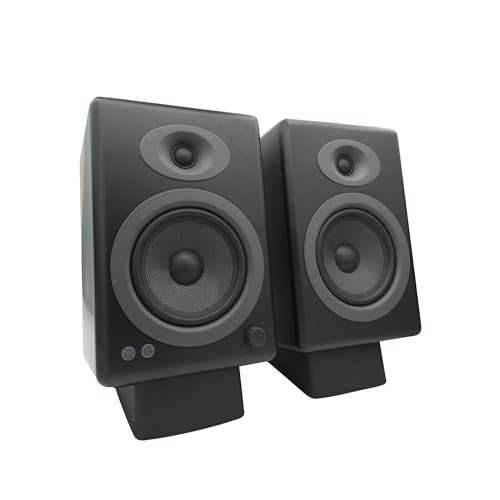
The first thing I noticed with the Audioengine A5s was how easy they are to listen to for long stretches. I didn’t get that “hi-fi demo room” feeling where everything is pushed forward and a little too eager; instead, they sound relaxed, full, and generally well-balanced.
What stood out most to me was the low end. These speakers have enough weight to make records feel satisfying without turning bass lines into a muddy mess, which is exactly what I want from powered speakers in a real room.
The top end stays smooth rather than sharp, so I never felt like cymbals or vocal sibilance were being shoved in my face. They’re not the kind of speakers that try to impress you with fake detail; they just make music feel solid and easy to live with.
The A5s look clean and straightforward in a way I appreciate. They don’t scream for attention, and that makes them easy to drop into a listening room, office, or living space without the whole setup looking overdesigned.
They also feel like proper, grown-up gear when you handle them. The cabinets have enough heft to feel stable, and that matters because lightweight powered speakers can sound a little loose and cheap even when the driver count looks impressive on paper.
The included stands make a bigger difference than I expected. Getting the speakers up off the surface and angled properly helps them sound more focused, and it also makes the whole setup look more intentional instead of like two boxes parked on a shelf.
I like gear that gets out of my way, and the A5s do that well. Once they’re placed and connected, there isn’t much fussing around, and I didn’t feel like I had to keep tweaking settings just to enjoy a record or stream some music.
They’re the kind of speakers that work best when you want a simple system that behaves predictably. I could sit down, power them up, and get straight to listening without thinking about an amp, separate components, or a pile of extra boxes.
In day-to-day use, that simplicity matters more than people admit. If a speaker is going to live in your space and get used constantly, I’d rather have something that’s easy to trust than something that looks more exciting in a brochure.
04Connectivity & System Fit
The A5s make the most sense for someone building a compact, no-nonsense system. They’re a good match for a turntable setup, a desktop rig, or a small living room where you want decent sound without going down the rabbit hole of separates.
What I like here is that they feel flexible without being bloated with unnecessary extras. They cover the basics in a way that actually supports real listening habits, which is more useful than a long feature list you’ll never touch.
I also think their powered design makes them especially appealing if you want fewer boxes and less cable clutter. That simplicity can be a real advantage when you’re trying to keep a vinyl setup tidy and practical instead of turning it into a full-time project.
I’d point the A5s toward someone who wants a serious step up from basic computer speakers or entry-level all-in-one sound gear. They have enough scale and composure to feel like a real stereo, but they don’t demand a complicated system around them.
They’re also a smart choice if you value easy listening over hyper-analytical sound. If your idea of a good speaker is something that makes records enjoyable, forgiving, and consistently musical, these hit that brief nicely.
I wouldn’t buy them if I were chasing ultra-audiophile precision or a system that’s meant to be endlessly upgraded piece by piece. But for a straightforward powered-speaker setup that sounds confident and lives well in the real world, they make a lot of sense.