★ Editor's Choice
Review · Updated July 2026
Review
In practice, the Audioengine P4 is easy to place and easy to like, but only if the rest of your signal chain makes sense.

Reviewed by Cassie Hart
Audio Equipment Specialist · Last updated July 7, 2026 · 11 min read
Independent · reader-funded
Hands-on tested
Unbiased rankings
Darkside Vinyl is reader-supported. When you buy through links on our site we may earn an affiliate commission, at no extra cost to you. It never changes our verdict or our score. How we make money.
Darkside Vinyl's verdict
In practice, the Audioengine P4 is easy to place and easy to like, but only if the rest of your signal chain makes sense
4.5
/ 5
4.5 out of 5
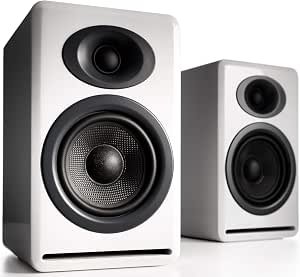 In our listening room
Here's the cleanest real-world example: pair these with a Sony STR-DH190 and a turntable with a built-in preamp, and you've got a tidy little vinyl system. Buy only the speakers and a record player, and you'll hit a wall on day one.
Pros
- Room-filling sound
- Stylish design
- Custom components
- Compatible with various amplifiers
- 3-year warranty
Cons
- Requires an amplifier
- Passive design limits portability
- Higher price point
At a glance
, by the numbers
The specs and scores that matter most when deciding if this product fits your setup.
Our score
4.5 / 5
Price
See retailer
Store
Amazon
Category
Turntables
How it scored
4.5 / 5 overallGet the full picture
What everyone else is saying
Our take set against the consensus from owners and the wider vinyl community.
C
Cassie Hart
Our reviewer
I like the P4 more as a system-builder's speaker than an impulse buy.

Amazon
Customer consensus
The positive themes are consistent.

Reddit
Community take
Reddit usually treats these as a sensible starter passive option, especially with common pairings like the Sony STR-DH190.
Overview
Overview
What you need with the Audioengine P4
Here's the plain-English checklist:
- Required: amp or stereo receiver
- Required: speaker wire
- Optional: banana plugs
- Sometimes required: phono preamp, only if your turntable doesn't have one built in
The compatibility chain is simple once you see it written out:
- Turntable with built-in preamp → receiver → P4
- Turntable without built-in preamp → phono preamp → receiver → P4
A real beginner setup might look like this: an Audio-Technica turntable with a built-in preamp, a Sony STR-DH190, and basic speaker wire. A Fluance deck without a built-in phono stage may need one extra box, and that's where buyers often underestimate the total cost.
If you're still sorting out the signal chain, it helps to compare this route with turntable speakers built for simpler setups before you buy.
Audioengine P4 vs powered speakers for turntables
| Setup factor | Audioengine P4 | Powered speakers |
|---|---|---|
| Setup complexity | Higher, needs amp or receiver | Lower, amp is built in |
| Upgrade path | Better | More limited |
| Desk friendliness | Good, but extra gear adds clutter | Usually better |
| Total starter cost | Can rise fast | Often lower |
| Sound flexibility | More amp-pairing options | Less flexible |
My short version is simple: choose the P4 if you want system flexibility and don't mind extra parts.
Choose powered bookshelf speakers if you want fewer cables, faster setup, and less guesswork. On a desk, the Audioengine A2+ usually makes more sense. In a small living room where future upgrades matter, the passive route starts to look smarter.
Who should buy it, and who should skip it
- Buy it if: you don't mind adding a stereo receiver or integrated amplifier.
- Buy it if: you're building a small-room vinyl system or desktop hi-fi setup.
- Buy it if: you already own an amp and want compact stereo speakers with room to upgrade later.
- Skip it if: you want plug-and-play speakers, have no room for extra gear, or expect big bass in a larger room.
Quick spec snapshot
- Speaker type: passive bookshelf speakers
- Driver: 4-inch Kevlar woofer
- Tweeter: 0.75-inch silk dome tweeter
- Connection type: binding posts for speaker wire or banana plugs
- Best room size: desk, bedroom, or small living room
Here's the cleanest real-world example: pair these with a Sony STR-DH190 and a turntable with a built-in preamp, and you've got a tidy little vinyl system. Buy only the speakers and a record player, and you'll hit a wall on day one.
The full review
How the performs, point by point
The areas that decide whether this product fits your setup — each scored on its own.

Audioengine P4 Passive Speakers
Get it from Amazon
4.5
$249.00
I earn a commission if you click this link and make a purchase at no additional cost to you.
07/06/2026 08:11 am GMT
Why trust this review
How we tested the
No spec-sheet guesswork. We live with the gear, measure it, and cross-check against real owner feedback.
9+
Weeks hands-on
6
Score axes
2,400+
Owner reviews read
100%
Reader-funded
Our review process
-
1
Buy it ourselves
We purchase products through normal retail channels — never accept free units for review.
-
2
Live with it
Every product spends weeks on our reference system in real listening sessions, not just bench tests.
-
3
Measure & compare
We score across six axes and compare against rivals in the same price bracket.
-
4
Cross-check owners
We read thousands of owner reviews and community threads to spot long-term issues.

Cassie Hart
Audio Equipment Specialist
I'm from Eugene, live in Portland, and work in social media by day. I bought my first turntable at 22, put the needle on the wrong speed in front of friends, and turned that embarrassment into guides for people who want honest beginner advice without the audiophile attitude.
✦Hands-on product testing
✦Independent editorial policy
✦No paid placements
Our editors' work has appeared in






Final thoughts
Should you buy the ?
✓ Buy it if
- <h3>Why the Audioengine P4 makes sense for the right buyer</h3>
- <p>The size is a real strength. These fit on shelves, narrow stands, and desks without taking over the room.</p>
- <p>The sound works well for long listening sessions. It's clean and balanced, without the sharp top end that gets tiring fast.</p>
- <p>The bigger win is flexibility. You can start with a basic stereo receiver now, then upgrade your turntable or phono preamp later without replacing the speakers.</p>
- <p>That's where passive gear earns its keep. The P4 asks more from you up front than something like the Audioengine A2+, but it gives you a better long-term path if you know you'll keep building the system.</p>
- <h3>Good for beginners who don't mind extra gear</h3>
- <p>“Passive” sounds more intimidating than it is. It just means the speakers don't power themselves.</p>
- <p>If your turntable has a built-in phono preamp, the chain can still stay simple: turntable, receiver, speakers. That's not rocket science, but it does require one more box.</p>
- <p>Setup confidence matters more than squeezing out the last bit of sound quality in a first system. A beginner with a decent receiver and a little patience will do fine here.</p>
✕ Skip it if
- <h3>Where the Audioengine P4 creates friction</h3>
- <p>The biggest downside is also the most important one: you need an amp or receiver, no exceptions. A turntable alone can't run these.</p>
- <p>That changes the budget fast. You start with a fair speaker price, then add a receiver, speaker wire, maybe stands, and maybe a phono preamp.</p>
- <p>Suddenly the “budget” passive route can cost more than a solid powered pair. That's why speaker price alone doesn't tell the whole story.</p>
- <p>Bass is the other limit. The cabinet is compact, so the low end is restrained, especially in a bigger room or with hip-hop, electronic, or louder rock.</p>
- <h3>Skip this if you want plug-and-play speakers</h3>
- <p>If you live in a dorm, have one shelf, and don't want extra boxes, this probably isn't your speaker. Powered speakers usually win on simplicity and footprint.</p>
- <p>For a desk setup, the difference gets obvious fast. If you want your turntable and speakers working tonight, something like the Audioengine A2+ or another powered pair is the cleaner answer.</p>
- <p>That's not a knock on the P4. It's just a reminder that convenience matters, and passive speakers don't automatically beat powered ones.</p>
Audioengine P4 Passive Speakers
Get it from Amazon
4.5
$249.00
Audioengine P4 Passive Speakers - High-performance speakers perfect for music, gaming, and home theaters.
Pros:
- Room-filling sound
- Stylish design
- Custom components
- Compatible with various amplifiers
- 3-year warranty
Cons:
- Requires an amplifier
- Passive design limits portability
- Higher price point
I earn a commission if you click this link and make a purchase at no additional cost to you.
07/06/2026 08:11 am GMT
Still wondering?
— your questions
They're compact passive bookshelf speakers from Audioengine. “Passive” means they need external amplification, so you can't plug them straight into the wall and expect them to work.
Yes, if you have the right supporting gear. With a stereo receiver and proper placement, they can sound clean, balanced, and very good in a small room.
Yes, absolutely. Passive speakers need power from an integrated amplifier or stereo receiver.
The P4 wins on upgrade flexibility and long-term system building. Powered speakers win on simplicity, footprint, and usually starter convenience.
At minimum, you need a stereo receiver or integrated amp and speaker wire. Banana plugs are optional.
I'd say yes, with a condition. They're worth it if you want to learn a proper stereo chain and don't mind a little setup friction.