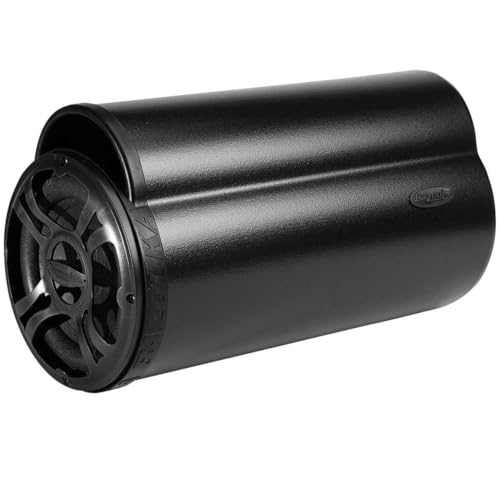
The Bazooka BTA8250D is all about punchy bass, and it delivers that in spades. It fills out the low end nicely, especially when paired with stock door speakers in smaller cabins like hatchbacks or sedans. You can really feel the difference when you crank up some hip-hop or rock; it adds a fullness that’s often missing from factory setups.
That said, don’t expect this little tube to compete with traditional sealed subwoofers. While it does a great job of enhancing the overall sound, it won’t satisfy those looking for deep, earth-shaking bass. If you’re after competition-style thump, you might find yourself wanting more after installation.
The tube design of the BTA8250D is a clever way to maximize cargo space in your vehicle. It fits neatly in corners or along the sides of your trunk, which is a huge bonus for anyone who needs to haul stuff around. I appreciate how it uses space efficiently compared to bulky square boxes that can take up a lot of room.
However, the shape does come with some caveats. Depending on your trunk layout, it might not fit as seamlessly as you’d hope. It’s always a good idea to do a little measuring before you buy, just to ensure it’ll work with your setup.
One of the best features of the BTA8250D is its built-in Class D amplifier, which simplifies installation. You get everything you need in one package, meaning less clutter and fewer components to worry about. Plus, the speaker-level inputs make it a breeze to integrate into a factory stereo without needing to swap out your head unit.
The remote bass control is another handy touch. It allows for quick adjustments on the fly, which is especially useful if you’re experimenting with different genres or just want to dial it back a bit for a quieter drive. Overall, the setup process is straightforward, making it a great choice for those who want to enhance their sound without diving into a complex installation.
04Connectivity & Features
The BTA8250D gives you some solid connectivity options. You get both RCA and speaker-level inputs, which means it can easily adapt to whatever audio setup you have. If you’ve got an aftermarket head unit, the RCA inputs are perfect; if you’re sticking with the factory radio, the speaker-level inputs are a lifesaver.
This flexibility is one of the reasons I think the BTA8250D makes so much sense for everyday drivers. It’s designed for those who want a straightforward bass upgrade without the hassle of piecing together a complex system. In a world where simplicity is key, this product shines.
In my experience, the BTA8250D is a great companion for daily driving. It enhances the listening experience without overwhelming it, making your commute or road trip much more enjoyable. Whether you’re jamming out to your favorite playlist or just cruising along, this bass tube adds a nice layer of depth to the sound.
That said, if you’re someone who loves blasting bass-heavy tracks at high volumes in a larger vehicle, you might find it lacking. While it does a fantastic job of filling in the gaps, it’s not going to replace a full-blown subwoofer setup. For most daily drivers, though, it’s a solid upgrade that won’t disappoint.