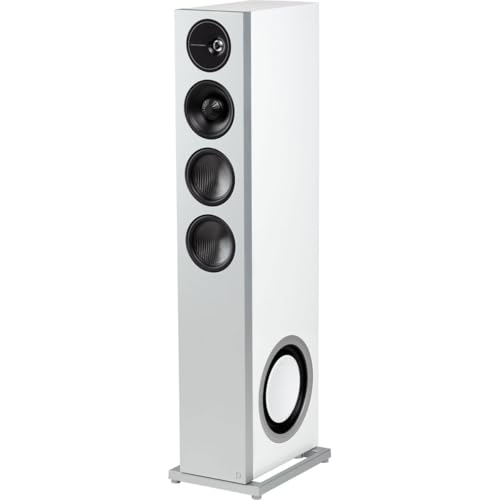
Key specs and what they mean in practice
| Spec |
What to know |
| Speaker type |
Floorstanding speaker |
| Powered or passive |
Passive speaker |
| Finish |
White |
| Ideal room size |
Medium to large rooms |
| Amplifier required |
Yes, stereo receiver or integrated amp |
| Best use case |
Traditional home stereo or home theater setup |
For vinyl listeners, the main takeaway isn't the frequency response line on a product page. It's that this is a room-filling speaker that expects real supporting gear.
If you're comparing it with a powered system, remember the split: one is simpler, the other is the traditional hi-fi path.
What you need with it
You'll need four basics: a turntable, a phono preamp if your table or amp doesn't have one, a stereo receiver or integrated amp, and speaker wire.
A common chain looks like this: turntable with built-in preamp to stereo receiver to D17. If your turntable doesn't have that built in, the chain becomes turntable to phono preamp to receiver to speakers.
If your turntable has RCA outputs, that still doesn't mean it can power passive speakers by itself. For setup help, see our phono preamp guide and full turntable setup guide.
Tower speaker vs bookshelf speaker for vinyl setups
| Factor |
Tower speaker |
Bookshelf speaker |
| Room size |
Better in medium to large rooms |
Better in small to medium rooms |
| Bass response |
Usually fuller, more weight |
Often lighter without a sub |
| Placement |
Needs more breathing room |
Easier to place |
| Total system cost |
Higher footprint and system cost |
Usually cheaper overall |
If you've got space to pull speakers away from the wall and you sit a real distance from them, the D17 can justify itself. If you're working with a bedroom, apartment corner, or tight budget, bookshelf speakers are often the smarter buy.