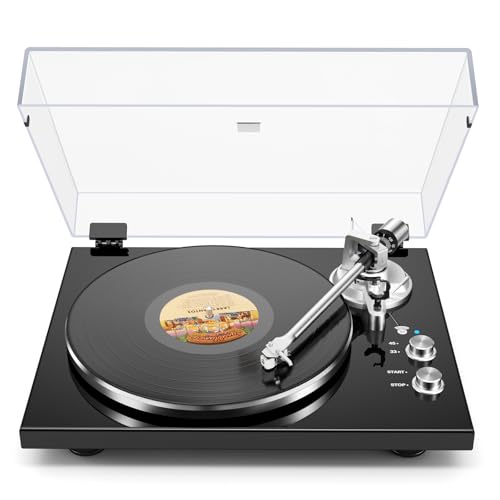
Specs in practice: what the features actually mean
| Feature |
What it means |
What this means in practice |
| Built-in speakers |
Audio plays without external speakers |
Easiest setup, weakest sound quality ceiling |
| Bluetooth |
Wireless function, but behavior may vary by model |
Confirm whether it sends audio out, receives from a phone, or both |
| RCA line output |
Connects to external line-level gear |
You can add powered speakers or a receiver later |
| Built-in phono preamp |
Boosts signal to line level |
No separate phono stage is usually needed |
| Ceramic cartridge |
Budget cartridge type common on all-in-ones |
Lower performance and less confidence than better moving magnet setups |
| 3-speed playback |
Supports more than just LPs |
Useful if you play 45s or older 78-capable records |
| Auto-stop if included |
Platter stops at record end |
Nice convenience feature, but not a reason to buy by itself |
| Dust cover if included |
Helps keep dust off platter and record area |
Good for apartment use, especially on open shelves |
A common mistake is seeing Bluetooth on the box and assuming every wireless setup will work the same way. Check whether this model sends audio to Bluetooth speakers, receives audio from a phone, or does both.
Compatibility checklist: what you need and what you don't
Here's the short answer: for basic playback, you usually don't need external speakers or a separate phono preamp.
| Gear |
Works directly? |
Notes |
| Powered speakers |
Yes, usually via RCA |
Built-in preamp should handle line-level output |
| Passive speakers |
No |
You still need an amp or receiver |
| Receiver |
Yes, if it has line input |
Use AUX, Line, or similar input |
| Headphones |
Maybe |
Only direct if the unit has a headphone jack |
| Separate phono preamp |
Usually no |
Not needed if the internal preamp is active |
I've seen buyers connect a unit like this straight to passive bookshelf speakers, get no sound, and assume the turntable is dead. The real issue is simple: passive speakers need amplification.
Record safety and long-term use
Cheap turntables aren't guaranteed to ruin records overnight. That part gets overstated.
Still, stylus quality, ceramic cartridge design, tracking force, and alignment consistency all matter. Better beginner decks usually handle those basics with more confidence.
If you play used records a few times a month, this risk may be acceptable. If you're buying expensive new pressings regularly, I'd step up.
Quick comparison: DIGITNOW vs. AT-LP60X and suitcase models
| Model |
Best for |
Main strengths |
Main tradeoffs |
| DIGITNOW Belt Drive Turntable |
Casual listeners who want an all-in-one setup |
Built-in speakers, simple setup, low upfront cost |
Weaker sound, limited upgrade path, lower tracking confidence |
| Audio-Technica AT-LP60X |
Beginners who want a better long-term first deck |
Better playback quality, stronger tracking, better value over time |
Needs external speakers, higher total cost |
| Typical suitcase turntable |
Portable, giftable casual use |
Compact design, easy to move |
Similar sound and record-care compromises, often limited outputs |
Against the Audio-Technica AT-LP60X, the DIGITNOW wins on all-in-one simplicity and lower upfront cost. The AT-LP60X wins on sound quality, tracking confidence, and long-term value.
Against a typical Victrola suitcase turntable, the DIGITNOW may be a little better for home use if the cabinet and outputs are better thought out. Suitcase models still win on portability, while both sit in the same convenience-first category.
Choose the DIGITNOW if you want the cheapest casual listening setup with built-in speakers. Choose the AT-LP60X if you want a cleaner first step into vinyl and can add speakers now or later.