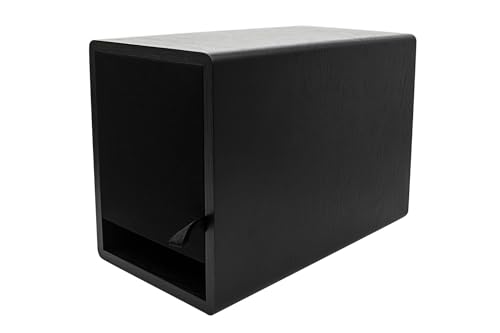
Specs snapshot
| Spec |
Details |
| Driver size |
6.5-inch |
| Cabinet style |
Compact, low-profile cabinet |
| Amplifier |
Built-in amplifier |
| Inputs |
Line-level RCA inputs, speaker-level inputs |
| Controls |
Adjustable crossover, phase adjustment, gain knob |
| Best room size |
Small rooms, apartments, nearfield to compact living rooms |
| Best use case |
Music-focused bass support in tight spaces |
What the main specs mean for music listening
The small cabinet helps a lot with placement. You can tuck it near a media console, under furniture, or beside a stand where a normal cube sub would be a problem.
The downside is simple physics. A compact enclosure and 6.5-inch driver won't move air like a larger box, so deep bass and output are limited.
What this means in practice
For records, adjustable crossover matters more than headline wattage. You want the sub to hand off cleanly below your mains, not call attention to itself.
Phase adjustment and gain help the bass lock in with your speakers. When they're set right, kick drums get weight and bass lines get shape without sounding detached.
Connection options for vinyl and stereo systems
| System |
Can it work? |
Best connection path |
| Turntable + phono preamp + powered speakers |
Yes, sometimes |
From speaker sub out or line out, if available |
| Turntable + receiver + passive speakers |
Yes |
Receiver subwoofer pre-out or speaker-level inputs |
| TV + compact stereo |
Yes |
Line-level output or receiver-based connection |
A turntable can't usually connect straight to a subwoofer by itself. Phono-level signal isn't the same as a line-level sub feed, so you need a phono preamp, receiver, or powered speaker chain with the right outputs.
If you need a refresher, see our guides on what a phono preamp does and how to build the full signal chain.
A common real-world case is powered speakers with no dedicated sub out. In that setup, the FF6.5 only makes sense if you have line-level pass-through, preamp outputs, or a speaker-level path that matches your gear.
Small room performance, what to expect
In a small room, this sub can make a lean pair of speakers sound more grounded. That's the right expectation.
It does best filling in missing low end, not delivering chest-hit impact. Corner placement can add weight, but it can also make bass one-note, so you'll want to experiment a bit.