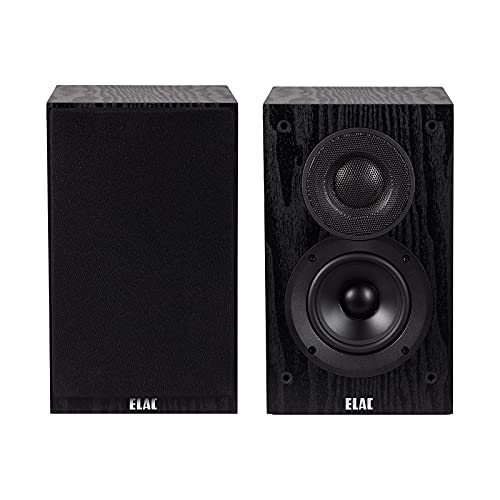
Specs Snapshot
| Spec |
Details |
| Speaker type |
Passive bookshelf speakers |
| Driver size |
4-inch woofer |
| Tweeter |
Silk dome tweeter |
| Connection |
Wired binding posts |
| Best room size |
Small room, bedroom, desktop, nearfield |
What this means in practice: these are built for close to moderate listening distances, not for shaking a large shared room.
Vinyl Setup Compatibility
The basic chain is simple: turntable, phono preamp if needed, stereo receiver or integrated amplifier, speaker wire, then the ELAC speakers.
If your turntable has a built-in phono preamp, like many beginner Audio-Technica models, you can run RCA into a compact receiver and then speaker wire to the binding posts.
If your deck doesn't have one, you'll need a separate phono stage before the amp. If you need a refresher, see this guide on what a phono preamp does and this turntable setup guide.
Passive vs Powered for Beginners
Passive speakers mean more boxes and more wires, but they also give you more flexibility later.
Powered speakers mean less setup friction and often a lower total starting cost.
If you're buying for a dorm or office and have no gear yet, you may be happier with an Edifier R1280DB-style setup.
If you already own a receiver, or want to upgrade piece by piece, passive usually gives you more long-term value in a vinyl setup.
Compared With 5.25 Inch Bookshelf Speakers
Larger bookshelf speakers usually give you fuller bass and more output.
That's just physics, not marketing.
The B4.2 makes more sense when the room is small and the listening distance is short.
If your system lives on a desk, bedroom stand, or apartment corner shelf, these compact ELAC wired speakers are easier to place and easier to justify than a bulkier pair.
For broader options, see the site's picks for best turntable speakers.