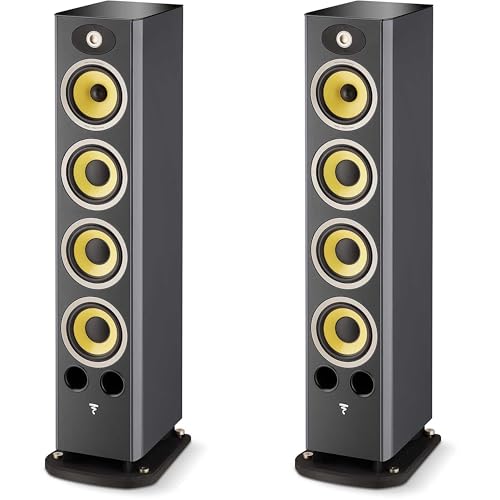
Specs that matter in practice
| Spec |
What it means |
| Speaker type |
3-way bass-reflex floorstanding speaker |
| Sensitivity |
Around 92 dB, easier to drive than many rivals |
| Nominal impedance |
8 ohms |
| Frequency response |
Full-range performance with meaningful bass reach |
| Driver layout |
Multiple bass drivers, dedicated midrange, TNF tweeter |
| Best room size |
Medium to large rooms |
The headline spec is sensitivity, but don’t overread it. High sensitivity means your amp doesn’t need huge wattage for satisfying volume.
It doesn’t mean a cheap amp will control the bass well. That part still comes down to amplifier quality.
The 3-way driver layout matters for records because it spreads the work more cleanly. Bass, mids, and treble each get their own lane, which helps vocals stay open while the low end carries more weight.
Compared with bookshelf speakers, the practical gain is scale. You’re buying more cabinet volume, more bass authority, and a bigger presentation, not just a few extra detail points.
System match, turntable and amp pairings
If I were matching these in a vinyl-first system, I’d keep it simple and balanced:
- Rega pairing: Rega Planar 3, separate phono preamp, quality integrated amp with good current delivery
- Pro-Ject pairing: Pro-Ject Debut Pro or X1, better external phono stage, mid-to-upper-tier integrated amp
- Fluance pairing: Fluance RT85, upgraded phono preamp, strong stereo receiver or integrated amp
A quality integrated amp is usually the cleanest path. A stereo receiver is fine if it’s genuinely built for two-channel music, not just feature-stuffed home theater duty.
You can skip a subwoofer in many rooms, and that’s one of the main selling points here. But if your room is very large, or you want chestier low end for electronic records, a sub can still make sense.
Floorstanders still need placement work. They need breathing room, toe-in testing, and some distance from boundaries.
If your chain looks close to this, compare it against the best turntable speakers list and the turntable buying guide.
Focal Aria K2 936 vs KEF R7 vs Klipsch Forte IV
The Focal sits in the middle of a useful three-way split. It gives you scale, detail, and a refined top end that works well for long vinyl sessions.
| Speaker |
Sound profile |
Best for |
Watch out for |
| Focal Aria K2 936 |
Balanced, full-range, refined |
Vinyl listeners who want scale without harshness |
Needs a capable amp and room to breathe |
| KEF R7 |
Precise, controlled, imaging-first |
Buyers who prioritize focus and refinement |
Can feel less bold or physical than larger-sounding rivals |
| Klipsch Forte IV |
Dynamic, lively, immediate |
Listeners who want slam and live-feel energy |
Bigger personality can be too forward for some rooms or tastes |
The KEF R7 is the refinement-first option. If you care most about imaging precision and a modern, controlled presentation, it’s a strong alternative.
The Klipsch Forte IV is the personality pick. It feels bigger, livelier, and more immediate, but not everyone wants that much energy every night.
If you listen to jazz, vocals, acoustic records, and long evening sides, I’d lean Focal or KEF. If you want more slam and live-feel drama, Klipsch makes the stronger case.
Bowers & Wilkins 703 S3 also belongs in the conversation, though it often feels like a different flavor of premium rather than a cleaner value play.