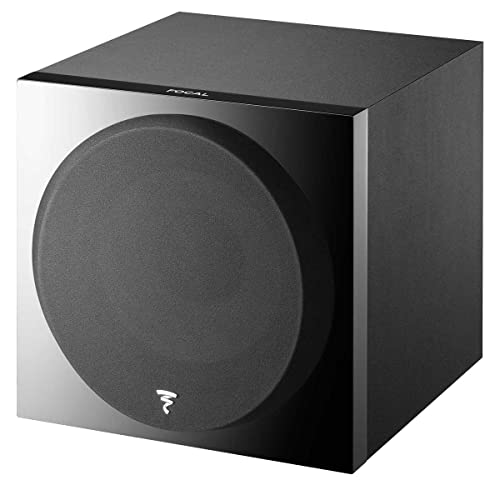
Specs snapshot
| Spec |
Details |
| Driver size |
12-inch flax cone |
| Enclosure type |
Sealed enclosure |
| Amplifier type |
Class D amplifier |
| Inputs |
RCA/LFE input |
| Controls |
Low-pass crossover, phase adjustment, level |
| Best-use case |
Small to medium music-first stereo rooms |
What this means in practice: this is a compact sealed subwoofer built for control and integration, not exaggerated room shake.
How it fits a turntable-based stereo system
The cleanest chain looks like this: turntable to phono preamp to stereo receiver or integrated amp, then out to bookshelf speakers and the sub. If your amp has a dedicated sub out, adding it is usually straightforward.
If you're using powered speakers, slow down and check outputs first. A subwoofer only works well when the signal chain supports clean integration.
For setup basics, see the turntable setup guide, this explainer on what a phono preamp does, and our picks for best turntable speakers.
Setup tips, crossover, phase, and placement
Start the crossover near where your bookshelf speakers begin to roll off, not at some random high number. If your speakers already reach fairly low, a lower setting usually blends better.
Use phase control to help the sub disappear into the system, not to fake extra bass. And don't park it in the first corner and call it done.
I've seen small-room setups improve just by moving the cabinet a couple of feet off the corner and backing down the crossover. Bloated bass turns into something that locks in with the speakers and stops pulling attention away from the record.
For music, sealed and ported subs have different strengths:
| Type |
Typical character |
| Sealed cabinet |
Tighter, more controlled, easier to blend |
| Ported subwoofer |
More output, more room interaction, better for movie impact |