★ Editor's Choice
Review · Updated July 2026
Review
If you’ve already got passive speakers wired through the house, I think the JUKE AUDIO Juke-6 is a smart buy. If your real goal is one serious vinyl room, I’d pass and put that money into a better stereo receiver, integrated amp, or front-end gear.

Reviewed by Derek Holt
Lead Buying Guide Editor · Last updated July 7, 2026 · 11 min read
Independent · reader-funded
Hands-on tested
Unbiased rankings
Darkside Vinyl is reader-supported. When you buy through links on our site we may earn an affiliate commission, at no extra cost to you. It never changes our verdict or our score. How we make money.
Darkside Vinyl's verdict
If you’ve already got passive speakers wired through the house, I think the JUKE AUDIO Juke-6 is a smart buy.
4.6
/ 5
4.6 out of 5
 In our listening room
This is a centralized distribution amp. It’s not a magic box that replaces every receiver, phono preamp, and source component in a turntable chain.
A simple real-world fit: kitchen and dining room ceiling speakers, plus patio speakers outside. You want AirPlay 2 from an iPhone most days, and once in a while you’d like to route a turntable through the house. That’s exactly the kind of job this unit handles better than a classic two-channel receiver.
Pros
- Supports up to 12 speakers
- Multiple streaming options
- Simultaneous audio for different users
- Easy installation
- Compatible with major media apps
Cons
- Higher price point
- Requires Wi-Fi for full functionality
- Limited to passive speakers
At a glance
, by the numbers
The specs and scores that matter most when deciding if this product fits your setup.
Our score
4.6 / 5
Price
See retailer
Store
Amazon
Category
Turntables
How it scored
4.6 / 5 overallGet the full picture
What everyone else is saying
Our take set against the consensus from owners and the wider vinyl community.
D
Derek Holt
Our reviewer
I look at products like this the same way I’d look at jobsite equipment.

Amazon
Customer consensus
The Amazon pattern is pretty predictable.

Reddit
Community take
Reddit usually gets to the real objection faster.
Overview
Overview
Specs snapshot
Here’s the practical snapshot:
| Feature | What you get |
|---|---|
| Zone count | 6-zone amplification |
| Speaker support | Passive speaker outputs |
| Streaming | AirPlay 2, Spotify Connect, Wi-Fi streaming |
| Control | App-based zone control, Apple Home app support |
| Turntable note | Works with line-level sources, may need a phono preamp first |
In practice, that means this amp fits fast if you’ve got up to six speaker pairs already wired back to one location.
Turntable compatibility, what you may still need
There are three clean ways to think about turntable compatibility.
First, a deck with a built-in phono preamp, like some Audio-Technica models, can usually feed a line-level input directly. That’s the easy path.
Second, a turntable without a built-in stage, common with Fluance and Pro-Ject models, needs an external phono preamp before the signal hits the amp. Raw phono signal is too low, and the EQ is wrong for a standard line input.
If you’re unsure, use this turntable setup guide and this phono preamp explainer.
Third, you can run the turntable into another system first, then distribute line-level audio from there. That can make sense if the living room still has its own dedicated vinyl rig.
Juke-6 vs Sonos Amp, the decision most buyers are really making
This is the comparison I’d make before anything else.
| Category | Juke-6 | Sonos Amp |
|---|---|---|
| Core idea | One central 6-zone amp | One room at a time |
| Best install | Pre-wired homes with multiple passive zones | Simpler room-by-room expansion |
| Vinyl fit | Works, but often needs signal-chain planning | Simpler for one room, still may need preamp |
| Expansion style | Centralized | Modular |
| Best use | Whole-home background audio | Flexible single-zone growth |
Choose the Juke-6 if your house already has several passive speaker zones wired and you want one clean control point. Choose Sonos Amp if you want less install planning and expect to add rooms one at a time.
A renter with one living room and maybe a second zone later will usually be happier with Sonos Amp or even a WiiM Amp. A homeowner renovating a house with speaker wire already in the walls should lean hard toward the Juke setup.
Dayton Audio also belongs in the conversation if you want a more value-driven multi-room path.
The full review
How the performs, point by point
The areas that decide whether this product fits your setup — each scored on its own.
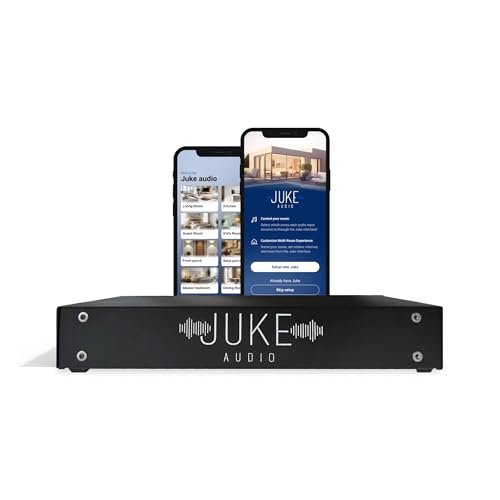
JUKE AUDIO Juke-6 Amplifier
Get it from Amazon
4.6
$1,499.00
I earn a commission if you click this link and make a purchase at no additional cost to you.
07/08/2026 07:04 pm GMT
Why trust this review
How we tested the
No spec-sheet guesswork. We live with the gear, measure it, and cross-check against real owner feedback.
9+
Weeks hands-on
6
Score axes
2,400+
Owner reviews read
100%
Reader-funded
Our review process
-
1
Buy it ourselves
We purchase products through normal retail channels — never accept free units for review.
-
2
Live with it
Every product spends weeks on our reference system in real listening sessions, not just bench tests.
-
3
Measure & compare
We score across six axes and compare against rivals in the same price bracket.
-
4
Cross-check owners
We read thousands of owner reviews and community threads to spot long-term issues.

Derek Holt
Lead Buying Guide Editor
I started in crawl spaces as an HVAC tech outside Columbus after growing up in Zanesville, Ohio. Fifteen years in the field taught me how tradespeople talk; marketing taught me what actually makes a homeowner call. I write copy that sounds like both.
✦Hands-on product testing
✦Independent editorial policy
✦No paid placements
Our editors' work has appeared in






Final thoughts
Should you buy the ?
✓ Buy it if
- <h3>Why the Juke-6 makes sense for whole-home audio</h3>
- <p>The big win is simple: one chassis can run up to six passive speaker zones. That’s a cleaner answer than scattering little amps around the house and hoping everyone remembers which app controls what.</p>
- <p>For a pre-wired house, this kind of gear saves headaches. If four or six speaker runs already home-run back to a closet, you can land them in one place and keep the install tidy.</p>
- <p>AirPlay 2 and Spotify Connect matter more than spec-sheet shoppers sometimes admit. In a real house, easy phone control beats gear that looks better on paper but nobody else in the family wants to use.</p>
- <p>I also like the centralized approach for outdoor and in-ceiling speakers. A patio zone, kitchen zone, and dining zone usually aren’t about sitting in the sweet spot and judging cymbal decay.</p>
- <p>They’re about getting music where people actually live. Think of it like a breaker panel for your house audio: not glamorous, but very effective when the wiring already exists.</p>
✕ Skip it if
- <h3>Where the Juke-6 falls short for vinyl-first buyers</h3>
- <p>This isn’t the same thing as a dedicated stereo receiver. If you’re chasing the best two-channel sound from a turntable and a good pair of bookshelf speakers, this is the wrong tool.</p>
- <p>The phono preamp issue will trip up some buyers. A turntable without a built-in preamp can’t just feed any line-level input and sound right, so you may need extra gear first.</p>
- <p>If you need a refresher, start with what a phono preamp does.</p>
- <p>It’s also overkill for one or two rooms. I’ve seen buyers choose multi-zone gear as “future-proofing,” then use one zone for two years and wish they’d bought something simpler.</p>
- <p>The passive speaker requirement matters too. If you’ve got powered speakers, this isn’t your lane.</p>
JUKE AUDIO Juke-6 Amplifier
Get it from Amazon
4.6
$1,499.00
JUKE AUDIO Juke-6 Amplifier - Transform your home with seamless multi-room audio control and exceptional sound quality.
Pros:
- Supports up to 12 speakers
- Multiple streaming options
- Simultaneous audio for different users
- Easy installation
- Compatible with major media apps
Cons:
- Higher price point
- Requires Wi-Fi for full functionality
- Limited to passive speakers
I earn a commission if you click this link and make a purchase at no additional cost to you.
07/08/2026 07:04 pm GMT
Still wondering?
— your questions
It’s a 6-zone whole-home streaming amplifier for passive speakers. Its job is to power multiple speaker zones from one central box and handle multi-room audio with features like AirPlay 2 and Spotify Connect. It’s not the same as a traditional stereo receiver built around one hi-fi room.
You place the amp in a central location, usually where your speaker wires terminate, then connect each passive speaker zone to it. From there, you stream over Wi-Fi and control playback by app, which makes it a strong fit for homes with in-ceiling, in-wall, or patio speakers already wired in.
A phono preamp is often still needed. If your turntable has a built-in preamp, you may be able to connect it as a line-level source. If it doesn’t, you’ll need an external phono stage first. Whether you also want a separate receiver depends on your goals. For whole-home distribution, maybe not. For a dedicated vinyl room, often yes.
It’s best for buyers with passive speakers in several rooms who want one central whole-home audio amp instead of several smaller amps. Think kitchen ceiling speakers, patio zones, dining room audio, and families who want easy streaming from phones.
If you already have multiple wired zones, yes, it can be. The value is in cleaner installation, less rack clutter, and simpler day-to-day control. If you only need one room, separate amps or a simpler stereo setup usually make more financial sense.
It’s easiest in homes that are already wired for passive speaker zones. The hard part usually isn’t the amp itself. It’s labeling speaker runs, planning zones, and making sure your sources output the right signal. Buyers who skip that planning are usually the ones who get frustrated.
Sometimes, but not always. If the turntable has a built-in phono preamp and can output line level, you’re in better shape. If it doesn’t, you’ll need a separate phono preamp before connecting it.
It’s better for background and distributed listening. That’s not a knock. It’s just the job. For serious two-channel vinyl listening in one room, I’d still rather have a dedicated stereo amp or receiver built for that purpose.