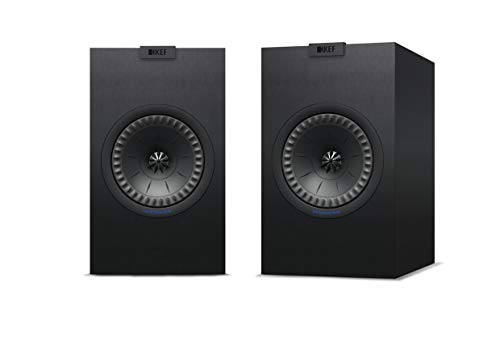
The Q150 use KEF's Uni-Q array, which places a 1-inch vented tweeter in the acoustic center of a 5.25-inch aluminum bass driver.
That's the design choice behind the focused imaging people keep talking about.
Specs that matter for a vinyl setup
| Spec |
KEF Q150 |
| Driver |
Uni-Q array with 5.25-inch aluminum bass driver and 1-inch vented tweeter |
| Impedance |
8 ohms nominal |
| Sensitivity |
86 dB |
| Frequency response |
51 Hz to 28 kHz |
| Cabinet |
Rear-ported bookshelf speaker |
| Connections |
Binding posts |
| Best room size |
Small to mid-size rooms |
What this means in practice: the modest sensitivity is one reason amp pairing matters. You don't need fancy gear, but you do want a competent stereo receiver or integrated amplifier.
What the setup chain looks like
If you're using an Audio-Technica AT-LP120X, the path is simple: turntable to stereo receiver, then speaker wire to the Q150. That works because the AT-LP120X includes a built-in phono stage.
If you're using a Fluance RT82, the chain is longer: turntable to phono preamp, then to a receiver or integrated amp, then out to the speakers. That's why the Q150 can be a great upgrade, but not always a cheap one.
Basic placement still matters. Put them on stands, aim for ear level, and leave some space behind the rear bass port.
If you're still deciding between system types, our guide to powered vs passive speakers for turntables can help clarify the tradeoff.
KEF Q150 vs powered speakers for turntables
Powered speakers win on convenience, every time. If you want fewer boxes and less setup friction, something like the Audioengine A5+ is easier to live with.
The Q150 win on upgrade path and often on imaging. I think they're better for hobbyists who want a scalable system, not beginners who want the fastest possible setup.
KEF Q150 vs ELAC Debut 2.0 B6.2 or Klipsch R-51M
| Speaker |
Type |
Amp required |
Sound profile |
Best for |
| KEF Q150 |
Passive bookshelf |
Yes |
Focused imaging, clear mids, refined center image |
Small rooms, nearfield vinyl listening |
| ELAC Debut 2.0 B6.2 |
Passive bookshelf |
Yes |
Warmer, fuller bass, more forgiving placement |
Listeners who want more low-end weight |
| Klipsch R-51M |
Passive bookshelf |
Yes |
More energetic treble, easier to drive |
Modest receivers and a livelier sound |
| Audioengine A5+ |
Powered bookshelf |
No separate amp |
Convenient, simple, all-in-one style |
Buyers who want easy setup |
The ELAC Debut 2.0 B6.2 usually sounds warmer and fuller down low. It's also often a bit more forgiving about placement.
It's a better fit if you want more bass weight first.
The Klipsch R-51M is easier to drive and more energetic up top. It's a practical option if you're using a modest receiver and want more bite.
The KEF sit in the detail-focused lane. If your priority is cleaner imaging and a more refined center image, they're the stronger pick.