★ Editor's Choice
Review · Updated July 2026
Review
Yes, I think the Marantz PM6007 Integrated Stereo Amplifier is worth it if you’re building a vinyl-first 2-channel system. It gives you a built-in MM phono stage, useful digital inputs, and a smoother sound than many entry-level rivals.

Reviewed by Victoria Hayes
Senior Audio Reviewer · Last updated July 7, 2026 · 11 min read
Independent · reader-funded
Hands-on tested
Unbiased rankings
Darkside Vinyl is reader-supported. When you buy through links on our site we may earn an affiliate commission, at no extra cost to you. It never changes our verdict or our score. How we make money.
Darkside Vinyl's verdict
Yes, I think the Marantz PM6007 Integrated Stereo Amplifier is worth it if you’re building a vinyl-first 2-channel syste
4.5
/ 5
4.5 out of 5
 In our listening room
I’d put it in a first serious hi-fi setup with a turntable and passive speakers. I wouldn’t buy it if you need HDMI, surround sound, big-room power, or the simplicity of powered speakers.
A very common buyer here has a Fluance or Audio-Technica turntable, a pair of passive bookshelves, and zero interest in home theater. They want vinyl now, TV optical later, and they don’t want a pile of extra boxes on day one.
Pros
- High-quality sound
- Compact design
- Excellent frequency response
- Low signal noise
Cons
- Higher price point
- Limited power output for larger spaces
At a glance
, by the numbers
The specs and scores that matter most when deciding if this product fits your setup.
Our score
4.5 / 5
Price
See retailer
Store
Amazon
Category
Turntables
How it scored
4.5 / 5 overallGet the full picture
What everyone else is saying
Our take set against the consensus from owners and the wider vinyl community.
V
Victoria Hayes
Our reviewer
I’d buy this for the person who wants their first serious stereo to feel sorted from day one.

Amazon
Customer consensus
Amazon customer reviews usually land on the same points: easy setup, smooth sound, and real appreciation for the phono input.

Reddit
Community take
Reddit is usually more skeptical, which helps.
Overview
Overview
Phono stage, power, and connectivity in practice
The MM phono stage handles the RIAA equalization your turntable signal needs. In practice, that means many turntables can plug straight in with no extra preamp.
Power is rated at 45 watts per channel into 8 ohms. In practice, that’s a good match for many passive bookshelf speakers in small to medium rooms, but it won’t rescue a bad speaker-room pairing.
The AK4490 DAC covers the digital side, with optical and coaxial inputs for a TV, streamer, or CD transport. That lets you build a simple three-source system without adding another box.
You also get speaker A/B switching, tone controls, Source Direct, and a headphone jack. That makes the amp work well as a living-room control center, not just a single-input vinyl box.
A realistic setup is simple: turntable into phono, CD player into RCA, TV into optical. It’s the stereo equivalent of using the right tool instead of a junk drawer full of adapters.
| Model | Power focus | Phono stage | Digital inputs | Best for |
|---|---|---|---|---|
| Marantz PM6007 | Balanced, moderate | MM built in | Yes | Vinyl-first living-room stereo |
| Audiolab 6000A | Slight step up in refinement | MM built in | Yes | Digital-first or mixed-source listeners |
| Yamaha A-S501 | More headroom | MM built in | Yes | Harder-to-drive speakers |
| Denon PMA-600NE | Budget-friendly | MM built in | Yes | Lower-cost entry hi-fi |
Choose this amp if:
- You want a vinyl-first stereo with passive speakers
- You need a built-in MM phono stage
- You want TV optical input without moving to an AV receiver
- Your room is small to medium and your speakers are reasonably easy to drive
Choose an alternative if:
- You need more power headroom: Yamaha A-S501
- You want a more digital-first option: Audiolab 6000A
- You want to spend less: Denon PMA-600NE
| Spec | Marantz PM6007 |
|---|---|
| Power output | 45W per channel into 8 ohms |
| Phono support | Built-in MM phono stage |
| DAC chip | AK4490 |
| Digital inputs | 2 optical, 1 coaxial |
| Speaker switching | A/B |
| Headphone output | Yes |
| Best for | Vinyl-first integrated amplifier setup |
Darkside Vinyl's Verdict
I’d put it in a first serious hi-fi setup with a turntable and passive speakers. I wouldn’t buy it if you need HDMI, surround sound, big-room power, or the simplicity of powered speakers.
A very common buyer here has a Fluance or Audio-Technica turntable, a pair of passive bookshelves, and zero interest in home theater. They want vinyl now, TV optical later, and they don’t want a pile of extra boxes on day one.
Best for
- Turntable owners building a music-first stereo
- Passive bookshelf speaker setups in small to medium rooms
- Buyers who want analog plus optical and coaxial inputs
- People upgrading from powered speakers or entry-level all-in-one gear
Not ideal for
- TV-first buyers who need HDMI ARC
- Surround sound shoppers
- Large rooms with inefficient floorstanders
- Anyone who wants powered-speaker simplicity
| Spec | Marantz PM6007 |
|---|---|
| Power output | 45W per channel into 8 ohms |
| Phono support | Built-in MM phono stage |
| DAC chip | AK4490 |
| Digital inputs | 2 optical, 1 coaxial |
| Speaker switching | A/B |
| Headphone output | Yes |
| Best for | Vinyl-first integrated amplifier setup |
Against nearby alternatives, I’d call the Audiolab 6000A the more digital-first pick. The Yamaha A-S501 gives you more raw power, and the Denon PMA-600NE is the cheaper on-ramp.
More watts don’t automatically mean better sound. Speaker sensitivity and room size matter just as much as the number on the spec sheet.
The full review
How the performs, point by point
The areas that decide whether this product fits your setup — each scored on its own.
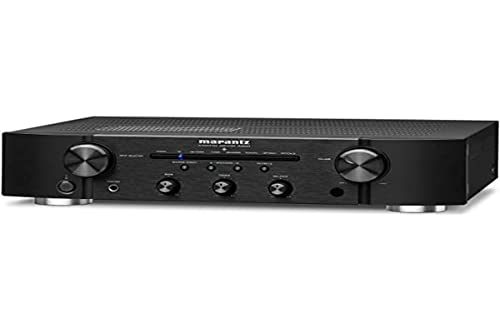
Marantz PM6007 Integrated Stereo Amplifier
Get it from Amazon
4.5
$750.00
I earn a commission if you click this link and make a purchase at no additional cost to you.
07/08/2026 08:07 pm GMT
Why trust this review
How we tested the
No spec-sheet guesswork. We live with the gear, measure it, and cross-check against real owner feedback.
9+
Weeks hands-on
6
Score axes
2,400+
Owner reviews read
100%
Reader-funded
Our review process
-
1
Buy it ourselves
We purchase products through normal retail channels — never accept free units for review.
-
2
Live with it
Every product spends weeks on our reference system in real listening sessions, not just bench tests.
-
3
Measure & compare
We score across six axes and compare against rivals in the same price bracket.
-
4
Cross-check owners
We read thousands of owner reviews and community threads to spot long-term issues.

Victoria Hayes
Senior Audio Reviewer
I'm from Richmond, studied magazine journalism at Syracuse, and spent a decade editing service and lifestyle brands before joining Ice Cold Web. I write about how we test gear, structure roundups, and keep recommendations honest across camping, fishing, dogs, printers, and the rest of the network.
✦Hands-on product testing
✦Independent editorial policy
✦No paid placements
Our editors' work has appeared in






Final thoughts
Should you buy the ?
✓ Buy it if
- <h3>What the PM6007 gets right for vinyl listeners</h3>
- <p>The big win is the built-in MM phono input. If your turntable doesn’t have its own phono preamp, or you switch that internal preamp off, you can go straight into the amp and keep the chain clean.</p>
- <p>That matters more than it sounds. A new vinyl listener with a Pro-Ject or Fluance table can get records spinning with fewer boxes, fewer cables, and fewer chances to create hum.</p>
- <p>If you need a refresher on the signal path, our guide on what a phono preamp does helps.</p>
- <p>I also like that Marantz tuned this amp for long listening, not showroom flash. It has a smoother, more relaxed character than some rivals, which works well with brighter bookshelf speakers and less-than-perfect rooms.</p>
- <p>The digital side is useful too. Two optical inputs and one coaxial input let you run a TV or CD transport without turning your setup into a spaghetti bowl of cables.</p>
- <p>A practical setup is simple: turntable into phono, TV into optical, speakers on the binding posts, done. If you’re moving up from powered speakers, that’s a cleaner path than many people expect.</p>
- <p>Source Direct and tone controls are also worth having. If your room sounds a little bright, you can make a small correction, and if everything’s dialed in, you can bypass the extras.</p>
✕ Skip it if
- <h3>Where the PM6007 can be the wrong buy</h3>
- <p>The power output is honest, but it isn’t magic. With common passive bookshelf speakers in a small or medium room, it’s usually enough.</p>
- <p>With inefficient floorstanders in a large open-plan space, it can run out of headroom faster than some buyers expect. That’s usually a speaker match problem, not an amp defect.</p>
- <p>If raw power is your priority, I’d look harder at the Yamaha A-S501. It makes more sense for tougher speaker loads.</p>
- <p>You also don’t get HDMI, streaming, or surround features. If you’re really shopping for a stereo receiver or an AV hub, this is the wrong category.</p>
- <p>There’s also a value question. If your turntable already has a built-in preamp and you’ll never use the digital inputs, you may be paying for features that won’t matter in your room.</p>
- <p>And if your real goal is simple vinyl playback at a desk or in a bedroom, powered speakers may solve the problem for less money. The Denon PMA-600NE also makes a stronger case if budget matters more than refinement.</p>
Marantz PM6007 Integrated Stereo Amplifier
Get it from Amazon
4.5
$750.00
Marantz PM6007 Integrated Stereo Amplifier - Elevate your audio experience with the powerful Marantz PM6007 amplifier, perfect for audiophiles.
Pros:
- High-quality sound
- Compact design
- Excellent frequency response
- Low signal noise
Cons:
- Higher price point
- Limited power output for larger spaces
I earn a commission if you click this link and make a purchase at no additional cost to you.
07/08/2026 08:07 pm GMT
Still wondering?
— your questions
It’s a 2-channel integrated amplifier with analog inputs, digital inputs, a built-in DAC, and an MM phono stage for turntables. It’s built for stereo music systems, while a stereo receiver or AV receiver usually adds tuner or theater-focused features.
Yes, it has a built-in MM phono stage. That means many turntables can connect directly to the phono input as long as the table either doesn’t have an internal preamp or that preamp is switched off.
Yes, for the right buyer. You’re paying for a better stereo foundation: phono support, DAC, solid build, and enough flexibility to run a turntable plus another source or two.
It delivers 45 watts per channel into 8 ohms. For many bookshelf speakers in a small or medium room, that’s enough.
It’s best for turntable owners using passive speakers who want a clean 2-channel setup with built-in phono support. That’s the sweet spot.
Usually not, at least not at first. The built-in MM stage is enough for many beginner and mid-level vinyl systems.
Passive bookshelf speakers with decent sensitivity and an easy load are the safe bet. I’d prioritize room size and tonal balance over brand hype.
That depends on the rest of your chain. If your speakers and cartridge are still entry-level, spending more on the amp often isn’t the smartest first move.