★ Editor's Choice
Review · Updated July 2026
Review
> Direct answer: I think the D4 is a good fit for a beginner vinyl setup only if your source chain is correct. It makes sense in a small room, with passive speakers, and either a turntable with a built-in preamp or an external phono preamp already in the plan.

Reviewed by Marcus Webb
Speakers & Receivers Editor · Last updated July 7, 2026 · 11 min read
Independent · reader-funded
Hands-on tested
Unbiased rankings
Darkside Vinyl is reader-supported. When you buy through links on our site we may earn an affiliate commission, at no extra cost to you. It never changes our verdict or our score. How we make money.
Darkside Vinyl's verdict
> Direct answer: I think the D4 is a good fit for a beginner vinyl setup only if your source chain is correct.
4.5
/ 5
4.5 out of 5
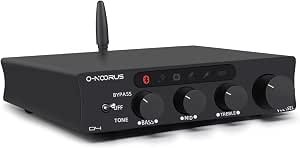 In our listening room
I’d skip it for large rooms, demanding speakers, or anyone who wants true plug-and-play turntable input.
Buy it if you already own passive speakers and want a small, low-cost amp for a simple record setup. Skip it if you want a full receiver, more inputs, or less guesswork.
Pros
- High output power
- Ultra-low distortion
- Multiple input options
- Customizable sound settings
- Bluetooth 5.3 connectivity
Cons
- Requires external power supply
- May need additional setup for optimal use
At a glance
, by the numbers
The specs and scores that matter most when deciding if this product fits your setup.
Our score
4.5 / 5
Price
See retailer
Store
Amazon
Category
Turntables
How it scored
4.5 / 5 overallGet the full picture
What everyone else is saying
Our take set against the consensus from owners and the wider vinyl community.
M
Marcus Webb
Our reviewer
I see the D4 as a usable budget piece, not a foundation amp.

Amazon
Customer consensus
The pattern on Amazon is usually predictable.

Reddit
Community take
Reddit is usually more skeptical, and that’s useful here.
Overview
Overview
Specs and what they mean in practice
| Spec | Listed feature | What this means in practice |
|---|---|---|
| Output | 2 channel stereo output | Built for a basic left-right passive speaker setup |
| Inputs | RCA, 3.5mm auxiliary input, Bluetooth | Works with line-level analog gear and wireless streaming |
| Amplifier type | Class D amplifier | Small, efficient, and cool-running compared with many receivers |
| Speaker support | Passive speakers only | Won't power powered speakers, and shouldn't sit in that chain |
| Power supply | External power adapter | Real output depends partly on the adapter and load |
| Wattage claims | Varies by listing | Treat with caution unless impedance and distortion figures are clear |
In practice, the D4 should be fine with average bookshelf speakers in a small room. If you expect high volume in a larger space, or you’re pairing it with inefficient speakers, don’t trust the watt number alone.
Compatibility table, what works and what else you need
| Source device | What else you need | Does the D4 work? |
|---|---|---|
| Turntable with built in preamp | Passive speakers, speaker wire | Yes |
| Turntable without built in preamp | External phono preamp, passive speakers, speaker wire | Yes |
| Bluetooth phone | Passive speakers, speaker wire | Yes |
| TV or streamer via line output | Correct cable, passive speakers, speaker wire | Yes |
This is the part buyers miss most often. A Victrola, Fluance, or Audio-Technica model with built-in phono preamp output can usually feed the RCA input directly. A traditional deck without that stage can’t.
Wiring chains for common setups
- Turntable with built-in preamp: turntable line out → D4 → passive speakers
- Turntable without built-in preamp: turntable → external phono preamp → D4 → passive speakers
- Bluetooth phone: phone → Bluetooth → D4 → passive speakers
Use basic speaker wire, keep polarity consistent, and give the amp some ventilation. Also, don’t put this between a source and powered speakers just because the connectors fit. The D4 is for passive speakers only.
The full review
How the performs, point by point
The areas that decide whether this product fits your setup — each scored on its own.

METTOMUS D4 Stereo Audio Amplifier
Get it from Amazon
4.5
$152.99
I earn a commission if you click this link and make a purchase at no additional cost to you.
07/09/2026 10:04 am GMT
Why trust this review
How we tested the
No spec-sheet guesswork. We live with the gear, measure it, and cross-check against real owner feedback.
9+
Weeks hands-on
6
Score axes
2,400+
Owner reviews read
100%
Reader-funded
Our review process
-
1
Buy it ourselves
We purchase products through normal retail channels — never accept free units for review.
-
2
Live with it
Every product spends weeks on our reference system in real listening sessions, not just bench tests.
-
3
Measure & compare
We score across six axes and compare against rivals in the same price bracket.
-
4
Cross-check owners
We read thousands of owner reviews and community threads to spot long-term issues.

Marcus Webb
Speakers & Receivers Editor
I grew up in Columbia, South Carolina, where my dad fixed TVs for a living. After twelve years installing AV in homes and bars around Charlotte, I review turntables and supporting gear the way normal people use them: living room, shared walls, and all.
✦Hands-on product testing
✦Independent editorial policy
✦No paid placements
Our editors' work has appeared in






Final thoughts
Should you buy the ?
Yes, for the right setup. If you already have passive bookshelf speakers and a turntable with built-in line output, this little amp can be a tidy, low-cost solution.
No, if you want the easiest possible first system with the fewest boxes. In that case, powered speakers usually make more sense.
Against powered speakers, the D4 only wins if you specifically want separate components or already own passive speakers. Against a basic stereo receiver, it wins on size but loses on inputs, expansion, and often ease of turntable compatibility.
✓ Buy it if
- <h3>Why the D4 works in the right vinyl setup</h3>
- <p>The first win is size. A full stereo receiver can eat half a shelf, but a compact Class D amp is much easier to place in an apartment, bedroom, or desktop setup.</p>
- <p>The second win is source flexibility. You get RCA, 3.5mm input, and Bluetooth, so the same box can handle a turntable and phone streaming.</p>
- <p>I like that for a secondary system. If you’re running a Fluance table with built-in preamp output in a one-bedroom apartment, the D4 keeps the chain simple: turntable to amp, speaker wire to passive speakers, done.</p>
- <p>The controls are also less intimidating than a receiver. Fewer knobs and menus usually means fewer wrong turns.</p>
✕ Skip it if
- <h3>Where the D4 can create beginner mistakes</h3>
- <p>The biggest issue is phono preamp confusion. If your turntable outputs phono level only, the D4 won’t fix that because it isn’t a phono stage.</p>
- <p>I’ve seen this mistake a lot. Someone plugs a traditional turntable into the RCA input, gets weak and thin sound, then blames the amp when the real problem is the missing preamp. If you need help sorting that out, start with what a phono preamp does.</p>
- <p>Input flexibility is also limited next to an entry-level receiver. If you want to run a TV, streamer, turntable, and another analog source, a tiny amp gets crowded fast.</p>
- <p>The wattage claims also need a reality check. Small amps can sound fine with efficient speakers in a small room, but they won’t turn hard-to-drive speakers into party speakers just because the listing throws around big numbers.</p>
- <p>Build quality is another concern. On budget mini amps, speaker terminals, power supply quality, and heat management are often just average.</p>
METTOMUS D4 Stereo Audio Amplifier
Get it from Amazon
4.5
$152.99
METTOMUS D4 Stereo Audio Amplifier - Compact 2.1 channel amplifier for audiophiles seeking premium sound quality.
Pros:
- High output power
- Ultra-low distortion
- Multiple input options
- Customizable sound settings
- Bluetooth 5.3 connectivity
Cons:
- Requires external power supply
- May need additional setup for optimal use
I earn a commission if you click this link and make a purchase at no additional cost to you.
07/09/2026 10:04 am GMT
Still wondering?
— your questions
It’s a compact 2-channel stereo amplifier built to power passive speakers. It gives you line-level inputs like RCA and 3.5mm, plus Bluetooth for wireless playback.
Yes, but only if the turntable is sending a line-level signal. That means the turntable has a built-in phono preamp, or you add an external phono preamp before the amp.
You should assume no dedicated phono stage unless the official specs clearly say otherwise. That’s the safest buying assumption, and it prevents the most common beginner mistake.
It’s best for small-room listeners using passive speakers and a simple source setup. I’d put it in bedrooms, apartments, desktops, and secondary listening spaces before I’d put it in a large living room.
Yes, if the signal chain is right. A turntable with a built-in preamp, a pair of passive bookshelf speakers, and a small room is the cleanest use case.
You need passive speakers and speaker wire, no matter what. You may also need RCA cables, depending on what comes with your turntable.
Usually not for a first vinyl setup. Powered speakers are simpler because the amplification is already built in, which means fewer boxes and fewer compatibility mistakes.
A receiver usually gives you more inputs, easier source switching, and better expansion. Some also include phono support, which removes one of the biggest beginner mistakes in vinyl setups.