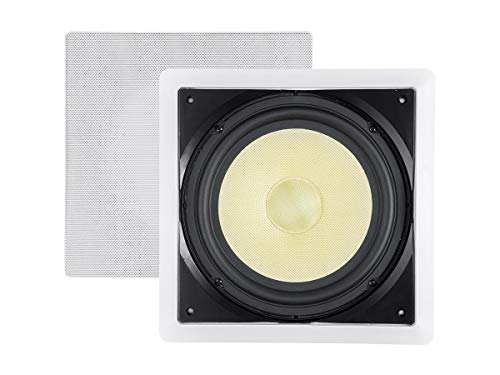
Key specs and fit
This Monoprice in-wall subwoofer sits in the architectural category first and the bargain-bass category second. It's a passive 10 inch wall subwoofer meant to disappear into the room, not dominate it.
That makes it more attractive for living-room systems than for buyers chasing raw output. If you're still building a basic setup, stronger bookshelf speakers may be the smarter first move.
Before You Buy checklist
- Check wall cavity space and depth before ordering.
- Confirm stud spacing and cutout dimensions.
- Verify amplifier compatibility and impedance rating.
- Decide whether you want music-first support or movie-first impact.
- Be honest about whether you're willing to cut drywall.
If you've got a turntable feeding powered speakers, this probably isn't your next clean upgrade. If you've got an AVR, speaker-wire paths, and a planned media wall, it starts to make a lot more sense.
Compatibility and setup notes
Compatibility note: This is a passive design. It needs external amplification, plus sane crossover integration through a home theater receiver or dedicated subwoofer amplifier.
A stereo receiver may not give you the same bass-management flexibility as an AVR. That matters if you want proper crossover control, LFE channel handling, or cleaner integration with your mains.
You'll also want to think through speaker-wire runs, terminal connections, and whether your install calls for a back box. Banana plugs may be part of the wider system, but the real issue is the signal path, not connector glamour.
If you need help sorting the rest of your chain, start with how to set up a record player or brush up on what a phono preamp does.
In-wall subwoofer vs traditional cabinet subwoofer
| Factor |
Monoprice in-wall subwoofer |
Traditional cabinet subwoofer |
| Bass depth |
Moderate, system dependent |
Usually deeper for the money |
| Installation effort |
High |
Low |
| Room impact |
Minimal visual footprint |
Takes floor space |
| Aesthetics |
Excellent |
Visible box |
| Upgrade flexibility |
Limited after install |
Easy to move or replace |
If your room and gear pass that checklist, the final call comes down to whether you value clean installation more than easy bass gains.