★ Editor's Choice
Review · Updated July 2026
Review
NAD C 588 is a belt-drive hi-fi turntable that includes an Ortofon OM 10 moving magnet cartridge, but it does not include a built-in phono preamp. That makes it a strong step-up option for phono-ready systems, but a less convenient fit for powered speakers on their own.

Reviewed by Marcus Webb
Speakers & Receivers Editor · Last updated July 7, 2026 · 11 min read
Independent · reader-funded
Hands-on tested
Unbiased rankings
Darkside Vinyl is reader-supported. When you buy through links on our site we may earn an affiliate commission, at no extra cost to you. It never changes our verdict or our score. How we make money.
Darkside Vinyl's verdict
NAD C 588 is a belt-drive hi-fi turntable that includes an Ortofon OM 10 moving magnet cartridge, but it does not*
4.5
/ 5
4.5 out of 5
 In our listening room
Yes, if you're moving up from a basic deck and already have a phono input, or you're willing to add a phono preamp. No, if you want true plug-and-play use with powered speakers and no extra boxes.
If you're coming from an AT-LP60-level table into a receiver with a phono input, you'll likely hear the NAD's cleaner sound right away. If you're using powered speakers with no phono stage, you'll hit extra cost and wiring before you hear the benefit.
Pros
- High-precision synchronous clock motor
- Carbon fiber tonearm for precise tracking
- Preinstalled Ortofon 2M Red cartridge
- Massive MDF base with vibration damping
- Versatile 33/45 rpm playback options
Cons
- Premium price point
- Requires careful setup
- Limited to vinyl playback
At a glance
, by the numbers
The specs and scores that matter most when deciding if this product fits your setup.
Our score
4.5 / 5
Price
See retailer
Store
Amazon
Category
Turntables
How it scored
4.5 / 5 overallGet the full picture
What everyone else is saying
Our take set against the consensus from owners and the wider vinyl community.
M
Marcus Webb
Our reviewer
I like the NAD best when it's treated as a clean step-up deck, not a convenience buy.

Amazon
Customer consensus
Amazon feedback usually splits in a predictable way.

Reddit
Community take
Reddit tends to be more skeptical, which is often useful.
Overview
Overview
Specs and what they mean in practice
| Spec | NAD C 588 |
|---|---|
| Drive type | Belt-drive |
| Cartridge | Ortofon OM 10 |
| Built-in phono preamp | No |
| Speed support | 33/45 RPM |
| Tonearm material | Aluminum |
| Upgrade path | Stylus and cartridge upgrades possible |
The belt-drive layout helps with motor isolation and fits the NAD's hi-fi positioning. The OM 10 is the spec that saves you time on day one, while the missing preamp is the spec that can change your whole shopping list.
33/45 RPM support covers normal LPs and singles, which is all most buyers need. The aluminum tonearm and upgradeable stylus path matter more long term because this table can grow with a better system.
A product page can make "no built-in preamp" look minor. In practice, that's the difference between playing records tonight or ordering another box first.
Compatibility checklist and key comparisons
| Setup | Will it work? | What you need |
|---|---|---|
| Powered speakers only | Not directly | External phono preamp |
| Receiver with phono input | Yes | RCA connection |
| Receiver without phono input | Not directly | External phono preamp |
| External phono preamp in system | Yes | RCA from turntable to preamp |
If you already own a stereo receiver with a phono input, the NAD gets easier to justify fast. If you're starting with powered speakers and want the shortest path to music, this isn't the easiest route.
| Model | Cartridge value | Setup ease | Upgrade flexibility | Best fit |
|---|---|---|---|---|
| NAD C 588 | Strong, OM 10 included | Moderate | Good | Step-up buyers with phono-ready systems |
| Fluance RT85 | Excellent on paper | Moderate | Good | Value-focused shoppers |
| Pro-Ject Debut Carbon EVO | Good | Moderate | Very good | Buyers chasing refinement |
| Rega Planar 1 | Simpler starter feel | Easier | Good | Beginners who want less fuss |
Choose the NAD if you want a serious belt-drive turntable with room to grow. Choose Fluance if you want stronger paper value, Pro-Ject if you want a more refined enthusiast pick, and Rega if setup ease matters most.
Should you buy it?
Yes, if you're moving up from a basic deck and already have a phono input, or you're willing to add a phono preamp. No, if you want true plug-and-play use with powered speakers and no extra boxes.
If you're coming from an AT-LP60-level table into a receiver with a phono input, you'll likely hear the NAD's cleaner sound right away. If you're using powered speakers with no phono stage, you'll hit extra cost and wiring before you hear the benefit.
Best for: Step-up buyers who want a more serious hi-fi table with a pre-installed cartridge
Not for: Anyone who wants the easiest first-time setup with powered speakers alone
Bottom line: The OM 10 adds real value, but the missing phono stage changes the total cost
Recommendation: Buy it if your system is ready for it
The NAD sits in an interesting middle spot. The Fluance RT85 often wins on paper value, while the Pro-Ject Debut Carbon EVO feels a bit more polished.
If your setup sounds close to that, the next question is simple: does the NAD make your system better, or just more complicated?
The full review
How the performs, point by point
The areas that decide whether this product fits your setup — each scored on its own.
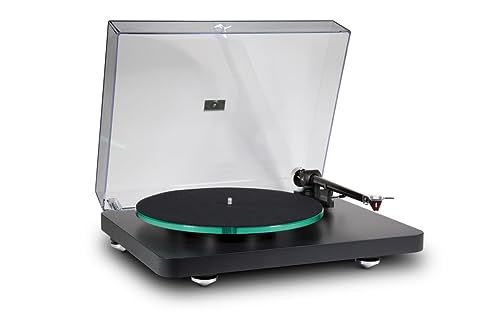
NAD C 588 Turntable with Ortofon Cartridge
Get it from Amazon
4.5
$1,199.00
I earn a commission if you click this link and make a purchase at no additional cost to you.
07/08/2026 06:02 pm GMT
Why trust this review
How we tested the
No spec-sheet guesswork. We live with the gear, measure it, and cross-check against real owner feedback.
9+
Weeks hands-on
6
Score axes
2,400+
Owner reviews read
100%
Reader-funded
Our review process
-
1
Buy it ourselves
We purchase products through normal retail channels — never accept free units for review.
-
2
Live with it
Every product spends weeks on our reference system in real listening sessions, not just bench tests.
-
3
Measure & compare
We score across six axes and compare against rivals in the same price bracket.
-
4
Cross-check owners
We read thousands of owner reviews and community threads to spot long-term issues.

Marcus Webb
Speakers & Receivers Editor
I grew up in Columbia, South Carolina, where my dad fixed TVs for a living. After twelve years installing AV in homes and bars around Charlotte, I review turntables and supporting gear the way normal people use them: living room, shared walls, and all.
✦Hands-on product testing
✦Independent editorial policy
✦No paid placements
Our editors' work has appeared in






Final thoughts
Should you buy the ?
✓ Buy it if
- <h3>Cartridge value and cleaner step-up sound</h3>
- <p>The Ortofon OM 10 saves you from one of the most annoying upgrade decisions: picking a cartridge before you've even heard the table. That's real value, not fluff.</p>
- <p>I wouldn't call it a miracle upgrade, but I would call it a cleaner, calmer step up from cheap automatic decks and all-in-ones. It usually tracks with more confidence, which means less fuzz on busy passages and fewer ugly moments when the music gets dense.</p>
- <p>If you're coming from a basic record player, this is the kind of upgrade that feels obvious without sounding overhyped. You also won't spend your first night hunched over a headshell like you're doing surgery on a grape.</p>
- <h3>Solid hi-fi design and upgrade headroom</h3>
- <p>This is a proper belt-drive turntable built for a real two-channel system. It doesn't feel like a dead-end beginner toy dressed up with flashy extras.</p>
- <p>That matters if you plan to improve the rest of your chain later. You can start with the stock setup now, then upgrade the stylus, phono stage, or speakers as your budget allows.</p>
- <p>I've seen plenty of people buy convenience-first gear, then replace the whole thing once their speakers improve. The NAD gives you more room to grow from the start.</p>
✕ Skip it if
- <h3>No built-in phono preamp changes the real cost</h3>
- <p>The NAD C 588 doesn't have a built-in phono preamp. That means it can't plug straight into most powered speakers or many modern amps by itself.</p>
- <p>In practice, that matters a lot. A phono stage handles RIAA equalization and boosts the tiny cartridge signal to line level, so without it the sound will be weak, thin, and wrong.</p>
- <p>If you own Edifier-style powered speakers with no phono input, you'll need an external box between the table and the speakers. That's more money, one more power cable, and one more thing fighting for shelf space.</p>
- <p>Before you pay more for the deck itself, look at the whole signal chain. If you need the table, preamp, and speakers all at once, the value story changes fast.</p>
- <h3>Setup still isn't foolproof just because the cartridge is pre-mounted</h3>
- <p>Factory-mounted doesn't mean foolproof. You still need to check tracking force, anti-skate, platter setup, and where the table sits.</p>
- <p>That's where first-time buyers get tripped up. Hi-fi gear asks for a little patience, and the NAD is still hi-fi gear, not a toaster.</p>
- <p>I've heard good tables sound bad on shaky media consoles and springy apartment floors. If you skip the basics, you'll blame the turntable when the real problem is the stand under it.</p>
NAD C 588 Turntable with Ortofon Cartridge
Get it from Amazon
4.5
$1,199.00
NAD C 588 Turntable with Ortofon Cartridge - Exceptional sound quality for vinyl enthusiasts seeking precision and clarity.
Pros:
- High-precision synchronous clock motor
- Carbon fiber tonearm for precise tracking
- Preinstalled Ortofon 2M Red cartridge
- Massive MDF base with vibration damping
- Versatile 33/45 rpm playback options
Cons:
- Premium price point
- Requires careful setup
- Limited to vinyl playback
I earn a commission if you click this link and make a purchase at no additional cost to you.
07/08/2026 06:02 pm GMT
Still wondering?
— your questions
It's a belt-drive hi-fi turntable from NAD Electronics with a factory-installed Ortofon OM 10 moving magnet cartridge. It sits above entry-level decks and is aimed at buyers who want better sound and more upgrade room.
No, it doesn't. You'll need either a receiver or integrated amp with a phono input, or a separate external phono preamp.
It comes with the Ortofon OM 10. Yes, you can upgrade later, either by moving up within the OM stylus line or by changing the cartridge entirely.
It's best for buyers stepping up from basic turntables who want better tracking and cleaner sound without choosing a cartridge separately. It helps if you're already comfortable with basic setup and signal-chain matching.
Yes, in the right system. The value looks better if you already have a phono stage, because the included cartridge is useful, but the lack of a built-in preamp makes it less compelling for convenience-first setups.
Only if your receiver, amp, or speakers don't have a phono input. If your system already includes phono support, you won't need an external one.
It's manageable, but it isn't foolproof. The pre-mounted cartridge helps, but you still need to check tracking force, anti-skate, and placement.
It works best with a stereo receiver or integrated amp that has a phono input, paired with decent passive speakers. Powered speakers can work too, but only if you add an external phono preamp between the turntable and the speakers.