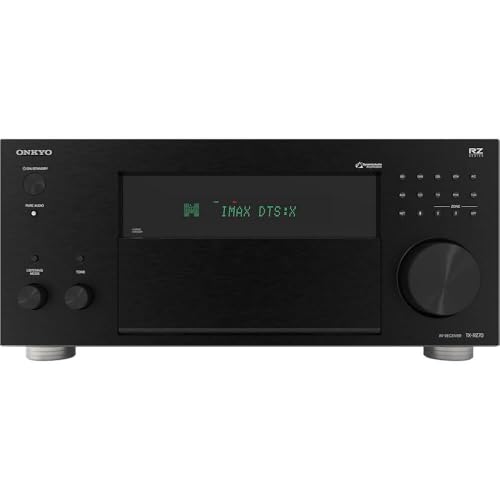
What the core specs mean in practice
The spec sheet sounds bigger than the buying decision really is. What matters is how those specs change the system you can build.
The 11.2-channel processing means this AVR can manage a large surround layout. But you still need to verify how many channels are powered and how many require external amplification.
That’s the difference between future-ready processing and a fully self-contained install.
HDMI 2.1, 8K passthrough, and eARC make it ready for modern TVs, gaming gear, and high-bandwidth video sources. THX Certified and IMAX Enhanced show where Onkyo aimed this model, and the ESS Sabre DAC plus Klipsch Optimize Mode round out the premium feature set.
The smarter question isn’t “Does it say 11.2?” It’s “How many speakers am I running now, how many later, and am I actually going to calibrate the room?”
Vinyl use, phono input, and who this receiver fits
Yes, the built-in phono stage makes this a legit receiver with phono input for turntable use. For most moving magnet setups, that’s enough to get started without adding another box.
If you’ve got a midrange turntable with an MM cartridge and no outboard phono gear, this Onkyo lets you connect directly and keep the signal chain simple. That’s a real convenience in a shared living room rack.
That said, a built-in phono section doesn’t always replace an external phono preamp. If vinyl is your priority, or you want more control over gain and sound, a separate stage can still make sense.
If you need a refresher, see our guide on what a phono preamp does and our turntable setup guide.
Quick fit check:
- Versus a cheaper AVR: the TX-RZ70 gives you better room correction, more expansion room, and a more serious long-term theater path.
- Versus a stereo-only amp: it gives you far more flexibility, but usually less value for a pure 2-channel vinyl room.
If your setup looks more like a hybrid movie-and-record system than a dedicated listening room, this model makes a lot more sense.