★ Editor's Choice
Review · Updated July 2026
Review
If footfall is your main problem, I think the Wallmount It 1 is one of the cleanest fixes you can buy. If you can’t mount into studs or solid masonry, I’d skip it and buy a dedicated stand instead.

Reviewed by Derek Holt
Lead Buying Guide Editor · Last updated July 7, 2026 · 11 min read
Independent · reader-funded
Hands-on tested
Unbiased rankings
Darkside Vinyl is reader-supported. When you buy through links on our site we may earn an affiliate commission, at no extra cost to you. It never changes our verdict or our score. How we make money.
Darkside Vinyl's verdict
If footfall is your main problem, I think the Wallmount It 1 is one of the cleanest fixes you can buy.
4.5
/ 5
4.5 out of 5
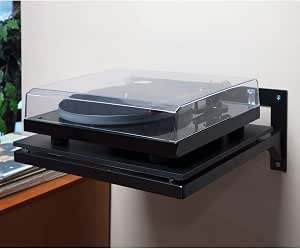 In our listening room
The big win is better stability and fewer skips, not some guaranteed night-and-day sound upgrade. Pro-Ject built this for vibration control, and that’s how I judge it.
Fit check:
Pros
- Resonance-free design
- Supports up to 66 lbs
- Height-adjustable spikes
- Rigid steel frame
- Easy installation
Cons
- Requires wall mounting
- May not fit all turntable sizes
- Limited aesthetic options
At a glance
, by the numbers
The specs and scores that matter most when deciding if this product fits your setup.
Our score
4.5 / 5
Price
See retailer
Store
Amazon
Category
Turntables
How it scored
4.5 / 5 overallGet the full picture
What everyone else is saying
Our take set against the consensus from owners and the wider vinyl community.
D
Derek Holt
Our reviewer
I like this shelf for a narrow problem, and I mean that as praise.

Amazon
Customer consensus
Amazon feedback usually clusters around build quality, stability, and whether the mount actually stopped skipping.

Reddit
Community take
Reddit is usually more blunt, which helps.
Overview
Overview
Build, design, and compatibility
This shelf is made for one job, and that’s part of the appeal. The usual formula is an MDF shelf on a steel frame with spikes for decoupling, which gives it more purpose than a generic wall shelf.
A Debut Carbon EVO makes sense here. So do the Rega Planar 1 and Fluance RT82.
An Audio-Technica AT-LP120X might work, but I’d verify both footprint and realistic weight support before ordering. That’s the rule with any hi-fi wall shelf: don’t trust eyeballing.
Measure the deck, check the wall, and confirm the load. Specs matter, but install details decide whether those specs help or hurt in a real room.
Installation caveats and placement checklist
Before you buy, run this checklist:
- Mount into wall studs or proper masonry support
- Confirm the wall section isn’t vibration-prone
- Use a level surface and verify final leveling
- Leave enough cable slack behind the turntable
- Check dust cover and tonearm clearance
- Confirm the shelf and wall can support the full load
- Mount at a comfortable operating height
Here’s the quick comparison:
| Option | Vibration Control | Installation Effort | Space Use |
|---|---|---|---|
| Wall shelf | Best for footfall control | Highest | Excellent |
| Floor stand | Good on solid floors | Easy | Moderate |
| Cabinet top | Usually weakest | Easiest | Uses existing furniture |
If your wall and turntable pass that checklist, the Wallmount It 1 gets a lot easier to justify.
| Verdict | Best Use Case | Ideal Buyer | Biggest Limitation |
|---|---|---|---|
| Worth it for the right room | Suspended wood floors and shaky furniture | Someone with a lightweight or midweight deck who can mount safely | Bad fit for renters or weak wall installs |
The full review
How the performs, point by point
The areas that decide whether this product fits your setup — each scored on its own.

Pro-Ject Wallmount It 1 Turntable Shelf
Get it from Amazon
4.5
$269.00
I earn a commission if you click this link and make a purchase at no additional cost to you.
07/08/2026 06:17 pm GMT
Why trust this review
How we tested the
No spec-sheet guesswork. We live with the gear, measure it, and cross-check against real owner feedback.
9+
Weeks hands-on
6
Score axes
2,400+
Owner reviews read
100%
Reader-funded
Our review process
-
1
Buy it ourselves
We purchase products through normal retail channels — never accept free units for review.
-
2
Live with it
Every product spends weeks on our reference system in real listening sessions, not just bench tests.
-
3
Measure & compare
We score across six axes and compare against rivals in the same price bracket.
-
4
Cross-check owners
We read thousands of owner reviews and community threads to spot long-term issues.

Derek Holt
Lead Buying Guide Editor
I started in crawl spaces as an HVAC tech outside Columbus after growing up in Zanesville, Ohio. Fifteen years in the field taught me how tradespeople talk; marketing taught me what actually makes a homeowner call. I write copy that sounds like both.
✦Hands-on product testing
✦Independent editorial policy
✦No paid placements
Our editors' work has appeared in






Final thoughts
Should you buy the ?
✓ Buy it if
- <h3>Where the Wallmount It 1 helps most</h3>
- <p>A proper wall-mounted shelf beats cabinet-top placement when the floor is the enemy. That’s why it works so well in older homes and upstairs apartments with bounce in the boards.</p>
- <p>It also frees up space fast. In a tight setup with powered speakers crowding a narrow console, moving the turntable to the wall gives you safer cueing room and less speaker vibration feeding back into the deck.</p>
- <p>The build matters too. An MDF platform, steel frame, and spike decoupling feel a lot more confidence-inspiring than a random floating shelf from the hardware aisle.</p>
- <h3>What this means in practice</h3>
- <p>Isolation isn’t magic. It just means less unwanted energy reaches the plinth, tonearm, cartridge, and stylus.</p>
- <p>That matters most with belt-drive turntables in footfall-heavy rooms. A Rega Planar 1 on a shaky cabinet might play fine when nobody moves, then mistrack the second someone walks by.</p>
- <p>Getting it onto a rigid wall shelf often helps more than changing mats or feet first. That’s the difference between fixing the cause and dressing up the symptom.</p>
- <p>Common matches include the Pro-Ject Debut Carbon EVO, Rega Planar 1, and Fluance RT82, as long as the footprint and weight fit. If you’re shopping in that range, the turntables under $1000 hub is a smart next stop.</p>
✕ Skip it if
- <h3>Installation and room limitations</h3>
- <p>This isn’t a casual drywall project. You need wall studs or proper masonry anchors, and not every wall section is equally stable.</p>
- <p>Renters have the obvious problem. You might not want the holes, the patching, or the conversation with the landlord.</p>
- <p>Placement height can also make or break daily use. I’ve seen shelves mounted too high above a console, which makes cueing awkward, tightens cable slack, and turns dust cover clearance into a nuisance.</p>
- <h3>Where it won't solve the real problem</h3>
- <p>A wall shelf won’t fix bad cartridge alignment, a worn stylus, wrong tracking force, or a table that isn’t level. It removes one variable, not all of them.</p>
- <p>That’s why an Audio-Technica AT-LP120X with setup problems can still skip on the wall. If the stylus is shot or the cartridge is off, this shelf won’t rescue it.</p>
- <p>It’s also not the best match for every footprint or weight class. Bigger DJ-style tables need careful measuring, and some buyers are better off with an isolation platform on a sturdy stand.</p>
Pro-Ject Wallmount It 1 Turntable Shelf
Get it from Amazon
4.5
$269.00
Pro-Ject Wallmount It 1 Turntable Shelf - Achieve optimal record playback with this resonance-free wall mount.
Pros:
- Resonance-free design
- Supports up to 66 lbs
- Height-adjustable spikes
- Rigid steel frame
- Easy installation
Cons:
- Requires wall mounting
- May not fit all turntable sizes
- Limited aesthetic options
I earn a commission if you click this link and make a purchase at no additional cost to you.
07/08/2026 06:17 pm GMT
Still wondering?
— your questions
It’s a purpose-built wall-mounted turntable shelf designed to reduce vibration from floors and furniture. It makes the most sense in rooms with footfall problems, limited floor space, or a shaky cabinet under an otherwise decent turntable.
It moves the record player off furniture and away from springy floor energy. When it’s mounted to a solid wall, it can reduce the mechanical disturbance reaching the plinth, tonearm, cartridge, and stylus.
Yes, if your real problem is footfall or furniture vibration. No, if you need a no-drill setup or already have a stable stand on a solid floor.
Lightweight to midweight hi-fi decks are the sweet spot. Good examples include the Pro-Ject Debut Carbon EVO, Rega Planar 1, and Fluance RT82, with dimensions and weight checked before you buy.
Check the official spec first, then treat your wall and mounting method as part of the real rating. Shelf capacity on paper doesn’t mean much if the wall support is weak or the anchors are wrong.
I’d call it moderate difficulty. It’s not brutal, but accuracy matters, especially with stud finding, leveling, cable planning, and getting the operating height right.
You should confirm current package contents before ordering. Even if hardware is included, it may not be right for your wall type, especially if you’re comparing drywall, studs, and masonry.
Go with a dedicated turntable stand or an isolation platform on a sturdy surface. That’s usually the safer move for renters and anyone who can’t mount into studs or masonry properly.