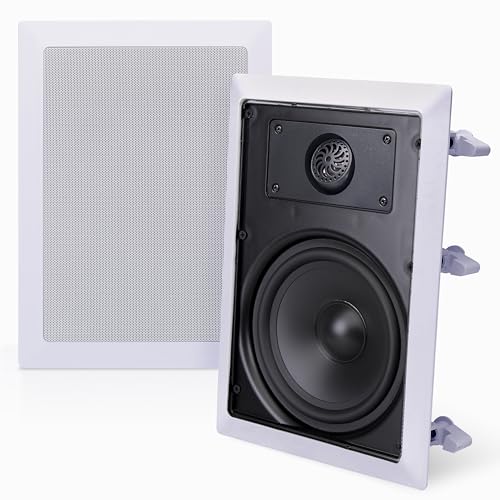
Specs and what they mean in practice
The key specs are simple: passive design, 6.5-inch woofer, 1-inch tweeter, flush-mount install, and power handling marketed around 150W. The part that matters most isn't the wattage. It's how the speaker works with your receiver and room.
Passive design means no built-in amplification. In practice, your turntable chain needs a receiver in the middle.
A 6.5-inch woofer is normal for budget speakers like this. Expect usable mids and some low end, but not deep, room-filling bass.
The 1-inch tweeter handles the highs. You'll get enough detail for casual listening, but don't expect refined sparkle.
Impedance and sensitivity matter more than the box headline. A modest receiver plus bad placement will shape the sound far more than the printed wattage.
Turntable compatibility checklist
Before you buy, make sure you have the full chain:
- Turntable
- Built-in or external phono preamp
- Stereo receiver or amplifier
- Speaker wire
- Wall cutout space and depth
The two common paths are simple. If your turntable has a built-in preamp, it goes to a receiver line input, then out to the Pyle speakers.
If it doesn't, you need a phono stage between the turntable and receiver. If that part is fuzzy, read our phono preamp guide and turntable setup guide.
Say you've got an Audio-Technica deck with a built-in preamp and an older Sony stereo receiver in a closet. Then these are workable, assuming you're fine running wire and cutting the wall.
Powered speakers skip the receiver step. These don't.
In-wall speakers vs bookshelf speakers for vinyl listening
Here's the short version: in-wall wins on appearance, bookshelf wins on flexibility and usually sound.
| Feature |
Pyle in-wall speakers |
Budget bookshelf speakers |
Powered desktop speakers |
| Install effort |
High |
Low |
Very low |
| Receiver needed |
Yes |
Usually yes |
No |
| Placement flexibility |
Low |
High |
Medium |
| Stereo imaging |
Fair |
Better |
Fair to good |
| Best for |
Clean permanent installs |
Better vinyl listening |
Easy starter setups |
Choose in-wall if you want the cleanest possible look and you're comfortable with a permanent install.
Choose bookshelf speakers if you care more about stereo separation, easier upgrades, and better odds of strong vinyl sound.
Choose powered speakers if you want the simplest starter setup with the fewest extra components.
If your listening chair is centered and you care about stereo separation, bookshelf speakers are easier to dial in. If the room doubles as family space and visible speakers are a non-starter, in-wall design wins on practicality.
Better-looking, maybe. Better-sounding for records, usually not.
Installation difficulty, before you cut drywall
The install isn't impossible, but it isn't casual either. Confirm cutout size, check wall depth and stud spacing, run speaker wire, connect the terminals, hook up the receiver, then test before the grille goes on.
The pain points are the usual ones: hidden obstacles, awkward wire fishing, and getting left-right placement symmetrical. That's easy in a remodel or pre-wired room, and harder in a finished wall.
I've seen both versions. In a pre-wired room, this is an afternoon job. In a finished space with no clean wire path, the labor and mess can outrun the low speaker price fast.