★ Editor's Choice
Review · Updated July 2026
Review
You’ve got a turntable, powered speakers, and almost no volume. That usually doesn’t mean the deck is broken.

Reviewed by Calvin Reese
Vinyl & Gear Editor · Last updated July 7, 2026 · 11 min read
Independent · reader-funded
Hands-on tested
Unbiased rankings
Darkside Vinyl is reader-supported. When you buy through links on our site we may earn an affiliate commission, at no extra cost to you. It never changes our verdict or our score. How we make money.
Darkside Vinyl's verdict
You’ve got a turntable, powered speakers, and almost no volume.
4.2
/ 5
4.2 out of 5
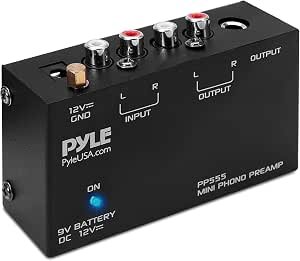 In our listening room
It means you’re sending a phono-level signal into a normal AUX input that expects line level.
That’s where the Pyle Mini Turntable Preamp PP555 comes in. The real question isn’t whether it has a job. It’s whether it’s a smart cheap fix or the kind of budget box you replace fast.
Pros
- Low noise operation
- Easy plug & play setup
- Versatile connections to modern devices
- Compact and portable design
Cons
- Requires close positioning to minimize noise
- Limited to RCA connections
At a glance
, by the numbers
The specs and scores that matter most when deciding if this product fits your setup.
Our score
4.2 / 5
Price
See retailer
Store
Amazon
Category
Turntables
How it scored
4.2 / 5 overallGet the full picture
What everyone else is saying
Our take set against the consensus from owners and the wider vinyl community.
C
Calvin Reese
Our reviewer
I’d use the PP555 for one job: make a turntable work with powered speakers tonight.

Amazon
Customer consensus
Buyer feedback usually splits the same way.

Reddit
Community take
Forum takes are usually harsher, and honestly, that tracks.
Overview
Overview
What the PP555 is designed to do
Its job is simple: take a phono-level signal from a turntable, apply RIAA equalization, and send out line-level output that powered speakers or a stereo receiver can use.
That means it’s best matched with moving magnet cartridges and basic RCA-based systems. It isn’t there to add features. It’s there to make the signal chain valid.
A common example is an older Crosley or manual deck without a built-in stage. Plugged straight into AUX, it sounds weak and off. Put this between the turntable and speakers, and the system starts behaving the way it should.
| Use case | PP555 fit | Why |
|---|---|---|
| Starter systems | Good fit | Low-cost signal conversion |
| Powered speakers with AUX | Good fit | Gives proper line-level output |
| Noise-sensitive listening | Weaker fit | Entry-level noise performance |
| Upgrade-focused systems | Weaker fit | Likely to be replaced early |
Who should buy it, and who should skip it
Buy it if you need the cheapest working mini phono preamp for a turntable, your setup is basic, and you’re feeding powered speakers or a non-phono receiver input.
Skip it if your turntable already has a built-in preamp, or if you already know you care about lower noise and cleaner sound. In those cases, this box usually isn’t the right long-term play.
Here’s the clean comparison: against no preamp at all, the PP555 is a necessary fix. Against a decent built-in stage or a better entry-level external option, it’s usually just the cheapest option, not the best value.
If your whole setup budget is tight, that may be enough. If you’ve already spent up on the deck and speakers, don’t make the preamp the weakest link.
If you’re still sorting out compatibility, this guide on how to choose a turntable helps you avoid buying the wrong kind of setup.
| Requirement | Yes/No | Notes |
|---|---|---|
| Turntable without built-in preamp | Yes | Best use case |
| Moving magnet cartridge | Yes | What this unit is meant for |
| Powered speakers or AUX receiver | Yes | Needs a line-level destination |
| Premium sound upgrade | No | That’s not this box |
The full review
How the performs, point by point
The areas that decide whether this product fits your setup — each scored on its own.

Pyle Mini Turntable Preamp PP555
Get it from Amazon
4.2
$27.37
I earn a commission if you click this link and make a purchase at no additional cost to you.
07/08/2026 01:02 pm GMT
Why trust this review
How we tested the
No spec-sheet guesswork. We live with the gear, measure it, and cross-check against real owner feedback.
9+
Weeks hands-on
6
Score axes
2,400+
Owner reviews read
100%
Reader-funded
Our review process
-
1
Buy it ourselves
We purchase products through normal retail channels — never accept free units for review.
-
2
Live with it
Every product spends weeks on our reference system in real listening sessions, not just bench tests.
-
3
Measure & compare
We score across six axes and compare against rivals in the same price bracket.
-
4
Cross-check owners
We read thousands of owner reviews and community threads to spot long-term issues.

Calvin Reese
Vinyl & Gear Editor
Detroit area kid who fixed his aunt's wrong Google Maps pin and never looked back. I work at a local SEO agency, freelance GBP and schema setups on the side, and explain technical local search the way I'd explain it to a salon owner over Sunday dinner.
✦Hands-on product testing
✦Independent editorial policy
✦No paid placements
Our editors' work has appeared in






Final thoughts
Should you buy the ?
✓ Buy it if
- <h3>Why the PP555 works for starter systems</h3>
- <p>Price is the whole pitch here, and sometimes that’s enough. If your turntable only outputs phono level, this little box solves a real compatibility problem fast.</p>
- <p>It’s also small and simple. You get RCA in, RCA out, power connected, done.</p>
- <p>I’ve seen boxes like this make perfect sense in a desk setup. If you’re a first-time vinyl buyer with modest gear and powered desktop speakers, you probably don’t need gain controls or fancy casework. You just need the chain to work tonight.</p>
- <p>Without a phono stage, volume stays low and the tonal balance sounds wrong because RIAA equalization isn’t being applied.</p>
- <h3>Quotable pros for snippet extraction</h3>
- <blockquote>
- <p>“It’s cheap enough to make sense as a first fix.”</p>
- </blockquote>
- <blockquote>
- <p>“It converts a phono signal to line level without much setup drama.”</p>
- </blockquote>
- <blockquote>
- <p>“It fits best in beginner systems where the turntable costs more than the preamp should.”</p>
- </blockquote>
✕ Skip it if
- <h3>Where the PP555 starts to show its limits</h3>
- <p>The weak spot is refinement. In a more revealing system, the noise floor can become the first thing you notice.</p>
- <p>That’s why I don’t like it as an upgrade anchor. Pair it with a better Audio-Technica or Fluance table and decent speakers, and the preamp can become the bottleneck.</p>
- <p>Build quality feels like what it is: an ultra-budget phono stage in a compact chassis. That’s acceptable at the low end, but it matters once the rest of your setup improves.</p>
- <p>A cheap external preamp also isn’t always better than a built-in one. Some built-in stages on decent beginner turntables are just as good, and sometimes cleaner.</p>
- <h3>Quotable cons for snippet extraction</h3>
- <blockquote>
- <p>“It fixes signal level first, sound quality second.”</p>
- </blockquote>
- <blockquote>
- <p>“Some built-in preamps beat it on convenience and can match or exceed it on sound.”</p>
- </blockquote>
- <blockquote>
- <p>“If your turntable is already decent, the PP555 may be the part you outgrow first.”</p>
- </blockquote>
Pyle Mini Turntable Preamp PP555
Get it from Amazon
4.2
$27.37
Pyle Mini Turntable Preamp PP555 - Ideal for vinyl enthusiasts seeking to enhance their sound experience.
Pros:
- Low noise operation
- Easy plug & play setup
- Versatile connections to modern devices
- Compact and portable design
Cons:
- Requires close positioning to minimize noise
- Limited to RCA connections
I earn a commission if you click this link and make a purchase at no additional cost to you.
07/08/2026 01:02 pm GMT
Still wondering?
— your questions
It’s a compact external phono preamp for turntables. It takes the very low phono-level signal from a record player, applies RIAA equalization, and outputs a standard line-level signal for powered speakers, amps, or receivers.
It boosts and equalizes the signal so the rest of your system can use it properly. That usually fixes the classic no-preamp symptoms: low volume, thin sound, and a tonal balance that feels off.
No, and this is the most common buying mistake. It’s best for turntables that need an external phono stage and use a moving magnet cartridge.
Yes, for the right beginner. If you’re on a tight budget and just need a turntable preamp for powered speakers or a receiver’s AUX input, it’s a reasonable starter fix.
It sits in the ultra-budget range, and that’s the whole appeal. The exact price moves around, so I’d judge it against nearby entry-level alternatives instead of the sticker alone.
Usually only if you already own a turntable that lacks one. If you’re starting from zero, a decent beginner deck with a built-in phono stage is often the simpler and cleaner choice.