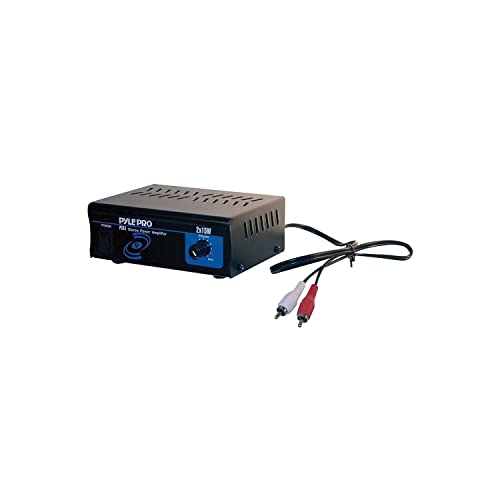
Specs snapshot, and what they mean in practice
Here’s the short version of what you’re getting:
| Feature |
What it is |
What it means in practice |
| 2-channel amplification |
Basic left/right speaker power |
Enough for a simple stereo setup |
| RCA stereo input |
Standard line-level input |
Works easily with built-in-preamp turntables and other RCA sources |
| Speaker output terminals |
Spring clip connections |
Simple hookup, but basic hardware |
| Headphone output |
Front-panel headphone jack |
Handy for convenience, not a receiver replacement |
| Volume control |
Single front knob |
Easy for beginners, limited control |
| Compact form factor |
Small desktop-sized amp |
Fits tight shelves, desks, and dorm rooms |
| Power adapter |
External power supply |
Keeps size down, but signals budget design |
The key thing is what the specs don’t say. This is only the speaker-amplification part of the chain, so it assumes the signal coming in is already line level.
With a small speaker amp like this, room size, listening distance, and speaker sensitivity matter more than marketing math.
Turntable compatibility, speaker matching, and setup limits
This amp works with turntables that have a built-in phono preamp. It also works with an external phono preamp placed between the turntable and the amp.
It also works with other line-level RCA sources.
It doesn’t work properly with a phono-only turntable connected straight in. Phono-level and line-level signals aren’t interchangeable, and that’s the beginner mistake I see most often.
A simple example helps. An Audio-Technica AT-LP60X can feed this amp directly because it has a built-in preamp.
A more traditional deck without one needs a separate phono stage first. If you need help sorting that out, start with the turntable setup guide or the guide on what a phono preamp is.
Speaker matching matters just as much. This compact amp is happiest with efficient passive bookshelf speakers in a small room or nearfield setup, not power-hungry speakers across a big living room.
If your setup already fits those limits, the PCA1 can make sense. If not, powered speakers or a basic receiver may be the cleaner path.