Review · Updated July 2026
Pyle PCB3BK Mini Cube Speakers Review
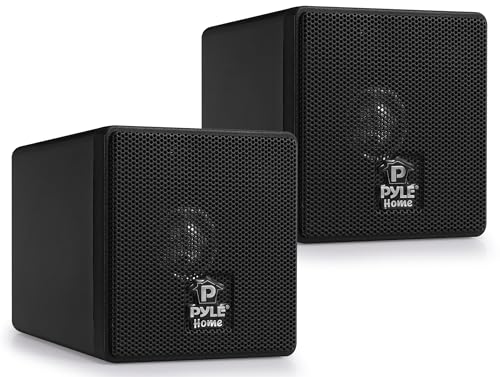
If you already have a stereo receiver or integrated amplifier, the Pyle PCB3BK can make sense as a dirt-cheap passive speaker pair for a very small room.
Darkside Vinyl is reader-supported. When you buy through links on our site we may earn an affiliate commission, at no extra cost to you. It never changes our verdict or our score. How we make money.
Darkside Vinyl's verdict
In our listening room
If you’re starting from zero, the low price is a little misleading. You may also need a receiver, speaker wire, and possibly a phono preamp.
For vinyl, yes, but only with the right amp and modest expectations. For TV, usually no.
Pros
- High power handling
- Video shielded for TV use
- Stylish design
- Full range audio
- Compact size
Cons
- Limited bass response
- Best suited for small spaces
At a glance
Pyle PCB3BK Mini Cube Speakers, by the numbers
The specs and scores that matter most when deciding if this product fits your setup.
How it scored
4.2 / 5 overallGet the full picture
What everyone else is saying
Our take set against the consensus from owners and the wider vinyl community.
I don’t hate cheap speakers when they’re honest about the job.
Amazon reviews usually split along expectation lines.
Reddit usually gives the blunt version: fine for the money, don’t expect bass, and buy powered speakers if you want easy setup.
Overview
Pyle PCB3BK Mini Cube Speakers Overview
Specs and what they mean in practice
Here’s the short version of the spec sheet:
| Spec | What to know |
|---|---|
| Speaker type | Passive mini speaker pair |
| Amplifier required | Yes |
| Size | Very compact cabinet |
| Impedance | Budget passive speaker load |
| Frequency response | Limited low-end reach |
| Best use case | Small room, nearfield, background music |
Passive speaker design means no internal amp. In practice, you need a receiver or integrated amplifier in the chain.
Compact size helps placement. The tradeoff is less bass and less scale.
Impedance and sensitivity matter less in isolation than amplifier matching. Don’t obsess over one number here; make sure your amp works properly and your room is small.
A beginner might see an impedance spec and assume it predicts sound quality. It doesn’t. At this level, placement, room size, and realistic volume matter more.
Turntable compatibility and total system cost
The full signal chain is simple once you lay it out: turntable, phono preamp if needed, receiver or integrated amp, speaker wire, then speakers.
The spring-clip speaker terminals are basic. They work fine with ordinary speaker wire, but this isn’t fancy hardware.
A turntable with a built-in preamp, like many entry Audio-Technica models, can feed a receiver directly. A basic Victrola or Crosley buyer may think this pair is the cheapest upgrade, but once you add a receiver and cables, powered speakers like the Edifier R1280T often become the cleaner buy.
That’s the real cost test. The cheapest speaker pair isn’t always the cheapest full setup.
The full review
How the Pyle PCB3BK Mini Cube Speakers performs, point by point
The areas that decide whether this product fits your setup — each scored on its own.
Why trust this review
How we tested the Pyle PCB3BK Mini Cube Speakers
No spec-sheet guesswork. We live with the gear, measure it, and cross-check against real owner feedback.
Our review process
-
1
Buy it ourselves
We purchase products through normal retail channels — never accept free units for review.
-
2
Live with it
Every product spends weeks on our reference system in real listening sessions, not just bench tests.
-
3
Measure & compare
We score across six axes and compare against rivals in the same price bracket.
-
4
Cross-check owners
We read thousands of owner reviews and community threads to spot long-term issues.
Our editors' work has appeared in
Final thoughts
Should you buy the Pyle PCB3BK Mini Cube Speakers?
✓ Buy it if
- <h3>Why the low price can make sense</h3>
- <p>The price works if you already own the missing gear. In that case, you’re buying a basic compact speaker pair, not building a whole system from scratch.</p>
- <p>They also take up almost no space. On a shelf, dresser, or small desk, that matters more than people think.</p>
- <p>If you’re upgrading from built-in suitcase turntable speakers, even a cheap passive pair can give you better stereo separation. A Crosley or Victrola all-in-one tends to blur everything into one box, while these at least let the left and right channels breathe.</p>
- <h3>Where these speakers are easiest to live with</h3>
- <p>These are small-room vinyl speakers, not living-room anchors. Bedroom, office, dorm shelf, or low-volume apartment listening—that’s the lane.</p>
- <p>Nearfield listening helps a lot. If you’re sitting five or six feet away at a desk playing jazz, podcasts, or older rock records, they can sound acceptable.</p>
- <p>Compared with a larger entry-level bookshelf model like the Micca MB42X, these just don’t have the cabinet volume to sound full.</p>
✕ Skip it if
- <h3>The biggest setup drawback: they need an amp</h3>
- <p>These are passive speakers, so there’s no built-in amplification. A turntable alone usually isn’t enough.</p>
- <p>Here’s the simple version:</p>
- <table>
- <thead>
- <tr>
- <th>Setup</th>
- <th>Works?</th>
- </tr>
- </thead>
- <tbody><tr>
- <td>Turntable with built-in preamp + receiver + speaker wire</td>
- <td>Yes</td>
- </tr>
- <tr>
- <td>Turntable with no preamp + receiver with phono input + speaker wire</td>
- <td>Yes</td>
- </tr>
- <tr>
- <td>Turntable with no preamp + external phono preamp + amp + speaker wire</td>
- <td>Yes</td>
- </tr>
- <tr>
- <td>Turntable only, no amp or receiver</td>
- <td>No</td>
- </tr>
- <tr>
- <td>Powered speakers instead of passive pair</td>
- <td>Easier</td>
- </tr>
- </tbody></table>
- <p>What this means in practice: if you have an Audio-Technica LP60X and no receiver, these won’t make sound by themselves.</p>
- <p>If you have that same LP60X feeding a basic stereo receiver through its RCA output, then you’re in business.</p>
- <p>If your turntable doesn’t have a built-in preamp, read what a phono preamp is before you buy anything. This is the compatibility checkpoint that decides whether the Pyle pair is usable at all.</p>
- <p>If you don't already own an amp, the low sticker price stops looking so cheap.</p>
- <h3>The sound limits are real</h3>
- <p>Tiny cabinets and small drivers can only move so much air. That means light bass, modest output, and not much authority in a bigger room.</p>
- <p>You’ll see specs like impedance, sensitivity, frequency response, and driver size. Those numbers matter, but not the way beginners often think.</p>
- <p>Impedance tells you how demanding the speaker is for the amplifier. At this price, the bigger question is whether your receiver can drive a basic passive pair cleanly in a small room.</p>
- <p>Sensitivity hints at how loud the speaker gets from a given amount of power. Small budget speakers need realistic volume expectations, especially with a cheap amp.</p>
- <p>Frequency response suggests how low and high the speaker can play. Don’t expect deep bass from a mini cabinet, no matter what the box says.</p>
- <p>Driver size matters because cabinet physics matter. Whether the listing says 4-inch woofer or 3.5-inch driver, you’re still dealing with a very compact enclosure that won’t fake bookshelf-speaker scale.</p>
- <p>Put them on a desk or narrow shelf and keep the volume moderate, and they can be serviceable. Ask them to fill a room with bass-heavy records, and they’ll sound thin and small.</p>
- High power handling
- Video shielded for TV use
- Stylish design
- Full range audio
- Compact size
- Limited bass response
- Best suited for small spaces
Still wondering?
Pyle PCB3BK Mini Cube Speakers — your questions
They’re a compact passive speaker pair for basic stereo use. They aren’t a complete record player speaker system on their own because they don’t include built-in amplification.
They’re passive. That means you need a stereo receiver or integrated amplifier to power them.
Yes, but only with the right signal chain. If your turntable has a built-in preamp, you still need a receiver or amp between the turntable and the speakers. If your turntable doesn’t have a built-in preamp, you’ll also need an external phono preamp or a receiver with a phono input.
They’re best for budget buyers with a small room and existing amplification. Think bedroom shelf systems, office listening, or a cheap secondary setup.
Usually only if you already own the missing gear. If you need to buy an amp, wire, and maybe a phono preamp too, powered speakers are often the simpler and smarter first purchase.
At minimum, you need a receiver or integrated amp and speaker wire. You may also need a phono preamp if your turntable doesn’t already have one built in.
Yes, for modest volume and nearfield or background listening. No, if you want deep bass or enough output to fill a larger room.
Powered bookshelf speakers are the easier route, especially something like the Edifier R1280T. You get fewer boxes, fewer cables, and a much simpler path from turntable to sound.