★ Editor's Choice
Review · Updated July 2026
Review
I’d only buy the Pyle PDA9HBU for one simple reason: you want records, Bluetooth, and passive speakers working in one room for as little money as possible.

Reviewed by Calvin Reese
Vinyl & Gear Editor · Last updated July 7, 2026 · 11 min read
Independent · reader-funded
Hands-on tested
Unbiased rankings
Darkside Vinyl is reader-supported. When you buy through links on our site we may earn an affiliate commission, at no extra cost to you. It never changes our verdict or our score. How we make money.
Darkside Vinyl's verdict
I’d only buy the Pyle PDA9HBU for one simple reason: you want records, Bluetooth, and passive speakers working in one ro
4.2
/ 5
4.2 out of 5
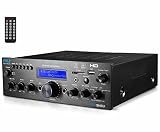 In our listening room
It makes sense for casual listeners who need lots of inputs on a tight budget. I wouldn't pick it if you want cleaner sound, more honest power, or a receiver I'd trust as the base of a long-term vinyl system.
The turntable part is where people get tripped up. It works best with a turntable that has a built-in preamp, or with an external phono preamp added to the chain. If you need help sorting that out, start with what a phono preamp does and then check our turntable setup guide.
Pros
- 200W power output
- Multiple input options
- Bluetooth connectivity
- Remote control included
- Digital LCD display
Cons
- Limited power for large rooms
- No built-in streaming services
- Basic design may not appeal to everyone
At a glance
, by the numbers
The specs and scores that matter most when deciding if this product fits your setup.
Our score
4.2 / 5
Price
See retailer
Store
Amazon
Category
Turntables
How it scored
4.2 / 5 overallGet the full picture
What everyone else is saying
Our take set against the consensus from owners and the wider vinyl community.
C
Calvin Reese
Our reviewer
I look at gear like this the same way I look at a rushed install.

Amazon
Customer consensus
The positive pattern on Amazon is easy to understand: buyers like the low price, input variety, Bluetooth convenience, and remote control.

Reddit
Community take
Reddit is usually more skeptical about Pyle gear in general.
Overview
Overview
Spec snapshot
| Spec | What to know |
|---|---|
| Phono input | Verify carefully before buying; don't assume standard RCA means phono-ready |
| Bluetooth | Yes, useful for phone streaming |
| Speaker support | Passive speakers required |
| Connectivity | RCA, USB input, SD card input, FM radio |
| Remote | Yes |
| Ideal use case | Cheap mixed-use stereo setup in a small room |
What this means in practice: this is a convenience hub first, and a vinyl amp second.
| Comparison | Better for |
|---|---|
| Pyle PDA9HBU vs Sony STR-DH190 | Choose Sony for cleaner vinyl-first simplicity |
| Pyle PDA9HBU vs compact class D mini amp | Choose the mini amp for small-room sound value |
| Pyle PDA9HBU vs powered speakers | Choose powered speakers for the fewest boxes |
Turntable compatibility, what works and what doesn't
- Turntable with built-in preamp: usually the easier match
- Turntable without built-in preamp: may need an external phono preamp
- Speakers: must be passive speakers
- Not an all-in-one: this amp alone doesn't complete a record-playing setup
If you already own an Audio-Technica or Victrola model with a built-in preamp, setup is usually straightforward. Connect the line-level RCA output to the amp, wire up your passive speakers, and you're in business.
If you're using a more traditional deck without that built-in stage, budget for an external phono preamp or pick a receiver with clearer phono support. If you want help checking your setup path, use our turntable setup guide and turntable buying guide.
What you need to complete the setup
Here’s the short checklist:
- Turntable
- Passive speakers
- Speaker wire
- Optional external phono preamp
That last item matters if your turntable doesn't have a built-in preamp. A lot of first-time buyers order the amp and deck, then realize on delivery day they still can't play a record because the speakers or wire are missing.
If you want fewer parts to manage, powered speakers are the simpler route. If you want to compare entry-level decks before building the rest of the system, start with our turntable hub or budget turntables under $100.
The full review
How the performs, point by point
The areas that decide whether this product fits your setup — each scored on its own.

Pyle PDA9HBU Wireless Amplifier
Get it from Amazon
4.2
$131.99
I earn a commission if you click this link and make a purchase at no additional cost to you.
07/08/2026 10:02 pm GMT
Why trust this review
How we tested the
No spec-sheet guesswork. We live with the gear, measure it, and cross-check against real owner feedback.
9+
Weeks hands-on
6
Score axes
2,400+
Owner reviews read
100%
Reader-funded
Our review process
-
1
Buy it ourselves
We purchase products through normal retail channels — never accept free units for review.
-
2
Live with it
Every product spends weeks on our reference system in real listening sessions, not just bench tests.
-
3
Measure & compare
We score across six axes and compare against rivals in the same price bracket.
-
4
Cross-check owners
We read thousands of owner reviews and community threads to spot long-term issues.

Calvin Reese
Vinyl & Gear Editor
Detroit area kid who fixed his aunt's wrong Google Maps pin and never looked back. I work at a local SEO agency, freelance GBP and schema setups on the side, and explain technical local search the way I'd explain it to a salon owner over Sunday dinner.
✦Hands-on product testing
✦Independent editorial policy
✦No paid placements
Our editors' work has appeared in






Final thoughts
Should you buy the ?
✓ Buy it if
- <h3>Why the feature list appeals to beginners</h3>
- <p>The big appeal is convenience. Bluetooth, USB, SD card input, FM radio, and a remote in one box is a lot at this price.</p>
- <p>That works well in a mixed-use room. If you spin records on weekends but stream Spotify the rest of the week, this can cut clutter and keep everything running through one amp.</p>
- <h3>Why it can work in a basic vinyl system</h3>
- <p>This unit is easier to live with if your turntable already has a built-in preamp. In that case, you can run a line-level RCA connection straight into the amp and keep the setup simple.</p>
- <p>That’s the common beginner scenario with brands like Audio-Technica or Victrola. If the deck has a switchable internal preamp, you can connect it like any other line source and get music playing without adding another box.</p>
✕ Skip it if
- <h3>Where the vinyl setup confusion starts</h3>
- <p>RCA inputs don't automatically mean phono-ready. That's the mistake I see most often with budget amps.</p>
- <p>A turntable without a built-in preamp sends a much weaker phono-level signal. A standard line-level RCA input expects a stronger signal, so the wrong connection can sound thin, quiet, and weak on bass.</p>
- <p>If you're unsure, assume you may still need an external phono preamp. Someone plugs a traditional turntable straight into RCA, cranks the volume, and blames the amp, when the missing phono stage is the real problem.</p>
- <h3>Why some buyers should skip it</h3>
- <p>If you expect hi-fi refinement, skip it. Feature-packed budget receivers usually give something up, and that often shows up as more noise, shaky power claims, or lower long-term confidence.</p>
- <p>Harder-to-drive bookshelf speakers can expose those limits fast. In a larger room, a cheap receiver can stop feeling like a bargain once you push it for control and clarity.</p>
- <p>I’d also test it hard during the return window. Check for hum, remote quirks, input switching issues, and whether the speaker terminals feel solid enough for regular use.</p>
Pyle PDA9HBU Wireless Amplifier
Get it from Amazon
4.2
$131.99
Pyle PDA9HBU Wireless Amplifier - Enhance your home audio experience with powerful sound and versatile connectivity options.
Pros:
- 200W power output
- Multiple input options
- Bluetooth connectivity
- Remote control included
- Digital LCD display
Cons:
- Limited power for large rooms
- No built-in streaming services
- Basic design may not appeal to everyone
I earn a commission if you click this link and make a purchase at no additional cost to you.
07/08/2026 10:02 pm GMT
Still wondering?
— your questions
It’s a budget 2-channel home audio amplifier/receiver from Pyle with Bluetooth, RCA, USB, SD, and FM support. Treat it as a low-cost stereo hub for passive speakers and multiple sources, not a serious hi-fi receiver built around vinyl performance.
Yes, but only if the signal chain is right. A turntable with a built-in preamp is usually the easy match because it can send line-level RCA output straight into the amp.
This is the part I'd verify carefully before buying. Don't assume that a standard RCA input means true phono support.
It can be, but only for the right beginner. If you're on a tight budget, want Bluetooth in the same room, and understand that you need passive speakers and maybe a phono preamp, it can work.
It can be worth it in value terms, not quality terms. For a spare room, bedroom, or first apartment system, the low price and input variety may be enough to justify it.
You need a turntable, passive speakers, and speaker wire. You may also need an external phono preamp if your turntable doesn't have one built in.