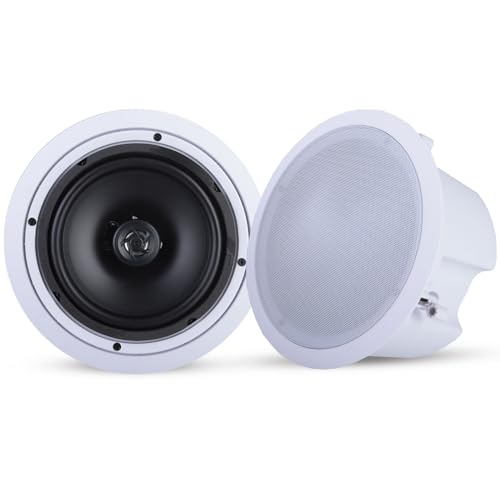
Specs at a glance
| Spec |
Pyle PDPC82 |
| Driver size |
8-inch woofer |
| Impedance |
8 ohms |
| Power handling |
Budget home-audio class |
| Sensitivity |
Moderate, easy enough for normal receivers |
| Mounting type |
Flush mount in-ceiling |
| Pair count |
2 speakers |
| Best use case |
Background music, secondary rooms, whole-home audio |
What this means in practice
Here’s the plain-English version: these are passive speakers, so you need amplification.
A normal stereo receiver can usually drive them just fine for casual listening. Ceiling placement favors broad room coverage, not precise stereo imaging.
A realistic setup is a Fluance or Audio-Technica turntable feeding an older Sony or Yamaha receiver. If the wire run is easy, this pair can work without much drama.
If you only own the turntable, the total cost climbs fast once you add a phono preamp, amplifier, speaker wire, and install supplies.
Turntable and receiver compatibility
Your signal chain should look like this: turntable, phono preamp if needed, stereo receiver or amplifier, speaker wire, then the Pyle pair.
Some turntables have a built-in phono preamp, which helps. The speakers still need amplifier power, because passive speakers don’t power themselves.
If that chain is still fuzzy, read what a phono preamp does and the full turntable setup guide.
Install-readiness checklist
Before buying, check five things:
- Ceiling depth
- Cutout size or template
- Wire run length
- Receiver power
- Whether you’re comfortable cutting drywall
Also check access. A simple attic run is one thing. Fishing speaker wire through a finished ceiling with no easy path is where a cheap speaker turns into an expensive afternoon.
Pyle PDPC82 vs bookshelf speakers for vinyl listening
| Feature |
Pyle PDPC82 |
Budget bookshelf speakers |
| Stereo imaging |
Weaker |
Better |
| Bass weight |
Modest |
Usually stronger |
| Install effort |
High |
Low |
| Room aesthetics |
Excellent |
Visible speakers |
| Turntable simplicity |
Needs receiver and wiring |
Powered models can be easier |
| Best for |
Hidden background audio |
Focused listening |
If your goal is focused listening from the couch, bookshelf speakers usually win.
If your goal is hidden audio and broad coverage, the ceiling pair makes more sense.
Choose the Pyle PDPC82 if you want a clean look, already own a receiver, and care more about room coverage than a precise soundstage.
Choose bookshelf speakers if vinyl listening is the priority and you want better imaging, easier placement, and stronger overall performance.