★ Editor's Choice
Review · Updated July 2026
Review
Verdict: I’d buy it if you need phono input, Bluetooth, source switching, and remote control in one rack-friendly box. I’d skip it if your main goal is the cleanest vinyl sound for the money.

Reviewed by Marcus Webb
Speakers & Receivers Editor · Last updated July 7, 2026 · 11 min read
Independent · reader-funded
Hands-on tested
Unbiased rankings
Darkside Vinyl is reader-supported. When you buy through links on our site we may earn an affiliate commission, at no extra cost to you. It never changes our verdict or our score. How we make money.
Darkside Vinyl's verdict
Verdict: I’d buy it if you need phono input, Bluetooth, source switching, and remote control in one rack-friendly bo
4.2
/ 5
4.2 out of 5
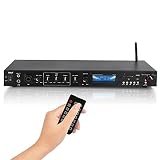 In our listening room
A basic Audio-Technica or Fluance deck, a pair of powered speakers, and a phone for nighttime streaming—that’s where this unit makes sense. I wouldn’t buy it as a pure phono upgrade.
Pros
- Bluetooth streaming up to 25ft
- FM radio tuning
- multiple input options
- user-friendly remote control
Cons
- Limited range for Bluetooth
- may require additional setup for optimal performance
At a glance
, by the numbers
The specs and scores that matter most when deciding if this product fits your setup.
Our score
4.2 / 5
Price
See retailer
Store
Amazon
Category
Turntables
How it scored
4.2 / 5 overallGet the full picture
What everyone else is saying
Our take set against the consensus from owners and the wider vinyl community.
M
Marcus Webb
Our reviewer
I’d judge the Pyle as a multi-function stereo preamp first, and a phono solution second.

Amazon
Customer consensus
Positive feedback usually comes from buyers who wanted value and flexibility.

Reddit
Community take
Reddit is usually more skeptical of Pyle gear, and I get why.
Overview
Overview
What the PPRE70BT does in a vinyl signal chain
This unit sits between your sources and your speakers or downstream amp. A turntable goes into the phono input, the internal stage applies RIAA equalization and gain, and the stereo RCA output feeds powered speakers, a power amp, or a receiver.
Simple signal paths look like this:
- Turntable → PPRE70BT → powered speakers
- Turntable → PPRE70BT → stereo receiver or power amp
- Phone via Bluetooth → PPRE70BT → speakers
It’s not a power amplifier, so it can’t drive passive speakers directly. It’s built around line-level control and source management.
A beginner who gets thin sound from a direct turntable-to-speaker connection can fix that here, as long as the turntable is connected to the correct phono input and grounded properly.
If your turntable already has a built-in preamp, you’d usually use a line input instead of the phono input. Using the wrong path can create gain and noise problems.
Who should buy it, and who should skip it
I’d buy it if you need one box for phono input, Bluetooth, line switching, and remote control. It fits best with powered speakers, simple rack installs, and mixed-use home stereo systems.
I’d skip it if you already own a receiver with a built-in phono stage, or if you only care about vinyl playback quality. I’d also skip it if you’re trying to solve hum that’s really coming from grounding or cable routing.
A common real-world split looks like this: someone with a Sony or Yamaha receiver already has most of this covered, so the Pyle adds little. Someone with powered speakers and no central control box gets a much stronger value case.
| Spec | What You Get |
|---|---|
| Phono support | Yes, moving magnet phono input |
| Bluetooth | Yes |
| Inputs | Phono plus multiple line-level RCA sources |
| Outputs | Stereo RCA out |
| Rack size | Rack-mount chassis |
| Remote | Yes |
| Best use case | Turntable plus powered speakers in a mixed-use living room |
The full review
How the performs, point by point
The areas that decide whether this product fits your setup — each scored on its own.

Pyle PPRE70BT Rack Mount Pre-Amplifier
$82.99
$68.08
Get it from Amazon
4.2
I earn a commission if you click this link and make a purchase at no additional cost to you.
07/08/2026 03:09 pm GMT
Why trust this review
How we tested the
No spec-sheet guesswork. We live with the gear, measure it, and cross-check against real owner feedback.
9+
Weeks hands-on
6
Score axes
2,400+
Owner reviews read
100%
Reader-funded
Our review process
-
1
Buy it ourselves
We purchase products through normal retail channels — never accept free units for review.
-
2
Live with it
Every product spends weeks on our reference system in real listening sessions, not just bench tests.
-
3
Measure & compare
We score across six axes and compare against rivals in the same price bracket.
-
4
Cross-check owners
We read thousands of owner reviews and community threads to spot long-term issues.

Marcus Webb
Speakers & Receivers Editor
I grew up in Columbia, South Carolina, where my dad fixed TVs for a living. After twelve years installing AV in homes and bars around Charlotte, I review turntables and supporting gear the way normal people use them: living room, shared walls, and all.
✦Hands-on product testing
✦Independent editorial policy
✦No paid placements
Our editors' work has appeared in






Final thoughts
Should you buy the ?
✓ Buy it if
- <h3>Why the PPRE70BT makes sense in a simple home system</h3>
- <p>The built-in phono input is the main reason vinyl buyers look at it. If your turntable has no internal phono preamp and uses an MM cartridge, you can run it straight in and get the RIAA equalization you need.</p>
- <p>If you’ve ever plugged a turntable into powered speakers and heard weak, thin sound, this fixes the signal-level problem.</p>
- <p>Bluetooth is convenient, even if it doesn’t improve record playback. In a real living room, being able to stream from your phone without adding another box is genuinely useful.</p>
- <p>In a small apartment setup, you can spin records on the weekend and stream playlists during the week through the same speakers.</p>
- <p>The extra line inputs help more than people expect. If you’ve got a CD player, streamer, or TV audio adapter in the same cabinet, this box can act as the front end instead of making you swap RCA cables like it’s 1997.</p>
- <p>The remote control also matters in a couch-based system. Powered speakers often make you reach behind the cabinet for volume, and that gets old fast.</p>
- <p>The rack chassis is useful if your system actually lives in a media rack or AV shelf. That doesn’t mean better sound, but it does make for a cleaner install.</p>
✕ Skip it if
- <h3>Where the PPRE70BT falls short for vinyl-first buyers</h3>
- <p>The weak point is the phono stage. It’s functional, but I wouldn’t expect the same refinement you’d get from a better dedicated phono preamp.</p>
- <p>Pair this with a revealing cartridge and decent speakers, and the preamp can become the bottleneck.</p>
- <p>Budget phono sections usually show their limits in hiss, gain handling, and overall composure. That matters more as the rest of your system improves.</p>
- <p>Bluetooth is a convenience feature, not a vinyl upgrade. It’s nice to have, but it shouldn’t sway you if your only goal is better record playback.</p>
- <p>The rack size can also be overkill. If your setup is just a turntable and powered speakers on one shelf, a small standalone phono stage is usually easier to place.</p>
- <p>If you already own a stereo receiver with a phono input, this may duplicate what you have. In that case, you’re paying for switching and form factor more than real sonic improvement.</p>
Pyle PPRE70BT Rack Mount Pre-Amplifier
$82.99
$68.08
Get it from Amazon
4.2
Pyle PPRE70BT Rack Mount Pre-Amplifier - Ideal for professional studios, offering versatile audio control and connectivity.
Pros:
- Bluetooth streaming up to 25ft
- FM radio tuning
- multiple input options
- user-friendly remote control
Cons:
- Limited range for Bluetooth
- may require additional setup for optimal performance
I earn a commission if you click this link and make a purchase at no additional cost to you.
07/08/2026 03:09 pm GMT
Still wondering?
— your questions
It’s a stereo preamp that combines a phono input, Bluetooth input, line-level switching, and remote control in a rack-mount chassis. Its job is to sit between your sources and your powered speakers, power amp, or receiver.
Yes, as long as the turntable uses a moving magnet cartridge and you connect it to the phono input, not a regular line input. You should also attach the ground wire if your turntable provides one.
It does include a real phono stage with RIAA equalization, so it’s not just a line-level switcher. The catch is that the phono section is part of a broader budget stereo preamp design, not a dedicated vinyl-first product.
It’s best for someone running powered speakers who wants one front-end box for records, Bluetooth streaming, and maybe one extra analog source. I’d call it a convenience-first choice for beginner to lower-mid budget systems.
It usually sits in budget stereo preamp territory, and that’s part of the appeal. The exact number moves around, so I’d check live Amazon pricing instead of locking onto an old list price.
If your system is built around convenience, it’s good enough. If your system is built around getting the best record playback you can for the money, spend more on a better dedicated phono stage.
It’s pretty straightforward: connect the turntable’s RCA leads to the phono input, attach the ground wire, then run the stereo output to your powered speakers. After that, select the right source and control volume from the front panel or remote.
Skip it if you already have volume control and source switching covered, and what you really want is lower noise, cleaner gain, and better vinyl playback. That buyer is usually better off with a dedicated phono preamp.