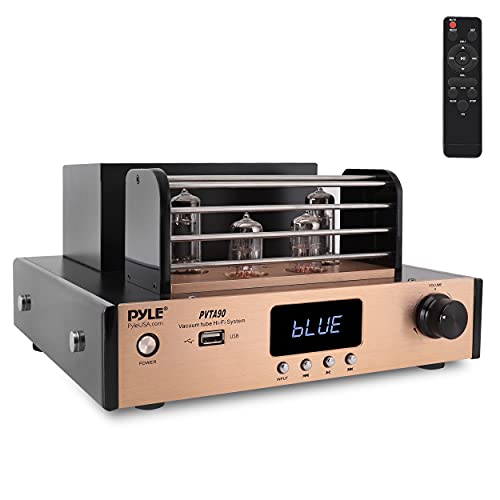
What the Pyle PVTA90 is, and what it isn't
The PVTA90 is best understood as a budget Bluetooth stereo receiver with tube-style branding.
It's not a dedicated phono receiver, and it's not a serious standalone tube amp.
I've seen buyers assume a product like this will turn a basic record player into a rich tube system.
In practice, it's closer to an entry-level receiver with extra styling and a longer feature list.
Turntable compatibility, the part that matters most
This is the make-or-break point.
If your turntable has a built-in phono preamp, you can usually run it straight into the RCA input.
That's the easy path, and it fits common beginner models from Audio-Technica, Victrola, Crosley, and some Fluance decks with line output.
If your turntable doesn't have a built-in preamp, you'll likely need an external phono preamp between the deck and the amp.
Otherwise, the signal will be weak, thin, and wrong.
In plain English, an AT-LP60X-style turntable can plug in directly through RCA.
A more traditional deck without line output needs extra help first.
If you want the simplest beginner hookup, a receiver with a dedicated phono input is usually easier.
Our turntable setup guide and phono preamp explainer walk through the full signal chain.
Convenience features vs sound-quality limits
The PVTA90 makes its case on convenience, not purity.
That can be enough, depending on your room and your expectations.
| Feature or benefit |
What it helps with |
What it doesn't fix |
| Bluetooth |
Easy phone streaming |
Better vinyl fidelity |
| FM radio |
Extra casual listening |
Cleaner amplification |
| USB playback |
More source flexibility |
Better turntable compatibility |
| SD card playback |
Standalone music playback |
Speaker power limits |
| Remote control |
Easier couch use |
Refinement at higher volume |
| Tube styling |
Visual appeal |
True tube-audio performance |
| Passive speaker support |
Builds a real stereo system |
Hard-to-drive speaker demands |
In a small apartment, switching from records to Bluetooth without changing gear can matter more than chasing the last bit of detail.
In a dedicated listening room, those same extras may feel like clutter.
Against a mini Class D amp like the Fosi Audio BT20A Pro, the Pyle gives you more built-in source options and more of a receiver feel.
The Fosi usually makes a stronger case if you care more about compact size and cleaner sound.
A standard stereo receiver often gives you the best upgrade path of the three.