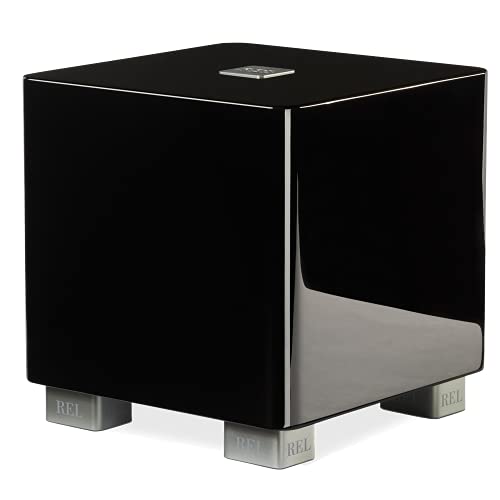
Key specs, and what they mean in practice
The design is straightforward: sealed enclosure, 8-inch long-throw driver, Class A/B amplification, and a compact cabinet.
That points to music integration, not brute-force room pressurization. In a 12 by 14 foot room, a sealed sub like this is often easier to blend than a larger ported box.
You give up some low-end drama, but you gain cleaner bass lines and less room overload. It’s the difference between adding foundation and dropping a cinder block in the corner.
Compared with the REL T/7x, the T/5x is easier to place and better suited to tighter spaces. The T/7x is the better pick if you need more headroom.
Compatibility with vinyl systems
The turntable usually doesn’t connect straight to the sub. The signal chain matters, and the T/5x makes the most sense when the rest of your system gives you a clean connection path.
| Scenario |
Can it work with REL T/5x? |
Best connection |
Watch-out |
| Turntable + phono preamp + integrated amp |
Yes |
High level input |
Best fit for passive bookshelf speakers |
| Turntable + stereo receiver |
Yes |
Speaker-level or sub out |
Check receiver outputs first |
| Turntable + powered speakers |
Sometimes |
Compatible line-level output |
Not all powered speakers make this easy |
| Turntable + phono preamp + amp with sub out |
Yes |
Low level RCA input |
Simple, but still tune crossover carefully |
The most common connection paths are:
- Turntable → phono preamp → integrated amp → REL via high-level input
- Turntable → phono stage receiver → REL via speaker-level or sub out
- Turntable → powered speakers → REL via compatible line-level output, if available
If you’re using passive speakers and an integrated amp, this is where REL’s approach makes sense. The sub sees the same sonic character as the main amp, which is one reason stereo listeners like it.
If you’re running powered speakers like Audioengine A5+, verify outputs before buying. For more setup help, see what is a phono preamp, the turntable setup guide, and how to choose a turntable.
Room size and placement guidance
Room fit is pretty easy to call:
- Small room: excellent fit
- Apartment: strong fit at moderate listening levels
- Medium room: good if your expectations are music-first
- Large open room: likely undersized
In an apartment living room, this can add weight without pushing bass through every wall. But if you stick it in a corner and leave the crossover too high, even a good compact hi-fi sub can sound thick and disconnected.
Use the listening seat as your reference point, not the spot beside the sub. Small placement moves and careful phase adjustment usually matter more than buyers expect.