Review · Updated July 2026
Rockville BLUAMP 150 Bluetooth Amplifier Review
If you want the smallest, cheapest path to passive-speaker vinyl playback in a small room, I think this little Rockville can make sense.
Darkside Vinyl is reader-supported. When you buy through links on our site we may earn an affiliate commission, at no extra cost to you. It never changes our verdict or our score. How we make money.
Darkside Vinyl's verdict
In our listening room
If you need a phono input, more connection options, or room to grow, I'd skip it and buy a stereo receiver instead.
Direct answer: Best for budget vinyl beginners using passive speakers in a bedroom, office, or apartment setup. Not ideal if your turntable lacks a built-in preamp, or if you want a system hub for multiple sources.
Pros
- Crisp audio at high volumes
- Versatile connectivity options
- Karaoke-ready with mic inputs
- Expandable audio system
- Durable metal build
Cons
- Limited Bluetooth range
- May require speaker setup knowledge
At a glance
Rockville BLUAMP 150 Bluetooth Amplifier, by the numbers
The specs and scores that matter most when deciding if this product fits your setup.
How it scored
4.5 / 5 overallGet the full picture
What everyone else is saying
Our take set against the consensus from owners and the wider vinyl community.
I'd call this a decent budget pick for one very specific job.
The positive feedback usually centers on three things: low price, compact size, and easy Bluetooth use.
Forum conversations are usually more skeptical, and that's useful.
Overview
Rockville BLUAMP 150 Bluetooth Amplifier Overview
Specs and features that matter for vinyl buyers
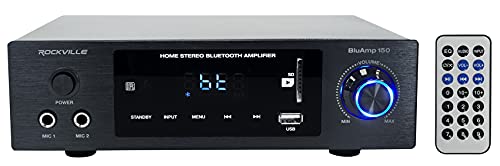
The useful stuff is basic: compact chassis, Bluetooth, RCA input, 2-channel stereo output, and speaker terminals for passive speakers.
The small chassis is great for tight shelves. The tradeoff is fewer controls, fewer inputs, and less upgrade room than a full-size receiver.
Bluetooth is a convenience feature, not a vinyl feature. It's nice for phone playback, but it doesn't give you phono support.
The RCA input matters most for turntable buyers. If your deck has a built-in preamp, that input is enough. If it doesn't, you need an external phono stage in between.
Class D amplification is common in this category. In practice, that usually means better efficiency and a smaller box, not guaranteed authority with every pair of speakers.
Connection table, what works directly and what needs extra gear
This is the part I'd verify before you buy anything else.
| Source | Works Directly? | Extra Gear Needed | Notes |
|---|---|---|---|
| Turntable with built-in preamp | Yes | None | Use RCA output set to line |
| Turntable without built-in preamp | No | External phono preamp | Raw phono signal needs correction and gain |
| Phone via Bluetooth | Yes | None | Easy secondary source |
| TV audio output | Maybe | Possibly adapter or compatible analog output | Keep expectations basic |
| Passive speakers | Yes | Speaker wire | Main use case |
| Powered speakers | No, usually unnecessary | None | Amp usually adds no value here |
A Fluance or Audio-Technica table with a built-in phono stage can go straight into the RCA input. A phono-only deck can't.
Any record player can't plug straight into any amplifier. Turntables often need a phono preamp unless they already output line level.
If you're still sorting that out, start with this guide on what a phono preamp is.
| Best for | Not ideal for |
|---|---|
| Turntables with built-in preamps | Turntables with phono-only output and no external preamp |
| Small passive bookshelf speakers | Large rooms or harder-to-drive speakers |
| Tight budgets and small shelves | Buyers who want TV, streamer, and upgrade flexibility |
| Casual vinyl plus Bluetooth streaming | Anyone who already owns powered speakers |
| Item | Compatible? | Notes |
|---|---|---|
| Turntable with built-in preamp | Yes | Connect to RCA input directly |
| Turntable without built-in preamp | No, not directly | Needs an external phono preamp |
| Passive speakers | Yes | This is what the amp is for |
| Powered speakers | Usually no | They already have amplification |
| Phone or tablet via Bluetooth | Yes | Good for casual streaming |
| TV source | Maybe | Depends on the TV’s output options |
The full review
How the Rockville BLUAMP 150 Bluetooth Amplifier performs, point by point
The details that matter when you're deciding — tested in our room, explained in plain language.
Why trust this review
How we tested the Rockville BLUAMP 150 Bluetooth Amplifier
No spec-sheet guesswork. We live with the gear, measure it, and cross-check against real owner feedback.
Our review process
-
1
Buy it ourselves
We purchase products through normal retail channels — never accept free units for review.
-
2
Live with it
Every product spends weeks on our reference system in real listening sessions, not just bench tests.
-
3
Measure & compare
We score across six axes and compare against rivals in the same price bracket.
-
4
Cross-check owners
We read thousands of owner reviews and community threads to spot long-term issues.
Our editors' work has appeared in
Final thoughts
Should you buy the Rockville BLUAMP 150 Bluetooth Amplifier?
✓ Buy it if
- <h3>Why the BLUAMP 150 works for simple vinyl systems</h3>
- <p>The biggest win is size. If you're building a compact setup on a desk, cube shelf, or narrow stand, a full-size receiver can feel like parking a pickup truck in a bike lane.</p>
- <p>The second win is cost. For a beginner who just wants a budget amp for a record player, this lowers the entry price.</p>
- <p>Bluetooth is useful too. If you spin records on weekends but stream from your phone during the week, it's convenient.</p>
- <p>I also like the simplicity. One basic RCA path is easier for beginners than a receiver full of ports they'll never touch.</p>
- <p>In a bedroom setup with efficient bookshelf speakers, this can be enough. Think small Polk or Micca-style passive speakers, moderate volume, and a turntable that already outputs line level.</p>
- <p>Compared with an entry Sony stereo receiver, it saves space and money. It doesn't replace the receiver category.</p>
✕ Skip it if
- <h3>Where the BLUAMP 150 falls short</h3>
- <p>The make-or-break issue is phono preamp compatibility. If your turntable doesn't have a built-in preamp, this compact Bluetooth amplifier probably won't solve that by itself.</p>
- <p>I see that mistake all the time. Someone plugs in a phono-only turntable, gets weak sound, and blames the amp when the signal chain is the real problem.</p>
- <p>Inputs are limited too. If you want to add a TV, streamer, CD player, or game console, this feels cramped fast.</p>
- <p>I'd also keep the power rating in context. Box wattage doesn't tell you how the amp will behave with inefficient speakers or in a larger room.</p>
- <p>That's where products like the Fosi Audio BT20A, or better yet an entry-level Sony receiver, usually feel safer. They give you more flexibility and a little more breathing room.</p>
- <p>A bad fit looks like this: larger room, older bookshelf speakers that need some push, and a turntable without a built-in preamp. At that point, the cheap amp stops being cheap.</p>
- Crisp audio at high volumes
- Versatile connectivity options
- Karaoke-ready with mic inputs
- Expandable audio system
- Durable metal build
- Limited Bluetooth range
- May require speaker setup knowledge
Still wondering?
Rockville BLUAMP 150 Bluetooth Amplifier — your questions
It's a compact 2-channel stereo amplifier from Rockville that powers passive speakers from basic sources like RCA and Bluetooth. Think of it as a small home audio amp, not a full stereo receiver.
Yes, if the setup is simple and matched correctly. I'd use it with a turntable that already has a built-in preamp, efficient passive bookshelf speakers, and a small room.
I wouldn't assume it does, and I'd tell any buyer to verify that point before ordering. The safe beginner assumption is this: many turntables still need an external phono preamp unless they already output line level.
Buy this instead of a receiver if space is tight, your source list is simple, and your goal is just to run passive speakers from a turntable with a built-in preamp plus maybe a phone over Bluetooth.
It can be, but only if size and simplicity matter more than flexibility. A small amp like this saves shelf space and upfront cost.
I'd stick with efficient passive bookshelf speakers in a small to medium-small room. That means speakers that don't need a ton of power to wake up.
Only if your record player has a built-in preamp or a line output mode. If it has a phono-only output, you need an external phono preamp between the turntable and amp.
Treat it like a total-system cost question, not just an amp price question. If you need the amp, an entry-level phono preamp, RCA cables, and speaker wire, your final cost climbs quickly.