★ Editor's Choice
Review · Updated July 2026
Review
I think the Rockville BLUAMP 90 only makes sense for a simple budget setup where your turntable already has a built-in preamp.

Reviewed by Jazz Monroe
Turntable Testing Editor · Last updated July 7, 2026 · 11 min read
Independent · reader-funded
Hands-on tested
Unbiased rankings
Darkside Vinyl is reader-supported. When you buy through links on our site we may earn an affiliate commission, at no extra cost to you. It never changes our verdict or our score. How we make money.
Darkside Vinyl's verdict
I think the Rockville BLUAMP 90 only makes sense for a simple budget setup where your turntable already has a built-in p
4.2
/ 5
4.2 out of 5
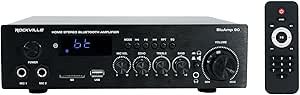 In our listening room
If your chain is sorted, this little amp can do the job without taking over your shelf. If it isn't, you'll end up buying extra gear fast.
I wouldn't call it the safest first pick for beginners. A Sony STR-DH190 or a better-known compact amp gives you fewer compatibility surprises and a cleaner upgrade path.
Pros
- Powerful 60W RMS output
- Versatile connectivity options
- Compact and durable design
- Easy USB/SD playback
Cons
- Limited power for large spaces
- May require additional speakers for optimal sound
- Basic remote control functionality
At a glance
, by the numbers
The specs and scores that matter most when deciding if this product fits your setup.
Our score
4.2 / 5
Price
See retailer
Store
Amazon
Category
Turntables
How it scored
4.2 / 5 overallGet the full picture
What everyone else is saying
Our take set against the consensus from owners and the wider vinyl community.
J
Jazz Monroe
Our reviewer
I think this amp is fine in a very narrow lane.

Amazon
Customer consensus
The likely themes are predictable: compact size, easy setup, good value, and Bluetooth convenience.

Reddit
Community take
Reddit usually gets to the useful question faster: does your turntable have a built-in preamp?
Overview
Overview
Turntable compatibility, what works and what doesn't
Treat the Rockville BLUAMP 90 as a line-level stereo amp, not a phono-ready receiver. That's the safest way to shop for it.
If your turntable has a built-in preamp, it can send line-level output through RCA and the hookup should be straightforward. Many beginner Audio-Technica decks work this way.
If your turntable outputs phono-level signal only, you'll need an external phono preamp before the amp. Many Fluance models fall into this camp.
Without that extra stage, the sound will be weak, thin, and wrong. If you need a refresher, start with our phono preamp guide and turntable setup guide.
Speaker matching and real-world power
Small amps usually do best with efficient passive bookshelf speakers in small to medium rooms. That's where this one makes the most sense.
A bedroom, office, or apartment living room is a fair target. A large open room or demanding speakers will expose the limits much faster.
This is why watt claims don't tell the whole story. Speaker sensitivity, impedance, and how cleanly the amp holds together at volume matter more.
Think compact bookshelf speakers on stands in a 12-by-14 room. That's workable. Try to fill a bigger shared living space, and you'll hear strain instead of headroom.
Mini comparison, Rockville BLUAMP 90 vs Sony STR-DH190 vs Fosi Audio BT20A
Here's the clean buying frame:
| Amp | Best for | Turntable friendliness | Built-in phono support | Size | Bluetooth | Upgrade room | Value for passive bookshelf speakers |
|---|---|---|---|---|---|---|---|
| Rockville BLUAMP 90 | Small shelf systems | Fair, only if your turntable is already preamped | No confirmed phono input | Smallest | Yes | Limited | Decent in the right chain |
| Sony STR-DH190 | First vinyl systems | Easiest for beginners | Yes | Full-size receiver | Yes | Better | Strong overall |
| Fosi Audio BT20A | Compact value setups | Fair, still needs phono planning | No | Very compact | Yes | Moderate | Often a better-known compact option |
If you want the smallest footprint and already understand your signal chain, the Rockville is the neatest fit. If you want fewer vinyl headaches, the Sony is the easier recommendation.
The Fosi sits in the middle for buyers who like compact Class D amps and don't mind handling phono needs separately. That's more of a tinkerer move than a true beginner move.
Choose Rockville if shelf space is your biggest constraint and your turntable already outputs line level.
Choose Sony if you want the easiest first-time vinyl setup with built-in phono support and more room to grow.
Choose Fosi if you want a compact amp and don't mind planning the phono stage separately.
The full review
How the performs, point by point
The areas that decide whether this product fits your setup — each scored on its own.

Rockville BLUAMP 90 Stereo Amplifier
Get it from Amazon
4.2
$64.95
I earn a commission if you click this link and make a purchase at no additional cost to you.
07/09/2026 12:17 am GMT
Why trust this review
How we tested the
No spec-sheet guesswork. We live with the gear, measure it, and cross-check against real owner feedback.
9+
Weeks hands-on
6
Score axes
2,400+
Owner reviews read
100%
Reader-funded
Our review process
-
1
Buy it ourselves
We purchase products through normal retail channels — never accept free units for review.
-
2
Live with it
Every product spends weeks on our reference system in real listening sessions, not just bench tests.
-
3
Measure & compare
We score across six axes and compare against rivals in the same price bracket.
-
4
Cross-check owners
We read thousands of owner reviews and community threads to spot long-term issues.

Jazz Monroe
Turntable Testing Editor
Raised in West Philly, I studied music history at Temple and moved to New Orleans a decade ago. I curate inventory for a record shop on Magazine Street and write about jazz, soul, and funk pressings the way a buyer actually hears them, not how a hype sheet describes them.
✦Hands-on product testing
✦Independent editorial policy
✦No paid placements
Our editors' work has appeared in






Final thoughts
Should you buy the ?
✓ Buy it if
- <h3>Why the BLUAMP 90 makes sense in a simple vinyl setup</h3>
- <p>The biggest win is size. If your setup lives on a TV stand, cube shelf, or narrow console, that small footprint matters.</p>
- <p>Bluetooth is useful too, just not for the reason sellers push. It won't improve your records, but it does let the same system handle quick phone streaming.</p>
- <p>The RCA input keeps hookup simple with line-level gear. If your turntable has a built-in preamp, setup is mostly cables and speaker wire.</p>
- <p>It's also a low-cost way to power passive speakers without jumping to a full-size receiver. For a first system with compact bookshelf speakers, that's a real plus.</p>
- <p>I can picture this working with an AT-LP60X, two small passive speakers, and a cramped media stand. In that lane, the BLUAMP 90 stays tidy and does enough.</p>
✕ Skip it if
- <h3>Where the BLUAMP 90 can become a false economy</h3>
- <p>The big issue is phono compatibility. If there's no dedicated phono input, many turntable owners will need an external phono preamp.</p>
- <p>That's where a cheap mini amp stops being cheap. Add a phono stage later, and your total cost starts creeping toward a Sony STR-DH190 or a decent used receiver.</p>
- <p>Power is the other place to stay realistic. Budget amps often look stronger on paper than they feel in a real room.</p>
- <p>You also give up flexibility. Fewer inputs, less upgrade room, and more question marks around noise floor and control quality are common tradeoffs here.</p>
- <p>I see this mistake all the time. Someone pairs a phono-only turntable with a line-level amp, gets weak thin sound, then blames the amp.</p>
- <p>At that point, the fix is another box and more cables. That's like buying a cheap suitcase with a broken handle, then spending extra to carry it better.</p>
Rockville BLUAMP 90 Stereo Amplifier
Get it from Amazon
4.2
$64.95
Rockville BLUAMP 90 Stereo Amplifier - Ideal for music lovers and karaoke enthusiasts seeking powerful sound.
Pros:
- Powerful 60W RMS output
- Versatile connectivity options
- Compact and durable design
- Easy USB/SD playback
Cons:
- Limited power for large spaces
- May require additional speakers for optimal sound
- Basic remote control functionality
I earn a commission if you click this link and make a purchase at no additional cost to you.
07/09/2026 12:17 am GMT
Still wondering?
— your questions
It's a compact 2-channel stereo amplifier with Bluetooth and RCA line input. Its job is to power passive speakers from line-level sources, not to replace a phono preamp.
Yes, if the turntable has a built-in preamp or if you add an external phono preamp first. No, not directly if your turntable outputs phono-level signal only.
You shouldn't assume it does. The safe move is to treat it as needing a separate phono stage unless the product documentation clearly confirms dedicated phono support.
Usually, yes, for efficient passive bookshelf speakers in a small or medium room. It's less convincing with harder-to-drive speakers or larger spaces where you want more volume and headroom.
It can be, but only if you already understand preamp compatibility. For a true beginner, a receiver with built-in phono support is often the easier and safer buy.
Yes, if your turntable doesn't have a built-in preamp. No, if your deck already outputs line-level signal through RCA.
Sometimes, yes, if your priority is saving space and keeping the system simple. Often, no, if a used receiver gives you phono input, more power, and more inputs for similar money.
Efficient passive bookshelf speakers are the best match. Keep the room small to medium, and avoid speakers that are known to be hard to drive.