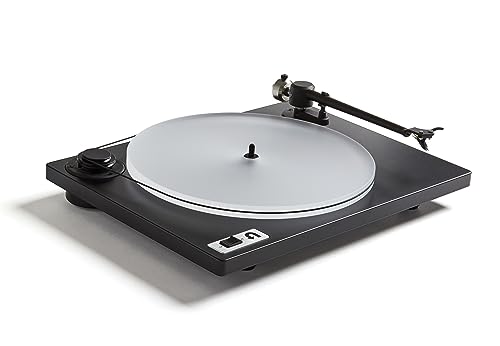
The Orbit Plus has that easygoing, listen-for-hours kind of sound that makes me want to keep flipping records. It doesn’t try to impress with hype or extra gloss; instead, it gives me a clean, balanced presentation that feels relaxed but still detailed enough to keep my attention.
What I notice most is how unfussy it is. Vocals sit naturally, guitars have a nice bite without getting sharp, and the whole presentation stays composed when a record gets busy. It’s the kind of turntable that lets the album do the talking, which is exactly what I want most of the time.
It also does a nice job of keeping surface noise from taking over the room. I’m not saying it magically erases a worn pressing, but it doesn’t exaggerate flaws or add its own drama, and that makes a big difference when I’m digging through older records.
The Orbit Plus has a simple, clean look that I appreciate every time I see it on a shelf. It doesn’t feel overdesigned or trying too hard, and that restraint gives it a kind of confidence that works well in a real living room.
In use, it feels nicely sorted rather than flashy. The plinth, platter, and overall layout give me the sense that the money went into the parts that matter for playback, not into gimmicks, and that’s usually a better tradeoff in my book.
It’s also the sort of deck that disappears visually once the record is spinning, which I mean as a compliment. I don’t need my turntable to be the center of attention; I need it to look good, sit quietly, and not annoy me every time I walk past it.
What I like most here is that the Orbit Plus doesn’t make me feel like I’m assembling a science project. It’s approachable, and once it’s set up, I can get straight to listening without a bunch of fiddling or second-guessing.
I also appreciate that it feels friendly for someone who wants a serious record player without getting buried in unnecessary complexity. There’s enough here to feel like a proper hi-fi component, but not so much that I’m constantly checking manuals or tweaking settings just to play an album.
That simplicity is a real part of the appeal. For a lot of people, especially if this is their main turntable in a straightforward stereo setup, the Orbit Plus hits a sweet spot between “plug it in and enjoy it” and “this is still a proper audiophile machine.”
This is the kind of turntable I’d trust for regular, non-audiophile-nerd life. It’s easy to live with, easy to enjoy, and it doesn’t demand much from me beyond putting on a record and dropping the needle.
Over time, that matters more than any one wow moment. I care about whether a turntable makes me want to play another side, and the Orbit Plus does that because it stays out of the way and keeps the experience focused on the music.
It also has the right temperament for mixed listening habits. Whether I’m putting on something quiet and intimate or something a little rougher around the edges, it handles the job without making me feel like I need to baby it.
I think the Orbit Plus makes the most sense for someone who wants a well-sorted turntable without a lot of extra baggage. If you care about sound and clean design, but you don’t want a deck that feels fussy or overcomplicated, this is very easy to get along with.
It’s also a strong fit for a first serious setup, especially if the rest of the system is simple and you want the turntable to be the one part you don’t have to worry about. I’d be comfortable recommending it to someone who wants to buy once, settle in, and just play records.
For me, the Orbit Plus feels like a turntable that knows exactly what it is. It’s not chasing flashy features or trying to be all things to all people, and that focus is a big part of why it works so well in the real world.