01Build and design: the part that changes the Crosley conversation
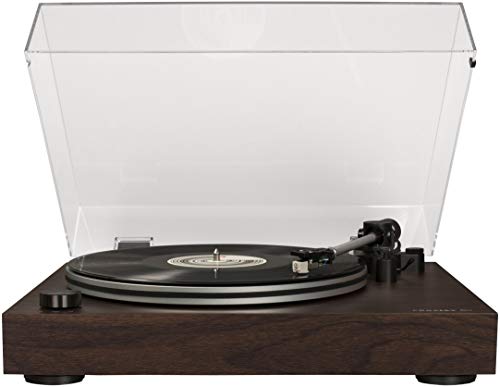
The biggest surprise with the C8A-WA is that it actually looks and feels like a real component. It’s a separate plinth design with a proper tonearm, so it immediately escapes that cramped suitcase-player vibe that gives Crosley such a mixed reputation in the first place.
That matters the second I put it next to a normal stereo stack. It doesn’t feel like a novelty box with a lid; it feels like something meant to live in a listening room, even if the finish and overall vibe are still more entry-level than fancy.
The adjustable counterweight and anti-skate are the real tells here. Those are the kinds of basics that make a turntable feel serious, because they give me actual control over tracking instead of the fixed-arm, hope-for-the-best approach you get on a lot of cheap all-in-one players.
02Setup and first impressions: easier than a true hi-fi deck, but still manual
The built-in phono preamp makes the first setup much less annoying than it could be. I can run RCA straight into powered speakers or a receiver’s line input without having to buy another box just to hear music, which is a very real win for a first-time buyer.
That’s especially helpful in apartments and bedrooms, where nobody wants a pile of extra gear taking over the room. If I already own powered bookshelf speakers, I’m basically one cable run away from spinning records.
That said, this is still a manual belt-drive turntable, not a push-button convenience machine. I have to think a little more about the setup, and that’s where some beginners will feel the difference right away.
03Everyday use: where the manual operation starts to matter
This is the area where the C8 loses easy points to something like the Audio-Technica AT-LP60X. On the Crosley, I’m cueing records by hand, handling the arm myself, and living with the normal routine that comes with a manual deck.
That doesn’t sound like a big deal until it’s late, I’m tired, and I just want to hear one side before bed. In that moment, an automatic turntable usually gets used more because it asks less of me.
I also need to know the basics, like when to switch between 33 1/3 and 45 RPM and how to handle the record each time. If someone wants Bluetooth-style convenience and zero learning curve, this isn’t the right lane.
04Sound and tracking: better fundamentals than the suitcase crowd
What I hear most from the C8A-WA is not some dramatic audiophile magic, but a sense that the hardware is finally doing the job properly. The AT3600L cartridge is a familiar, sensible choice, and with the counterweight and anti-skate set correctly, the table tracks in a way that cheap suitcase players simply don’t.
That translates into less of that nervous, compromised feeling I get from fixed-arm decks. Records feel safer, playback feels steadier, and I’m not constantly wondering whether the stylus is being asked to do too much.
I wouldn’t call it a giant leap into high-end territory, but it is a meaningful step up from the toy-like end of the market. For someone moving up from a suitcase player, the difference in control alone is worth paying attention to.
05Connectivity and real-world system fit
The built-in preamp keeps the C8A-WA flexible in a way that makes sense for a lot of homes. I can plug it into powered speakers, a receiver, or a basic stereo setup without having to decode the whole phono-versus-line-input puzzle first.
That’s a practical advantage because I’ve seen more first-time buyers get tripped up by signal-chain confusion than by sound quality itself. A built-in stage removes one common mistake, even if I decide to move to an external phono preamp later.
What it doesn’t solve is the rest of the system. There are no built-in speakers here, so I still need powered speakers or an amp-and-speaker setup, and that’s the point where the budget reality check kicks in for a lot of people.
06Who it’s really for: the right upgrade, but not the least risky buy
I think the C8A-WA makes the most sense for someone moving up from a suitcase player and wanting a more traditional turntable experience without jumping straight into deep hi-fi territory. It gives me real hardware basics, a built-in preamp, and enough control to feel like I’m learning the right way.
At the same time, I’ve got to be honest about brand trust. Audio-Technica and Fluance still carry more confidence in hi-fi circles, and that matters if I want the least controversial buy.
The common mistake here is buying the deck and then realizing I still need speakers, a stand, and a brush. Once the full setup starts adding up, a simpler automatic model or a better-known alternative can start looking smarter, even if the C8 itself is the more satisfying turntable to actually live with.