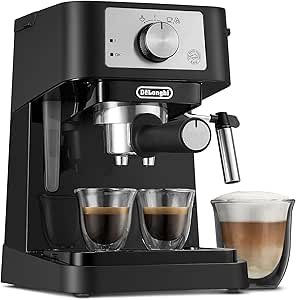
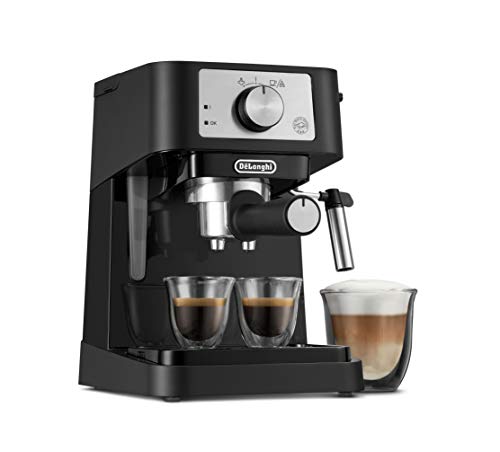
The first thing I noticed about the De’Longhi Stilosa is that it keeps things simple in a way that actually helps in a real kitchen. It doesn’t try to look like a tiny café machine, and that restraint makes it easy to live with on a counter that’s already crowded.
The styling is plain but neat, with just enough polish to avoid looking cheap. I also appreciate that it doesn’t demand a lot of visual attention, which matters if you want the machine to blend in instead of becoming the centerpiece of the room.
Using the Stilosa is straightforward once you get into its rhythm. It’s the kind of machine that rewards a little consistency: warm it up, lock in the portafilter, pull the shot, steam if you need it, done.
I like that it doesn’t bury you in menus or extra steps. For me, that makes it feel approachable on busy mornings, especially when I just want espresso without turning the whole thing into a project.
03Espresso quality and shot behavior
What matters most here is whether it can make a decent shot that feels satisfying, and the Stilosa does that job without pretending to be something fancier. When the grind and dose are in the right neighborhood, it gives me a cup that’s good enough to stand on its own or work well in milk drinks.
I wouldn’t call it a machine that flatters sloppy prep, though. It seems happiest when I pay attention to the basics, and that’s fair at this level because the results improve a lot when I do my part.
04Milk steaming and drink flexibility
The steam wand gives the machine enough range to handle lattes and cappuccinos without feeling like an afterthought. I wouldn’t buy it expecting café-level microfoam every time, but it gets the job done for home drinks and doesn’t make me fight it too hard.
That flexibility matters because it keeps the Stilosa from being a one-note espresso box. If your routine includes milk drinks, it can cover both sides of the house without needing a separate setup or a lot of extra gear.
05Learning curve and consistency
This is a machine that makes more sense the longer you use it. The basics are easy, but the best results come from learning how it responds to grind size, tamping, and timing, which is exactly what I want from an entry-level espresso machine.
I also found that consistency depends more on my routine than on the machine trying to compensate for me. That can be a blessing or a frustration depending on your experience, but I see it as a good stepping stone if you want to learn real espresso habits.
The Stilosa makes the most sense for someone who wants a simple, hands-on espresso machine and doesn’t need a bunch of extras. It feels aimed at people who care more about getting into home espresso than about having the most polished or automated experience.
If I were setting up a first espresso corner, this would be the kind of machine I’d consider when I wanted something approachable and not overly fussy. It’s not trying to be the final word in espresso, but it does a solid job of opening the door.