★ Editor's Choice
Review · Updated July 2026
Review
> Verdict: I think the Denon DP-300F is best for beginners who want convenience over tweakability. It’s a clear step up from suitcase players for record safety, stability, and system matching, but it isn’t the strongest sound-per-dollar buy if you’re comfortable with a manual deck like the Fluance RT82.

Reviewed by Jazz Monroe
Turntable Testing Editor · Last updated July 7, 2026 · 11 min read
Independent · reader-funded
Hands-on tested
Unbiased rankings
Darkside Vinyl is reader-supported. When you buy through links on our site we may earn an affiliate commission, at no extra cost to you. It never changes our verdict or our score. How we make money.
Darkside Vinyl's verdict
> Verdict: I think the Denon DP-300F is best for beginners who want convenience over tweakability.
4.5
/ 5
4.5 out of 5
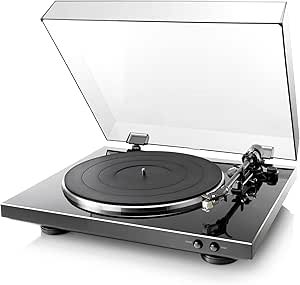 In our listening room
Ease matters here, and Denon gets that part right. If you want fully automatic operation, a built-in phono preamp, and fewer setup headaches, this table earns its place.
If you already know you don't mind manual cueing, I wouldn't call it the value champ. The Audio-Technica AT-LP60X is cheaper for basic automatic playback, and the Fluance RT82 makes a stronger performance case if convenience isn't your top filter.
Pros
- Built-in phono equalizer
- Automatic tonearm operation
- Reduced vibrations for clearer sound
- Easy setup
- Attractive design
Cons
- Higher price point
- Requires space for setup
- Limited to vinyl records
At a glance
, by the numbers
The specs and scores that matter most when deciding if this product fits your setup.
Our score
4.5 / 5
Price
See retailer
Store
Amazon
Category
Turntables
How it scored
4.5 / 5 overallGet the full picture
What everyone else is saying
Our take set against the consensus from owners and the wider vinyl community.
J
Jazz Monroe
Our reviewer
I think this is a sensible buy for the right person, and the wrong buy for the wrong reason.

Amazon
Customer consensus
Amazon reviews usually land on the same points: easy setup, beginner-friendly use, and appreciation for the built-in preamp.

Reddit
Community take
Reddit is usually fair but less sentimental.
Overview
Overview
Features and setup basics
This is a belt-drive turntable with fully automatic operation, a built-in phono preamp, a moving magnet cartridge, RCA outputs, and a dust cover. That's a solid feature set for a beginner automatic table.
Setup is still real, just manageable. Expect to fit the platter and belt, attach the dust cover, place it on a level surface, and make the right phono or line connection.
You don't need a long calibration session, but you shouldn't treat it like a toy either. A careful Saturday-afternoon setup is the right expectation.
Works with what, speakers and receiver compatibility
Here's the plain-English version:
| Setup type | Works with the DP-300F | Notes |
|---|---|---|
| Powered speakers with line input | Yes | Use the built-in preamp |
| Receiver with phono input | Yes | You can use the phono-stage path |
| Receiver without phono input | Yes | Use the built-in preamp into line input |
| Passive speakers alone | No | You still need an amp or receiver |
Line input means the signal is already boosted to the right level for a normal audio input. Phono input means the receiver handles that low-level turntable signal itself.
The mistake I see all the time is assuming a built-in preamp powers speakers. It doesn't. Passive speakers still need amplification somewhere in the chain.
If you own Edifier-style powered speakers with RCA input, this Denon is easy to slot in. If you only have passive bookshelf speakers, you're not done shopping yet.
Denon DP-300F vs AT-LP60X vs Sony PS-LX310BT
| Model | Automation | Built-in Preamp | Cartridge Flexibility | Best For |
|---|---|---|---|---|
| Denon DP-300F | Fully automatic | Yes | Moderate | Buyers who want convenience with a more grown-up feel |
| Audio-Technica AT-LP60X | Fully automatic | Yes | Limited | Lowest-cost easy starter |
| Sony PS-LX310BT | Fully automatic | Yes | Limited | Casual wireless listening |
Choose the Denon if you want easy playback but don't want the cheapest-feeling route. Choose the AT-LP60X if price is the main decider.
Choose the Sony if Bluetooth convenience matters more than wired simplicity. Most buyers here aren't chasing audiophile bragging rights. They're choosing which kind of convenience they actually want.
Upgrade path, what can improve later
The realistic path here is modest, not endless. You can improve the stylus, explore cartridge options, and get better results by upgrading speakers or moving to a better receiver and phono preamp later.
That's still healthier than buying a suitcase player and replacing everything. Start with a decent speaker pairing, then improve around the table instead of expecting the deck alone to transform the system.
That leaves the bottom-line question: is this your kind of convenience buy?
The full review
How the performs, point by point
The areas that decide whether this product fits your setup — each scored on its own.

Denon DP-300F Turntable
$499.00
$299.99
Get it from Amazon
4.5
I earn a commission if you click this link and make a purchase at no additional cost to you.
07/09/2026 03:06 pm GMT
Why trust this review
How we tested the
No spec-sheet guesswork. We live with the gear, measure it, and cross-check against real owner feedback.
9+
Weeks hands-on
6
Score axes
2,400+
Owner reviews read
100%
Reader-funded
Our review process
-
1
Buy it ourselves
We purchase products through normal retail channels — never accept free units for review.
-
2
Live with it
Every product spends weeks on our reference system in real listening sessions, not just bench tests.
-
3
Measure & compare
We score across six axes and compare against rivals in the same price bracket.
-
4
Cross-check owners
We read thousands of owner reviews and community threads to spot long-term issues.

Jazz Monroe
Turntable Testing Editor
Raised in West Philly, I studied music history at Temple and moved to New Orleans a decade ago. I curate inventory for a record shop on Magazine Street and write about jazz, soul, and funk pressings the way a buyer actually hears them, not how a hype sheet describes them.
✦Hands-on product testing
✦Independent editorial policy
✦No paid placements
Our editors' work has appeared in






Final thoughts
Should you buy the ?
✓ Buy it if
- <h3>What the Denon DP-300F gets right</h3>
- <p>The big win is ease. Auto start and auto return make first ownership feel simple, not like a lab assignment.</p>
- <p>The built-in phono preamp also prevents the wiring mistake I see most often. You can run the RCA outputs straight into a line input on powered speakers or a receiver without a phono input.</p>
- <p>It's also a real upgrade over a suitcase player. You get a proper cartridge setup, standard connections, and safer record handling without jumping straight into fussy enthusiast gear.</p>
- <p>Denon branding helps too. For a lot of buyers, a known hi-fi name feels safer than a random budget brand with glossy marketing and shaky quality control.</p>
- <p>If you're moving up from an all-in-one player and already own powered speakers, you can plug this into the line input and start listening the same afternoon. That's a much cleaner first system.</p>
- <h3>Why those strengths matter in a real setup</h3>
- <p>Features only matter if they solve a real annoyance. Here, automation solves one beginners actually feel every day.</p>
- <p>In a small apartment, auto return is useful. If you're playing records while cooking or cleaning, it's nice to know the tonearm won't sit in the runout groove until you remember it.</p>
- <p>Beginner-friendly doesn't mean zero setup. You still want a level surface, a correctly seated platter and belt, and a quick check that everything is tracking as it should.</p>
- <p>Speaker quality matters more than most people expect. Pair this with thin, cheap speakers and you'll blame the turntable for problems that start farther down the chain.</p>
✕ Skip it if
- <h3>Where the Denon DP-300F falls short</h3>
- <p>The hard truth is price pressure. For the money, there are manual decks that give you better sound and a stronger long-term platform.</p>
- <p>That's the main tradeoff. You're paying partly for convenience, not just playback performance.</p>
- <p>Its upgrade flexibility is better than a suitcase player, but I still wouldn't buy it as a future tinkering platform. If you're already thinking about cartridge swaps and system scaling, a manual deck probably fits your habits better.</p>
- <p>If you enjoy adjusting gear, don't mind lifting a tonearm, and want the best sound-per-dollar, this Denon will probably feel like the compromise.</p>
- <h3>Who will notice these downsides most</h3>
- <p>Enthusiast-leaning beginners will notice first. If you're already comparing the Fluance RT82, Sony PS-LX310BT, and AT-LP60X side by side, you're probably not shopping on convenience alone.</p>
- <p>The same goes for buyers planning upgrades within six months. If you already know better speakers and a cartridge change are coming, you may outgrow this Denon faster than expected.</p>
- <p>People who don't actually need auto return should be careful. If that feature sounds nice but not necessary, it may not justify the premium.</p>
Denon DP-300F Turntable
$499.00
$299.99
Get it from Amazon
4.5
Denon DP-300F Turntable - Experience your vinyl collection with enhanced sound quality and effortless operation.
Pros:
- Built-in phono equalizer
- Automatic tonearm operation
- Reduced vibrations for clearer sound
- Easy setup
- Attractive design
Cons:
- Higher price point
- Requires space for setup
- Limited to vinyl records
I earn a commission if you click this link and make a purchase at no additional cost to you.
07/09/2026 03:06 pm GMT
Still wondering?
— your questions
Yes, for the right kind of beginner. If you want automatic operation, easy setup, and a built-in phono preamp for simple speaker matching, it's a friendly place to start.
Yes, it does. That means you can connect it to powered speakers or a receiver without a phono input by using a line input.
It's fully automatic. You press start, the tonearm moves into place, and at the end of the side it returns automatically.
The Denon feels like the more substantial convenience option. The AT-LP60X is usually the cheaper easy-entry choice.
It can be, if you want Denon branding, easy system matching, and a more serious feel than the cheapest automatics. That's where the extra spend makes sense.
Usually not long. Expect a short beginner-friendly setup that includes the platter, belt, dust cover, and RCA connection.
Yes, unless you already own powered speakers or a compatible receiver-and-speaker setup. The turntable is a source component, not a full playback system.
It can grow modestly. Better speakers, a stylus upgrade, and smarter system matching can stretch it farther than many cheap record players.