Review · Updated July 2026
EMB Professional 6500W Power Amplifier Review
I’d only buy this EMB amp for a cheap utility setup, not as the heart of a first vinyl system.
Darkside Vinyl is reader-supported. When you buy through links on our site we may earn an affiliate commission, at no extra cost to you. It never changes our verdict or our score. How we make money.
Darkside Vinyl's verdict
In our listening room
It can make sense if you already own the upstream gear, understand gain staging, and just need basic power for passive speakers in a garage, workshop, or second room. If you're starting with a turntable and nothing else, a stereo receiver is usually the smarter move.
Best for: budget utility listening, passive speakers, secondary rooms, light PA-style use
Not for: first-time turntable buyers, quiet hi-fi rooms, one-box simplicity, anyone expecting true 6500W behavior
Pros
- High power output
- Excellent frequency response
- Low signal noise
- Versatile speaker connections
Cons
- May require additional cooling
- Heavier than typical amplifiers
At a glance
EMB Professional 6500W Power Amplifier, by the numbers
The specs and scores that matter most when deciding if this product fits your setup.
How it scored
4.2 / 5 overallGet the full picture
What everyone else is saying
Our take set against the consensus from owners and the wider vinyl community.
I don't hate this EMB Professional amplifier.
Amazon feedback usually splits by use case.
Reddit tends to be more skeptical about amps like this, especially around wattage claims.
Overview
EMB Professional 6500W Power Amplifier Overview
Specs that matter more than the headline wattage
The useful specs here are less glamorous than the front-panel claim.
| Spec | What it means in practice |
|---|---|
| Channel count | 2-channel amplifier for left and right passive speakers |
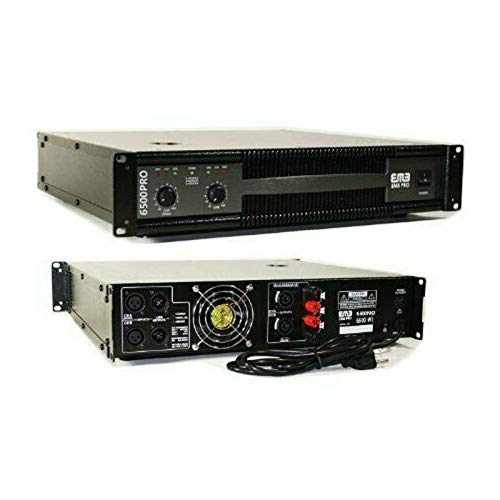
| Inputs | RCA inputs are easier for consumer gear than many pro-style alternatives |
| Outputs / terminals | Binding posts fit common speaker wire connections |
| Cooling | A cooling fan may add noise in quiet rooms |
| Rack format | Rack-mount chassis suits utility installs more than decor-focused spaces |
| Claimed power | Marketing headline, not enough for speaker matching by itself |
| Practical power framing | Look for RMS power, load handling, and clean output at normal volume |
If you’re comparing this to a compact Fosi Audio stereo amplifier, don't just stare at wattage. Physical size, fan behavior, and input type can matter just as much in a real room.
Turntable compatibility, what you need in the chain
Here’s the short version:
Turntable compatibility
- Turntable with built-in preamp: may work through the line-level path
- Standard turntable without preamp: needs an external phono preamp first
- Receiver or preamp in the middle: usually the cleaner, easier solution
Phono-level and line-level signals aren't the same. A turntable cartridge sends a very low signal that also needs EQ correction, and a phono preamp handles that before the amplifier stage.
This EMB unit is for powering passive speakers. It isn't a source switcher, and it isn't a phono stage.
A simple example: a Fluance or Audio-Technica turntable without a built-in preamp won't feed this amp correctly by itself. Add a phono preamp first, or skip the extra box and use a stereo receiver with a phono input.
Here’s the use-case matrix:
| Use case | Fit |
|---|---|
| Home vinyl setup from scratch | Poor fit |
| Passive bookshelf speakers with existing preamp | Fair fit |
| Garage or workshop system | Good fit |
| Small PA-style setup | Better fit than living-room hi-fi |
The full review
How the EMB Professional 6500W Power Amplifier performs, point by point
The details that matter when you're deciding — tested in our room, explained in plain language.
Why trust this review
How we tested the EMB Professional 6500W Power Amplifier
No spec-sheet guesswork. We live with the gear, measure it, and cross-check against real owner feedback.
Our review process
-
1
Buy it ourselves
We purchase products through normal retail channels — never accept free units for review.
-
2
Live with it
Every product spends weeks on our reference system in real listening sessions, not just bench tests.
-
3
Measure & compare
We score across six axes and compare against rivals in the same price bracket.
-
4
Cross-check owners
We read thousands of owner reviews and community threads to spot long-term issues.
Our editors' work has appeared in
Final thoughts
Should you buy the EMB Professional 6500W Power Amplifier?
✓ Buy it if
- 2-channel design: easy to understand for a simple left-right speaker setup
- RCA input path: friendlier for consumer audio gear than some PA alternatives
- Binding posts: easier for common passive speaker wire connections
- Rack format: useful for utility installs and equipment shelves
✕ Skip it if
- <h3>Where the EMB falls short for vinyl-first systems</h3>
- <p>The biggest problem is compatibility. This isn't a turntable-ready box.</p>
- <p>There’s no built-in phono preamp, so most turntables can't plug into it directly and sound right. A power amp wants a proper line-level signal, not the tiny phono-level output many record players send.</p>
- <p>That catches first-time buyers all the time. Someone hooks up a turntable straight to the amp, gets weak or thin sound, and assumes the unit is defective.</p>
- <p>Usually, the chain is the issue.</p>
- <p>A stereo receiver or integrated amplifier is easier because it often handles source switching, volume control, and sometimes phono input in one place. That’s a lot less friction for a first system.</p>
- <p>Then there’s room behavior. In a quiet listening space, fan noise, noise floor, and PA-style tuning matter more than they do in a garage.</p>
- <h3>The biggest spec-sheet trap</h3>
- <p>The "6500W" claim is the trap.</p>
- <p>That number is almost certainly peak power language or marketing shorthand, not the figure you should use for speaker matching in a home stereo system. What actually matters is RMS power, impedance support, thermal behavior, and whether the amp stays clean at normal listening levels.</p>
- <p>Here’s the practical framing:</p>
- <table>
- <thead>
- <tr>
- <th>Claimed power language</th>
- <th>What you should care about</th>
- </tr>
- </thead>
- <tbody><tr>
- <td>6500W headline</td>
- <td>Real clean output per channel</td>
- </tr>
- <tr>
- <td>Peak power rating</td>
- <td>RMS power into a stated load</td>
- </tr>
- <tr>
- <td>Big number on the box</td>
- <td>Stable performance with your speakers</td>
- </tr>
- <tr>
- <td>Loudness promise</td>
- <td>Noise, heat, and distortion at normal volume</td>
- </tr>
- </tbody></table>
- <p>A buyer might assume this amp can run any passive speakers because the wattage number looks huge. In practice, speaker sensitivity and impedance matching matter more than a giant peak claim.</p>
- <p>The chassis is also a clue. A rack-mount amplifier can be fine in a utility room, but it’s not always what you want sitting in a living room next to a turntable stand.</p>
- High power output
- Excellent frequency response
- Low signal noise
- Versatile speaker connections
- May require additional cooling
- Heavier than typical amplifiers
Still wondering?
EMB Professional 6500W Power Amplifier — your questions
It’s a budget 2-channel power amplifier for passive speakers. It’s aimed more at basic speaker power and light PA-style use than at being a full-featured vinyl control center.
It can be, if your expectations are realistic. If you already have the right source gear and just need inexpensive speaker power, the value is easier to defend.
Not by itself. If your turntable doesn't have a built-in preamp, you’ll need an external phono preamp or a stereo receiver in the chain before this amp.
Treat it as a marketing or peak power figure, not a real-world home listening number.
Usually, yes. A standard turntable needs a phono preamp first.
You’ll need passive speakers and speaker wire either way. If your turntable lacks a built-in preamp, you’ll also need a phono preamp, plus RCA cables and a sensible place to control volume in the chain.
It’s not impossible, but it’s less plug-and-play than a receiver.
If vinyl is your main use, I’d usually spend more on a stereo receiver.