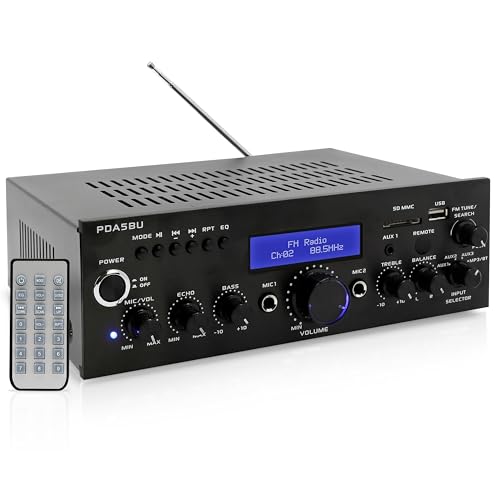
Inputs and outputs, what you actually get
The PDA5BU is a small 2-channel amp with convenience features, not a full-featured receiver.
| Feature |
Included |
What this means in practice |
| Bluetooth input |
Yes |
Stream audio from a phone or tablet to the amp |
| RCA input |
Yes |
Works with line-level sources, including some turntables |
| USB playback |
Yes |
Can play supported media files directly |
| SD card playback |
Yes |
Another direct media playback option |
| FM tuner |
Yes |
Built-in radio for casual listening |
| Speaker outputs |
Yes |
Connect passive bookshelf speakers with speaker wire terminals |
| Headphone support |
Limited or absent |
Don’t buy it expecting strong private listening features |
Turntable setup fit, when it works and when it doesn’t
This is the part people need spelled out plainly.
| Source device |
Works directly |
Needs phono preamp |
Recommended connection |
| Audio-Technica turntable with built-in preamp |
Yes |
No |
RCA line out to RCA input |
| Victrola turntable with line output |
Yes |
No |
RCA line out to RCA input |
| Fluance turntable without built-in preamp |
No |
Yes |
Turntable to phono preamp, then RCA to amp |
| Phone or tablet |
Yes |
No |
Bluetooth input |
| TV or streamer with analog out |
Usually |
No |
RCA output to RCA input |
A built-in-preamp turntable can usually plug straight in. A traditional deck without one can’t.
That means this amp only makes sense for vinyl if the turntable is already outputting line level. If not, read up on what a phono preamp is before you buy anything.
Pyle PDA5BU vs common beginner alternatives
Against a Sony STR-DH190, the Pyle loses on vinyl readiness, power, and upgrade room. The Sony takes up more space and costs more, but it’s a cleaner answer for many first systems.
Against a Fosi Audio BT20A, the Pyle wins on extra features like FM, USB, and SD. The Fosi usually makes more sense if you care more about a cleaner amp section than media extras.
Against powered bookshelf speakers, this Pyle only makes sense if you specifically want passive speakers. For a lot of beginners, powered speakers are the simpler path.
| Option |
Type |
Built-in phono preamp |
Best for |
Main tradeoff |
| Pyle PDA5BU |
Compact Bluetooth amp |
No |
Cheap passive-speaker setups with line-level sources |
Limited power and no direct support for phono-only turntables |
| Sony STR-DH190 |
Stereo receiver |
Yes |
First vinyl systems that need a simpler turntable path |
Bigger footprint and higher price |
| Fosi Audio BT20A |
Mini amp |
No |
Buyers who want a cleaner, simpler amp section |
Fewer extra features |
| Powered bookshelf speakers |
Self-powered speakers |
Sometimes, depending on model |
Beginners who want the fewest boxes |
Less flexibility if you want to swap amps later |