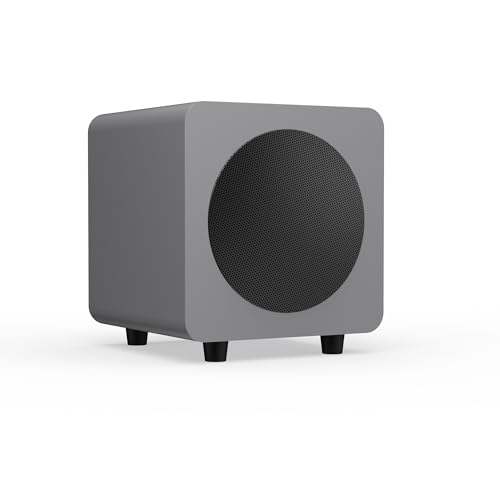
01Compact Size and Placement
The Kanto SUB6 shines in its compact design, making it a breeze to fit into tight spaces. I’ve tucked it beside my media stand and even under my desk without any hassle. This is a huge win for anyone dealing with cramped rooms; a bigger sub might offer more power, but if it takes up half the space in your living room, it’s just not practical.
Being able to place the SUB6 in those less-than-ideal corners means I didn’t have to rearrange my whole setup. I can still access my records and gear without tripping over a bulky subwoofer. That small footprint is more important than many audiophiles admit—it’s about finding that balance between sound quality and real-world usability.
02Sound Quality with Small Speakers
When paired with compact powered speakers like the Kanto YU4 or Audioengine A2+, the SUB6 really shows its strengths. It doesn’t just add bass; it allows those small speakers to breathe and perform without straining to hit lower frequencies. This makes for a more balanced sound, where vocals and highs can shine while the low end fills in nicely.
In my experience, the SUB6 does a fantastic job of rounding out the overall sound profile. Instead of muddying up the mix, it tightens everything up, letting the mids and highs shine through. It’s a perfect match for those looking to enhance their listening experience without overwhelming their compact setup.
03Limitations in Larger Spaces
While the SUB6 excels in small rooms, it does have its limits. If you’re in a medium to large space, you might find that the 6-inch driver doesn’t quite pack the punch you’re looking for. It can feel a bit too polite at times, especially if you’re used to the more impactful sound of larger subs.
For the casual listener or someone who enjoys a more nuanced bass experience, this might be fine. But if you’re after that chest-thumping bass for rock or electronic music, you may want to consider a bigger option. The SUB6 is great for filling in the gaps, but it won’t shake the walls in the same way a larger sub can.
04Setup and Compatibility
Setting up the SUB6 is straightforward, but it does require a compatible system. You need powered speakers with an RCA sub out; otherwise, you’re left with a nice-looking box that doesn’t do much. My experience was smooth, as I connected it through a phono preamp to my powered speakers, and it all clicked into place.
However, if you’re thinking about connecting a turntable directly to the SUB6, you’ll run into issues. The subwoofer needs to sit in the signal chain, and without a proper output path, you’re missing out on its full potential. It’s crucial to get that setup right before diving into subwoofer territory.
05Controls for Fine-Tuning
The SUB6 comes equipped with controls for crossover, phase, and gain, which are essential for blending it seamlessly with your main speakers. These adjustments let you tailor the sound to your specific room and system, avoiding that bloated bass that can happen if settings are off. I found that taking the time to tweak these controls really made a difference in how well the sub integrated with my speakers.
It’s easy to overlook these features when you’re excited about adding bass, but they’re what transform the SUB6 from just another subwoofer into a key part of your sound system. If you take the time to dial in the settings, you’ll find that it can provide a rich, engaging listening experience that enhances your vinyl collection beautifully.