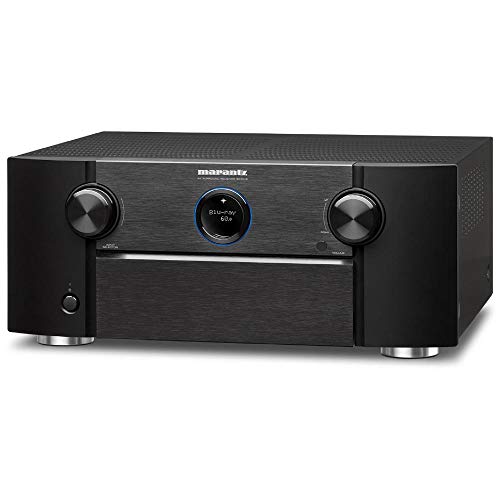
The SR7015 sounds like a Marantz should: smooth, weighty, and a little more refined than aggressive. I never got the sense that it was trying to impress me with sheer edge or brightness; instead, it leaned into a fuller, more relaxed presentation that made long listening sessions easy.
With movies, that pays off in a big way because dialogue stays clear without turning sharp, and effects have enough body to feel convincing. I also liked how it handled music playback through a decent set of speakers — it kept things organized and musical rather than turning everything into a clinical demo.
It’s not the kind of AVR that shouts for attention, and that’s exactly why I liked living with it. If your room or speakers already lean bright, this kind of voicing can be a real relief.
02Power and Real-World Drive
The SR7015 has enough muscle for a lot of normal living rooms, and it feels confident when the soundtrack gets busy. I didn’t hear it lose its composure easily, even when I pushed it with demanding scenes or higher listening levels.
What stood out to me was not just volume, but control. Bass stayed reasonably tight, the center channel didn’t get swallowed up, and the whole presentation held together better than a lot of receivers that sound impressive for five minutes and then start to feel strained.
That said, I’d still call this a receiver for sensible speaker matching, not a magic wand. If you’re trying to wake up very inefficient towers in a huge open space, I’d want to be realistic about what any AVR can do before assuming the spec sheet solves everything.
Marantz makes the SR7015 feel like a grown-up piece of gear rather than a science project. Once it’s in the rack, the layout makes sense, the menus are readable, and I never felt like I needed to fight the thing just to get basic operation sorted out.
The room correction and setup process are the kind of features I actually want in a receiver because they make the system better in a real room, not just on paper. I like gear that helps me get to listening faster, and this one does that without making me feel like I’m trapped in calibration purgatory.
Day to day, it behaves like a proper hub for a home theater system. Switching sources, adjusting levels, and moving between movie and music use feels straightforward enough that I stop thinking about the receiver and just use the system.
04Connectivity and Format Support
The SR7015 is built for people who want one box to handle a lot of different jobs. It gives you the kind of input and output flexibility that makes sense if your setup includes a TV, disc player, streamer, game console, and maybe a turntable chain feeding the system through a separate phono stage.
I appreciate when an AVR doesn’t make me choose between convenience and future-proofing, and this one lands in a pretty practical place. It’s the sort of receiver that can anchor a serious living room setup without immediately boxing you in.
For me, the bigger win is not just having the connections, but having a receiver that feels ready for modern use without becoming annoying. That matters more than a long feature checklist, because the best gear is the stuff you actually keep using without thinking about it.
05Build, Layout, and Ownership Feel
The SR7015 has the kind of physical presence I expect from a higher-tier AVR. It feels substantial, the front panel is clean, and it gives off the impression that it was designed to sit in a system for years rather than get replaced the second the next shiny model appears.
I also like that Marantz tends to keep the industrial design restrained. It doesn’t scream for attention in the room, which is a good thing when the real star of the show should be the speakers and the content, not the box doing the switching.
In daily use, that calm, no-nonsense feel matters more than people admit. If you’re the type who wants your receiver to disappear into the background and just do its job reliably, this one fits that mindset well.
I’d point the SR7015 toward someone building a serious home theater who also cares about how music sounds when the movie is over. It has enough refinement to make vinyl playback through a system feel respectable, while still doing the heavy lifting needed for surround sound and TV duty.
This is a good fit if you want an AVR that leans a little more musical and less sterile than some of the competition. I think that makes it especially appealing for listeners who split their time between films, records, and general everyday listening.
If you want a receiver that feels easy to live with, flexible enough to grow with, and polished enough not to annoy you after the honeymoon phase, the SR7015 makes a strong case for itself. It’s not flashy in the cheap-thrill sense — it’s the kind of gear that earns its place by making the whole system better.