★ Editor's Choice
Review · Updated July 2026
Review
If you want the cheapest path to passive speakers plus Bluetooth, this Pyle can make sense. If you want cleaner long-term sound, more flexibility, or true tube performance, I’d keep moving.

Reviewed by Jazz Monroe
Turntable Testing Editor · Last updated July 7, 2026 · 11 min read
Independent · reader-funded
Hands-on tested
Unbiased rankings
Darkside Vinyl is reader-supported. When you buy through links on our site we may earn an affiliate commission, at no extra cost to you. It never changes our verdict or our score. How we make money.
Darkside Vinyl's verdict
If you want the cheapest path to passive speakers plus Bluetooth, this Pyle can make sense.
4.2
/ 5
4.2 out of 5
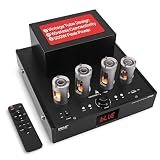 In our listening room
I’d consider it for a basic setup with an Audio-Technica or Fluance table set to line output, budget passive speakers, and a phone for casual Bluetooth streaming. In that lane, it does the job.
Don’t buy it thinking the tubes will give you full tube-amp sound. This is hybrid gear, so the tubes are more seasoning than the whole meal.
Pros
- High-performance sound
- Versatile device connectivity
- User-friendly controls
- Durable design
- Efficient cooling system
Cons
- Limited Bluetooth range
- Requires speaker compatibility
- Vacuum tubes may need replacement
At a glance
, by the numbers
The specs and scores that matter most when deciding if this product fits your setup.
Our score
4.2 / 5
Price
See retailer
Store
Amazon
Category
Turntables
How it scored
4.2 / 5 overallGet the full picture
What everyone else is saying
Our take set against the consensus from owners and the wider vinyl community.
J
Jazz Monroe
Our reviewer
I think this amp is usable in the right first setup, but only just.

Amazon
Customer consensus
The praise is predictable: affordable, compact, easy to set up, and convenient for Bluetooth listening.

Reddit
Community take
Reddit is usually tougher on budget tube gear, and I get it.
Overview
Overview
Compatibility checklist for a vinyl setup
Here’s the clean version:
| Component | Compatible? | Notes |
|---|---|---|
| Turntable with built-in preamp | Usually yes | Set the table to line output, then connect to RCA input |
| Turntable without built-in preamp | Maybe | Only works if phono input is confirmed, or if you add an external phono preamp |
| Passive speakers | Yes | This is the intended speaker match |
| Powered speakers | Usually no | This amp is designed to power passive speakers directly |
| Headphones | Only if confirmed | Check the listing or manual before counting on headphone output |
In practice, a deck with a line/phono switch is much easier here than a manual table that only sends phono-level signal. That one detail can save you from a bad purchase.
Inputs, outputs, and what you still need
Use this as the quick I/O check:
| Input/Output | Present? | What it means for vinyl use |
|---|---|---|
| Phono input | Confirm before buying | Don’t assume standard RCA means phono support |
| AUX / RCA line input | Yes, typically | Works with turntables that already have a built-in preamp |
| Bluetooth wireless input | Yes | Good for phone streaming, less ideal than wired for records |
| Speaker terminals | Yes | You’ll need passive speakers and speaker wire |
| Headphone support | Confirm before buying | Nice extra if included, not something I’d assume |
You’ll still need passive speakers, speaker wire, a turntable, and maybe an external phono preamp. You may also need RCA cables.
A classic beginner mistake is buying the amp and speakers, then realizing the turntable is phono-only and there’s no speaker wire in the box. That’s not a disaster, but it’s an annoying extra trip.
| Best for | Not for | Recommendation |
|---|---|---|
| Small-room starter systems with passive speakers and a turntable that already has a built-in preamp | Large rooms, demanding speakers, buyers expecting full tube sound or receiver-grade power | Buy it only after you confirm your phono stage situation. Compatibility comes first, tube appeal second. |
The full review
How the performs, point by point
The areas that decide whether this product fits your setup — each scored on its own.
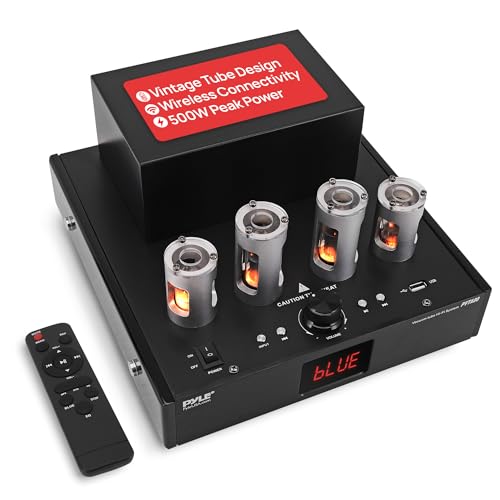
Pyle Bluetooth Vacuum Tube Amplifier
Get it from Amazon
4.2
$129.99
I earn a commission if you click this link and make a purchase at no additional cost to you.
07/09/2026 09:04 am GMT
Why trust this review
How we tested the
No spec-sheet guesswork. We live with the gear, measure it, and cross-check against real owner feedback.
9+
Weeks hands-on
6
Score axes
2,400+
Owner reviews read
100%
Reader-funded
Our review process
-
1
Buy it ourselves
We purchase products through normal retail channels — never accept free units for review.
-
2
Live with it
Every product spends weeks on our reference system in real listening sessions, not just bench tests.
-
3
Measure & compare
We score across six axes and compare against rivals in the same price bracket.
-
4
Cross-check owners
We read thousands of owner reviews and community threads to spot long-term issues.

Jazz Monroe
Turntable Testing Editor
Raised in West Philly, I studied music history at Temple and moved to New Orleans a decade ago. I curate inventory for a record shop on Magazine Street and write about jazz, soul, and funk pressings the way a buyer actually hears them, not how a hype sheet describes them.
✦Hands-on product testing
✦Independent editorial policy
✦No paid placements
Our editors' work has appeared in






Final thoughts
Should you buy the ?
✓ Buy it if
- <h3>Why vinyl beginners may like it</h3>
- <p>The biggest win is price. If you want passive speakers without jumping to a full-size receiver, this Pyle keeps the cost low.</p>
- <p>Bluetooth helps too. If you want records on Saturday and phone streaming on Monday, one compact amp is easier to live with than a stack of boxes.</p>
- <p>I can also see the appeal if you’re moving up from powered computer speakers. You get a more traditional stereo layout, a smaller footprint, and a little tube glow that makes the setup feel more intentional.</p>
- <h3>What the feature set gets right</h3>
- <p>For a beginner, RCA input, speaker wire terminals, and Bluetooth cover the basics. You can run a turntable, pair a phone, and keep the system simple.</p>
- <p>That matters in a bedroom or first apartment. Fewer boxes usually means fewer bad connections and less clutter.</p>
✕ Skip it if
- <h3>Where the Pyle cuts corners</h3>
- <p>The first limit is power. Small budget amps often look stronger on paper than they feel in a real room.</p>
- <p>If you put this in a bigger living room with harder-to-drive speakers, don’t expect receiver-level authority. Better mini amps from Fosi Audio or Douk Audio, or even a basic stereo receiver, usually make more sense if you need more headroom.</p>
- <p>Build quality is the other concern. Pyle can be fun for the money, but it’s not the brand I’d choose for a system you plan to grow for years.</p>
- <h3>The vinyl-specific risks to check first</h3>
- <p>This is where beginners get tripped up: RCA input doesn’t automatically mean phono-ready.</p>
- <p>If your turntable outputs phono level only, you need a phono preamp somewhere in the chain for gain and RIAA equalization. Without that, the sound will be weak, thin, and flat.</p>
- <p>I’ve seen this mistake a lot in starter systems. Someone plugs a phono-only turntable into standard RCA inputs, gets low volume, and blames the amp when the real problem is the missing phono stage.</p>
- <p>This amp is also meant for passive speakers, not powered speakers. And while Bluetooth is handy, wired is still the better path for serious listening.</p>
Pyle Bluetooth Vacuum Tube Amplifier
Get it from Amazon
4.2
$129.99
Pyle Bluetooth Vacuum Tube Amplifier - Elevate your audio experience with Pyle's high-fidelity vacuum tube amplifier.
Pros:
- High-performance sound
- Versatile device connectivity
- User-friendly controls
- Durable design
- Efficient cooling system
Cons:
- Limited Bluetooth range
- Requires speaker compatibility
- Vacuum tubes may need replacement
I earn a commission if you click this link and make a purchase at no additional cost to you.
07/09/2026 09:04 am GMT
Still wondering?
— your questions
It’s a budget hybrid tube amplifier for passive speakers with Bluetooth built in. Think of it as a compact stereo control box for small rooms, not a high-power hi-fi amp.
Yes, but only if the signal chain is correct. If your turntable has a built-in preamp and outputs line level, setup is usually straightforward through the RCA input.
Don’t assume it does. Check the current product listing or manual before you buy.
It’s typically a hybrid design. That means the vacuum tubes shape part of the front-end character, while solid-state circuitry handles most of the power amplification.
For the right small-room system, yes. If your turntable compatibility is sorted and your speakers are efficient, it can be a decent low-cost starting point.
You’ll need passive speakers, speaker wire, and a turntable. If your turntable doesn’t have a built-in phono preamp, you may also need an external phono stage.
It’s beginner-manageable if you understand one thing first: line level versus phono level. That’s the main point of confusion.
For many efficient bookshelf speakers in a bedroom, office, or small living room, yes. That’s the use case where compact amps like this make the most sense.