★ Editor's Choice
Review · Updated July 2026
Review
My short take: the Pyle PDA9HBU is a workable cheap amp for vinyl beginners, but only if your turntable already has a built-in preamp or line output.

Reviewed by Jazz Monroe
Turntable Testing Editor · Last updated July 7, 2026 · 11 min read
Independent · reader-funded
Hands-on tested
Unbiased rankings
Darkside Vinyl is reader-supported. When you buy through links on our site we may earn an affiliate commission, at no extra cost to you. It never changes our verdict or our score. How we make money.
Darkside Vinyl's verdict
My short take: the Pyle PDA9HBU is a workable cheap amp for vinyl beginners, but only if your turntable already has a bu
4.2
/ 5
4.2 out of 5
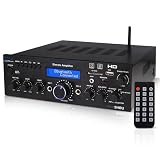 In our listening room
It makes the most sense for buyers who want an inexpensive way to power passive bookshelf speakers and stream Bluetooth from a phone.
I wouldn't buy it for a traditional turntable that lacks a phono stage. This amp doesn't fix that problem.
Pros
- 200 watts power output
- Multiple input options
- Bluetooth connectivity
- Digital LCD display
- Remote control included
Cons
- Limited to 200 watts
- Some users may find setup complex
- May require additional speakers for optimal sound
At a glance
, by the numbers
The specs and scores that matter most when deciding if this product fits your setup.
Our score
4.2 / 5
Price
See retailer
Store
Amazon
Category
Turntables
How it scored
4.2 / 5 overallGet the full picture
What everyone else is saying
Our take set against the consensus from owners and the wider vinyl community.
J
Jazz Monroe
Our reviewer
I don't hate what Pyle is trying to do here.

Amazon
Customer consensus
Amazon feedback usually praises the same things: affordability, feature count, and easy Bluetooth use.

Reddit
Community take
Reddit is usually tougher on Pyle.
Overview
Overview
If you're still considering it, use this section like a pre-purchase checklist. That's the easiest way to avoid buying one box and then realizing you're still missing two more.
Inputs, outputs, and turntable fit
| Feature | Included? | What it means in practice |
|---|---|---|
| Bluetooth | Yes | Good for phone streaming, not a replacement for turntable signal needs |
| RCA input | Yes | Works with line-level sources |
| Dedicated phono input | No | Many turntables need an external phono preamp |
| USB playback | Yes | Convenience feature, not vinyl-specific |
| FM radio | Yes | Secondary listening source |
| Speaker outputs | Yes | Designed to power passive speakers |
| Headphone use | Unclear or limited by listing | Check current specs before buying if this matters |
| Powered speaker fit | Not ideal | Powered speakers already have amplification |
In practice, a turntable with a built-in preamp can plug into RCA and play.
A traditional deck without one needs a phono stage between the turntable and the amp. That's the setup trap.
What you need besides the amp
You'll still need a few basics:
- A turntable
- Passive speakers
- Speaker wire
- An external phono preamp, if your turntable doesn't have one built in
I've seen this exact stall-out before: someone orders the amp and speakers, forgets speaker wire or the phono stage, and then can't play a record when the boxes arrive.
If you're using powered speakers, this amp is usually unnecessary. In that case, a built-in-preamp turntable into powered bookshelf speakers is often the simpler route.
For setup help, see this turntable setup guide.
Pyle PDA9HBU vs Sony STR-DH190 and Yamaha R-S202
| Model | Best For | Main Advantage | Main Tradeoff |
|---|---|---|---|
| Pyle PDA9HBU | Lowest-cost mixed-use setup | Cheap, lots of features, Bluetooth | No phono input |
| Sony STR-DH190 | Vinyl beginners | Easier direct turntable hookup | Costs more |
| Yamaha R-S202 | Longer-term stereo use | Better brand confidence, cleaner ownership path | Less bargain-priced |
Quick role matrix
| Need | Best Fit |
|---|---|
| Cheapest path to passive speakers + Bluetooth | Pyle PDA9HBU |
| Simplest direct turntable hookup | Sony STR-DH190 |
| Better long-term stereo upgrade path | Yamaha R-S202 |
| Powered speaker setup | Skip the amp entirely |
Choose the Pyle if price and Bluetooth matter most.
Choose Sony if vinyl simplicity matters most.
Choose Yamaha if you want to step above bargain-tier gear.
If you haven't bought your turntable yet, Sony is usually the safer move. If you already own a line-level deck and just need cheap speaker power, the Pyle still belongs in the conversation.
If you're still sorting out speaker matching, it helps to understand the difference between powered vs passive speakers.
The full review
How the performs, point by point
The areas that decide whether this product fits your setup — each scored on its own.
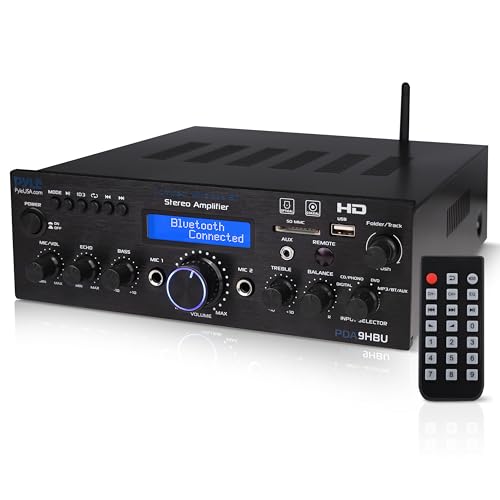
Pyle PDA9HBU Wireless Bluetooth Amplifier
Get it from Amazon
4.2
$105.92
I earn a commission if you click this link and make a purchase at no additional cost to you.
07/08/2026 08:06 pm GMT
Why trust this review
How we tested the
No spec-sheet guesswork. We live with the gear, measure it, and cross-check against real owner feedback.
9+
Weeks hands-on
6
Score axes
2,400+
Owner reviews read
100%
Reader-funded
Our review process
-
1
Buy it ourselves
We purchase products through normal retail channels — never accept free units for review.
-
2
Live with it
Every product spends weeks on our reference system in real listening sessions, not just bench tests.
-
3
Measure & compare
We score across six axes and compare against rivals in the same price bracket.
-
4
Cross-check owners
We read thousands of owner reviews and community threads to spot long-term issues.

Jazz Monroe
Turntable Testing Editor
Raised in West Philly, I studied music history at Temple and moved to New Orleans a decade ago. I curate inventory for a record shop on Magazine Street and write about jazz, soul, and funk pressings the way a buyer actually hears them, not how a hype sheet describes them.
✦Hands-on product testing
✦Independent editorial policy
✦No paid placements
Our editors' work has appeared in






Final thoughts
Should you buy the ?
I'd only buy the Pyle PDA9HBU if your system is already simple. That means a turntable with a built-in preamp, passive speakers, and modest expectations.
For a bedroom or apartment setup, that can be enough. For a more traditional vinyl path, spending a little more on a phono-ready receiver usually saves hassle.
✓ Buy it if
- <p>The appeal is simple: low price, lots of inputs, and enough convenience to make a first passive-speaker setup feel less intimidating.</p>
- <p>In a dorm, office, or bedroom, it can run your speakers for records, then switch over to Bluetooth for casual streaming.</p>
- <h3>Why the low price is appealing</h3>
- <p>A first setup gets expensive fast once you add speakers, wire, and maybe a stand or cleaning gear.</p>
- <p>That's where the Pyle earns a spot on the shortlist. It costs less up front than something like the Sony STR-DH190, and for casual listening that matters.</p>
- <p>If you're building around a budget turntable from Audio-Technica or Victrola, this kind of amp can make the math easier.</p>
- <h3>Why Bluetooth and extra inputs help</h3>
- <p>Bluetooth is useful here, just not for the reason some buyers think. It's for phone streaming, podcasts, or background music when the turntable isn't spinning.</p>
- <p>The extra inputs also help in a mixed-use room. USB playback, FM radio, and standard RCA input give it more flexibility than many tiny amps that only cover the basics.</p>
- <p>In a small apartment, that matters. You can spin records on weekends and stream from your phone during the week without changing the whole setup.</p>
✕ Skip it if
- <p>The biggest problem is simple: there's no dedicated phono input.</p>
- <p>That one missing piece changes the whole value story for vinyl buyers.</p>
- <h3>The phono preamp issue</h3>
- <p>A phono signal is weaker than standard line-level audio. It also needs RIAA equalization.</p>
- <p>If your turntable has a built-in preamp, like many entry-level Audio-Technica and Victrola models, you can usually run RCA straight into this amp.</p>
- <p>If it doesn't, the Pyle isn't enough by itself.</p>
- <p>This is the mistake I see all the time: someone spots RCA inputs and assumes the amp is turntable-ready. Then they hook up a traditional deck and wonder why the sound is weak or off.</p>
- <p>Line input and phono input aren't the same thing. If you need a refresher, start with what a phono preamp does.</p>
- <h3>Why vinyl-first buyers may outgrow it</h3>
- <p>If records are your main source, you may outgrow this faster than you expect.</p>
- <p>A common pattern goes like this: you start with cheap speakers and everything feels fine. Six months later you upgrade the speakers, and now the amp feels like the weak link.</p>
- <p>That's where Sony and Yamaha start to make more sense. The Sony STR-DH190 is simpler for turntables, and the Yamaha R-S202 feels like a cleaner long-term stereo move.</p>
Pyle PDA9HBU Wireless Bluetooth Amplifier
Get it from Amazon
4.2
$105.92
Pyle PDA9HBU Wireless Bluetooth Amplifier - Powerful stereo amplifier for karaoke and home theater enthusiasts.
Pros:
- 200 watts power output
- Multiple input options
- Bluetooth connectivity
- Digital LCD display
- Remote control included
Cons:
- Limited to 200 watts
- Some users may find setup complex
- May require additional speakers for optimal sound
I earn a commission if you click this link and make a purchase at no additional cost to you.
07/08/2026 08:06 pm GMT
Still wondering?
— your questions
It's a budget stereo amplifier that powers passive speakers and adds Bluetooth, RCA, USB, and FM playback.
Yes, but not with every turntable the same way.
No, it doesn't have a dedicated phono input or built-in phono stage.
Yes, for basic small-room listening it can do the job.
It can be, but only for the right first setup.
Only if your turntable doesn't already have one built in.
It's fairly easy if your gear matches.
The Sony STR-DH190 is the best alternative for direct turntable compatibility because it includes a phono input.