★ Editor's Choice
Review · Updated July 2026
Review
I’d buy the Rockville Rock Matrix 4 for a small business before I’d buy it for a record setup at home.

Reviewed by Marcus Webb
Speakers & Receivers Editor · Last updated July 7, 2026 · 11 min read
Independent · reader-funded
Hands-on tested
Unbiased rankings
Darkside Vinyl is reader-supported. When you buy through links on our site we may earn an affiliate commission, at no extra cost to you. It never changes our verdict or our score. How we make money.
Darkside Vinyl's verdict
I’d buy the Rockville Rock Matrix 4 for a small business before I’d buy it for a record setup at home.
4.5
/ 5
4.5 out of 5
 In our listening room
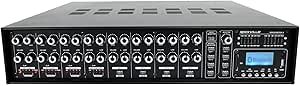
It’s a practical fit for bars, cafes, restaurants, offices, and multi-room background music where zone control matters. It’s usually the wrong buy for a single-room vinyl system, where a stereo receiver or integrated amp will be simpler and sound more natural.
A cafe owner gets real value here. One source can feed the dining room, patio, counter area, and hallway, each with its own volume trim.
Pros
- Powerful 440W output
- Flexible zone routing
- Emergency-ready features
- Bluetooth 5.0 connectivity
- Reliable performance
Cons
- Higher price point
- May require professional installation
- Limited to specific speaker configurations
At a glance
, by the numbers
The specs and scores that matter most when deciding if this product fits your setup.
Our score
4.5 / 5
Price
See retailer
Store
Amazon
Category
Turntables
How it scored
4.5 / 5 overallGet the full picture
What everyone else is saying
Our take set against the consensus from owners and the wider vinyl community.
M
Marcus Webb
Our reviewer
I think the Rock Matrix 4 makes sense when the goal is coverage, routing, and multiple zones.

Amazon
Customer consensus
Amazon reviews for products like this usually praise value, zone control, and install convenience.

Reddit
Community take
Reddit threads around commercial amps get practical fast.
Overview
Overview
The Rockville Rock Matrix 4 is best understood as a multi-room audio amp for coverage, not as a traditional home stereo centerpiece.
If the wiring examples below feel more like an install job than a weekend setup, that’s your clue this may not be the right amp for home vinyl.
Specs that matter, and what they mean
| Feature | What it means | Who benefits | Who does not |
|---|---|---|---|
| 4 zones | Separate speaker areas with independent control | Cafes, bars, offices | One-room listeners |
| 70V output | Supports distributed speaker runs | Commercial installs | Simple home stereo buyers |
| RCA line input | Accepts line-level sources | Streamers, media players, turntables with preamp | Raw turntables without phono stage |
| Bluetooth, USB, SD | Easy background music playback | Staff-managed business audio | Buyers chasing best vinyl fidelity |
| Rack-mount chassis | Better for installed systems | Small venue and back-office racks | Casual living room setups |
Compatibility with turntables and speakers
| Setup item | Compatible? | Extra gear needed | Notes |
|---|---|---|---|
| Turntable with built-in preamp | Yes | RCA cables | Best-case vinyl connection |
| Turntable without built-in preamp | Yes | External phono preamp | Required before line input |
| Passive 8-ohm speakers | Sometimes | Correct wiring plan | Check load and output support |
| 70V speakers | Yes | Proper distributed layout | Natural use case for this amp |
| Powered speakers | Usually no | Different system approach | Wrong tool for most active speaker setups |
What this means in practice
Zone count is a routing feature, not a sound-quality upgrade. A 4-zone audio amplifier helps you cover more areas cleanly, but it doesn’t automatically beat a good home stereo amp for records.
70V support only matters if you actually need distributed audio. Beginners often overbuy commercial gear because the feature list looks bigger than a standard receiver.
There’s also a power myth worth clearing up. Commercial amps aren’t automatically better because they look more industrial. They’re built for reliability and coverage, not always for stereo finesse.
Two real-world wiring examples
A bar or cafe setup is straightforward in concept: source player into RCA input, amp in a rack, speaker lines out to the dining area, counter, patio, and restroom zone, with an optional paging microphone at the host stand. That’s exactly the kind of job this unit is built for.
A home vinyl setup would look like this: turntable into a built-in phono stage or external phono preamp, then into the amp’s line input, then out to passive speakers. It can work, but if you’re using something like a Fluance or Audio-Technica deck with two bookshelf speakers, a stereo receiver is still the cleaner answer.
Who should buy it
- Small businesses running a 70V audio system or multi-zone background music
- Buyers who need a 4-zone amplifier with flexible source options
- Install-minded users who already know their speaker format and wiring plan
Who shouldn’t
- Most home vinyl listeners with one room and one pair of speakers
- Beginners who want a plug-and-play turntable setup
- Anyone using powered speakers as the main output system
If you’re checking price before sorting out compatibility, see the current listing first, then come back to the wiring notes.
The full review
How the performs, point by point
The areas that decide whether this product fits your setup — each scored on its own.

Rockville Rock Matrix 4 Commercial Amplifier
Get it from Amazon
4.5
$369.95
I earn a commission if you click this link and make a purchase at no additional cost to you.
07/08/2026 08:07 pm GMT
Why trust this review
How we tested the
No spec-sheet guesswork. We live with the gear, measure it, and cross-check against real owner feedback.
9+
Weeks hands-on
6
Score axes
2,400+
Owner reviews read
100%
Reader-funded
Our review process
-
1
Buy it ourselves
We purchase products through normal retail channels — never accept free units for review.
-
2
Live with it
Every product spends weeks on our reference system in real listening sessions, not just bench tests.
-
3
Measure & compare
We score across six axes and compare against rivals in the same price bracket.
-
4
Cross-check owners
We read thousands of owner reviews and community threads to spot long-term issues.

Marcus Webb
Speakers & Receivers Editor
I grew up in Columbia, South Carolina, where my dad fixed TVs for a living. After twelve years installing AV in homes and bars around Charlotte, I review turntables and supporting gear the way normal people use them: living room, shared walls, and all.
✦Hands-on product testing
✦Independent editorial policy
✦No paid placements
Our editors' work has appeared in






Final thoughts
Should you buy the ?
My recommendation is narrow on purpose: buy this Rockville unit for a small business, office, restaurant, bar, or multi-room background music system.
Skip it for most living room vinyl setups. If your goal is better stereo sound, easier setup, and cleaner turntable compatibility, put the money toward a stereo receiver, an integrated amp with phono input, or powered speakers with the right front-end gear.
If you’re opening a small cafe and need music in four areas, this makes practical sense. If you’re trying to get the most out of a turntable in one room, buy for the speaker system and listening goal, not the longest feature list.
✓ Buy it if
- <p>The biggest strength is zone control. That’s the whole point of a matrix-style commercial amp.</p>
- <p>It also gives you flexible source options: RCA input, Bluetooth, USB playback, and SD card playback. For a restaurant or bar, that means staff can swap sources without rebuilding the rack.</p>
- <p>It supports the kind of speaker planning commercial installs need, including 70V distribution and some standard 8-ohm use cases. That matters when you’re running long cable paths or covering multiple areas.</p>
- <p>The rack-mount chassis also makes sense in a back office, equipment shelf, or small venue rack. A home receiver fits a media console better, but it isn’t built for the same job.</p>
✕ Skip it if
- <p>This isn’t a hi-fi stereo amp first. It’s a commercial routing tool first, and that changes what you should expect.</p>
- <p>If you’re connecting a turntable, you’ll usually need a phono preamp unless the deck already has one built in. If you’re not clear on that part, start with our turntable setup guide and phono preamp explainer.</p>
- <p>It’s also more complicated than a stereo receiver for beginners. You’re dealing with zone logic, speaker format decisions, and install planning that many home users simply don’t need.</p>
- <p>I see the same mismatch all the time: someone spots Bluetooth and four zones, buys it for a living room, then realizes they still need the right turntable output, passive speakers, and a cleaner signal path. They spend more and end up with a clunkier system.</p>
- <p>It may also be the wrong category entirely for powered speakers. If your speakers already have amplification built in, this kind of commercial amp usually isn’t the right center of the system.</p>
Rockville Rock Matrix 4 Commercial Amplifier
Get it from Amazon
4.5
$369.95
Rockville Rock Matrix 4 Commercial Amplifier - Ideal for businesses, this amplifier delivers powerful multi-zone audio with flexible connectivity options.
Pros:
- Powerful 440W output
- Flexible zone routing
- Emergency-ready features
- Bluetooth 5.0 connectivity
- Reliable performance
Cons:
- Higher price point
- May require professional installation
- Limited to specific speaker configurations
I earn a commission if you click this link and make a purchase at no additional cost to you.
07/08/2026 08:07 pm GMT
Still wondering?
— your questions
It’s designed for multi-zone commercial background music and distributed audio. Think bars, restaurants, offices, retail spaces, and other installs where you need one amp to feed several speaker areas.
It can work with some 8-ohm speakers, and it’s naturally suited to 70V speaker systems. The catch is that compatibility doesn’t automatically mean it’s the best choice for your setup.
It can work for vinyl, but I wouldn’t call it the natural first choice. A turntable without a built-in preamp needs an external phono preamp before it can feed the amp’s RCA line input.
A 70V commercial amplifier is built for distributed audio: longer cable runs, more speakers, and area coverage across multiple zones. That’s why you see them in cafes, offices, and stores.
Yes, if you actually need multiple zones, distributed audio, and install flexibility. In that role, it solves a real problem and can be a better fit than stacking consumer gear.
If your turntable has a built-in phono preamp, you may only need RCA cables and the right passive speaker setup. If it doesn’t, you’ll need an external phono preamp first.
I’d call it moderate difficulty, and that’s being generous if you’ve never planned zones before. You need to think through speaker type, cable runs, ventilation, and how each area will be wired.
For most home listening, especially vinyl, buy the stereo receiver. It’s simpler, more turntable-friendly, and better aligned with two-channel playback.