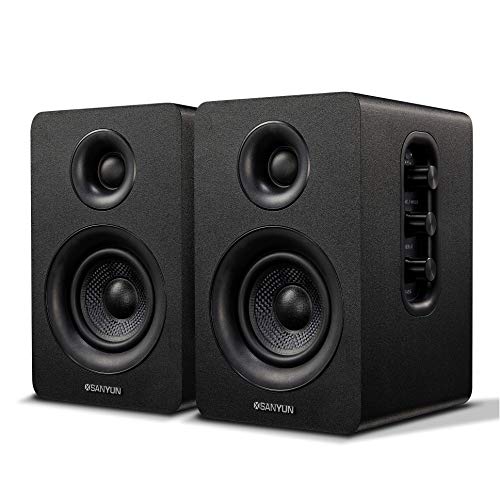
Specs and features that matter for vinyl beginners
Here's the plain-English version: the SW208 is a compact active speaker set with Bluetooth, RCA input, and 3.5mm AUX input. That means you don't need a receiver, but your turntable signal still has to be the right type.
The carbon fiber speaker unit and silk dome tweeter matter less as buzzwords than as behavior. In practice, you're getting decent clarity and a clean enough top end for close-range listening, not huge low-end authority.
An Audio-Technica AT-LP60X can usually connect straight in because it has a built-in phono preamp. A turntable without one needs an external phono stage first, and that extra box changes the value equation.
| Source |
Compatible? |
Notes |
| Turntable with built-in preamp |
Yes |
Connect by RCA |
| Turntable without built-in preamp |
Yes, with extra gear |
Needs external phono preamp |
| Phone |
Yes |
Bluetooth works well |
| Laptop |
Yes |
Bluetooth or 3.5mm AUX |
| TV |
Sometimes |
Depends on TV output options |
If you're comparing options, here's the short version.
| Speaker |
Best for |
Main strength |
Main drawback |
| Sanyun SW208 |
Small desks and nearfield vinyl |
Compact size and simple connectivity |
Limited bass and room scale |
| Edifier R1280T |
Bigger small-room listening |
Fuller sound and better room presence |
Larger footprint |
| Edifier R1280DB |
Multi-source setups |
More connectivity and fuller presentation |
Takes more space |
| PreSonus Eris 3.5 |
Desktop monitoring |
More monitor-like tuning |
Less relaxed for casual listening |
| Mackie CR3-X |
Compact desk audio |
Nearfield focus |
Not ideal for room-filling sound |
The SW208 beats the Edifier R1280T on compact size, loses on bass and room presence, and lands closer to the PreSonus Eris 3.5 for desktop use, though the Eris line feels more monitor-like in tuning.
Wattage alone will not tell you much here. Size, listening distance, inputs, and turntable compatibility matter more.