01Sound Quality and Midrange Honesty
The first thing I noticed with the HS5 W is how unapologetically honest it sounds. Vocals, guitars, snare hits, and piano all come through with a kind of plainspoken clarity that makes it easy to hear what’s actually on the recording, not what I wish was there.
That honesty is the whole point, and it’s also where the monitor can feel a little ruthless. If a mix is thin, harsh, or overly bright, the HS5 W doesn’t smooth it over for you, which is great for editing and mixing but not always the most flattering for casual listening.
In a real room, I found it especially useful for catching midrange problems fast. It’s the kind of speaker that tells you immediately whether a vocal is sitting right or if a guitar layer is fighting everything else.
02Bass Response and Low-End Reality
The low end is tight and controlled, but it’s not trying to pretend it’s a bigger speaker than it is. I wouldn’t buy the HS5 W expecting room-filling bass or that chesty thump you get from larger monitors or a subwoofer setup.
What it does give me is enough bass detail to judge kick and bass balance without the low end turning into a blob. For nearfield work, that restraint is actually helpful because it keeps the mix decisions honest instead of flattering.
If you listen to a lot of bass-heavy music, you’ll probably want to pair these with a sub or step up to something larger. On their own, they’re best when I care more about accuracy than sheer weight.
03Build, Finish, and Everyday Desk Use
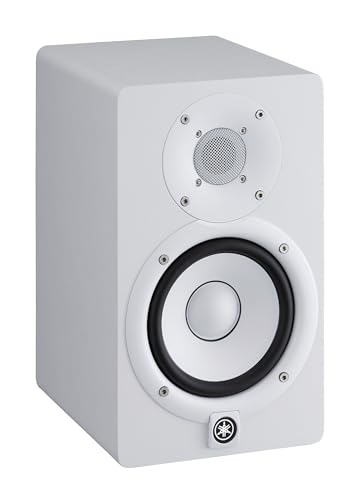
The HS5 W has that familiar Yamaha studio-monitor look: simple, squared-off, and built to disappear into the room. I like that it doesn’t try to be cute or flashy, because in a working setup I’d rather have something solid and straightforward.
The white finish gives it a cleaner, less industrial feel than the darker versions, which can be nice if the speakers live in a home studio or on a desk in a more visible space. It still looks like a tool, though, not a lifestyle product.
In day-to-day use, the cabinet feels sturdy and practical. I never got the sense that these were made for show; they feel like they were made to sit down, get used, and stay out of the way.
04Setup, Placement, and Room Fit
The HS5 W is easy enough to get going, but placement matters a lot more than with some more forgiving speakers. I found that small changes in angle and distance made a real difference, which is exactly what I expect from a monitor that’s meant to tell the truth.
These work best when I keep them in a proper nearfield setup and give them some breathing room. If you shove them too close to a wall or use them in a bad room, they’ll let you know pretty quickly.
For a desk setup, they make sense if I’m willing to treat the placement seriously. If I just want to plug in and enjoy music anywhere in the room, I’d look elsewhere.
05Who It’s For and What It’s Good At
I think the HS5 W makes the most sense for people who need a reliable reference more than a flattering sound. That includes home producers, engineers, and vinyl listeners who want to hear what’s actually happening in a recording without a bunch of extra warmth or gloss.
It’s also a strong fit for smaller studios where space is limited and precision matters more than big-room impact. I’d rather use these in a modest setup that’s well arranged than in a fancy room where the speakers are fighting the acoustics.
If your priority is relaxed listening, huge bass, or a speaker that makes every record sound rich and forgiving, this probably won’t be your favorite. But if I want a compact monitor that keeps me honest, the HS5 W does exactly that.