★ Editor's Choice
Review · Updated July 2026
Review
Amazon Basics USB-Powered Speakers are entry-level USB-powered desktop speakers made for nearfield computer audio. They can work with some turntables, but only when the turntable outputs line-level audio through a built-in or external phono preamp.

Reviewed by Sofia Ruiz
Contributing Vinyl Editor · Last updated July 7, 2026 · 11 min read
Independent · reader-funded
Hands-on tested
Unbiased rankings
Darkside Vinyl is reader-supported. When you buy through links on our site we may earn an affiliate commission, at no extra cost to you. It never changes our verdict or our score. How we make money.
Darkside Vinyl's verdict
Amazon Basics USB-Powered Speakers are entry-level USB-powered desktop speakers made for nearfield computer audio.
4.2
/ 5
4.2 out of 5
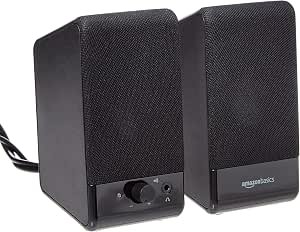 In our listening room
I'd buy these only for ultra-budget desk audio, or as a temporary turntable fix if your deck already has a built-in preamp.
I'd skip them if vinyl is your main source, if you want room-filling sound, or if you're already planning your next upgrade.
Pros
- USB-powered for easy setup
- Simple volume control
- Lightweight and portable
- Plug-and-play convenience
Cons
- Limited bass response
- 2.2 watts total power may not suffice for larger rooms
At a glance
, by the numbers
The specs and scores that matter most when deciding if this product fits your setup.
Our score
4.2 / 5
Price
See retailer
Store
Amazon
Category
Turntables
How it scored
4.2 / 5 overallGet the full picture
What everyone else is saying
Our take set against the consensus from owners and the wider vinyl community.
S
Sofia Ruiz
Our reviewer
I think these are decent budget desktop speakers and weak dedicated vinyl speakers.

Amazon
Customer consensus
The praise is predictable: cheap, compact, easy to use, and better than laptop speakers.

Reddit
Community take
Forum users are usually more blunt.
Overview
Overview
Core specs and what they mean in practice
The layout is simple: USB power, 3.5 mm audio input, compact desktop cabinets, built-in amplification, and volume control. In practice, that means convenience comes first.
If your source is a laptop on a desk, the design makes sense. If your source is a turntable across the room, it starts to feel like a workaround.
These are much closer to USB-powered computer speakers than even a small pair of powered bookshelf speakers. Cabinet size, amplifier headroom, and input options all point that way.
What you need to connect to a turntable
You need two things sorted first. The turntable must have a built-in phono preamp, or you need an external phono preamp in the chain.
You'll also usually need an RCA to 3.5 mm adapter or cable.
Here's the quick compatibility version:
- Audio-Technica LP60X: Yes, usually easy with RCA to 3.5 mm.
- Victrola suitcase models: Usually unnecessary, since many already have built-in speakers, but possible from line output on supported models.
- Crosley with built-in preamp: Usually yes, with the right cable.
- Turntable without preamp: No, not directly.
Mini comparison, computer use vs turntable use vs background listening
| Use case | Verdict | Main compromise | Better alternative |
|---|---|---|---|
| Computer desk listening | Good fit | Limited bass and scale | Creative Pebble |
| Turntable with built-in preamp | Works, temporary only | Thin sound, awkward adapter chain | Entry-level powered bookshelf speakers |
| Turntable without preamp | Not recommended | Needs extra gear before it will work right | Powered speakers plus phono preamp |
| Casual background music in a small room | Acceptable | Runs out of steam at distance | Small powered monitor speakers |
If you're trying to use one cheap pair for both work and records, this table is the decision in plain English. The compromise is manageable at a desk and much less acceptable once vinyl becomes the main event.
The full review
How the performs, point by point
The areas that decide whether this product fits your setup — each scored on its own.

Amazon Basics USB-Powered Speakers
Get it from Amazon
4.2
$16.75
I earn a commission if you click this link and make a purchase at no additional cost to you.
07/08/2026 04:10 pm GMT
Why trust this review
How we tested the
No spec-sheet guesswork. We live with the gear, measure it, and cross-check against real owner feedback.
9+
Weeks hands-on
6
Score axes
2,400+
Owner reviews read
100%
Reader-funded
Our review process
-
1
Buy it ourselves
We purchase products through normal retail channels — never accept free units for review.
-
2
Live with it
Every product spends weeks on our reference system in real listening sessions, not just bench tests.
-
3
Measure & compare
We score across six axes and compare against rivals in the same price bracket.
-
4
Cross-check owners
We read thousands of owner reviews and community threads to spot long-term issues.

Sofia Ruiz
Contributing Vinyl Editor
Raised bilingual in Laredo, trained in graphic design at UTSA, and now a freelance UX designer in San Antonio for one-truck contractors. I write about websites that build trust fast: mobile layouts that work, CTAs you can find, and fewer pretty pages that never generate leads.
✦Hands-on product testing
✦Independent editorial policy
✦No paid placements
Our editors' work has appeared in






Final thoughts
Should you buy the ?
✓ Buy it if
- <h3>What these speakers do well for the money</h3>
- <p>The price is the whole pitch. You get simple USB power, a 3.5 mm audio jack, and a tiny footprint that fits cramped desks.</p>
- <p>For podcasts, YouTube, Zoom, and casual music, they're fine. Sitting close, they beat built-in laptop and monitor speakers by a clear margin.</p>
- <p>I can also see them working in a small home office. If your source is a laptop all day and a turntable once in a while, the convenience is real.</p>
- <p>They can also work with some record players that already have a built-in preamp. That includes common beginner decks like the Audio-Technica LP60X, with the right RCA to 3.5 mm cable.</p>
- <h3>Why nearfield listening helps them</h3>
- <p>These are nearfield speakers, whether Amazon calls them that or not. Nearfield means they're designed to sound best when you're sitting close to them, usually a couple of feet away.</p>
- <p>Desk placement hides some of the thinness. Put them on either side of a monitor and they'll do the job while you work.</p>
- <p>Move them to a shelf six or eight feet away, and the limits show up fast. Bass gets thin, the sound shrinks, and the whole setup starts feeling like computer audio instead of music playback.</p>
✕ Skip it if
- <h3>Where the sound quality runs out of road</h3>
- <p>These don't sound like real entry-level powered bookshelf speakers, because they aren't. Bass is light, output is limited, and the presentation stays small even in a modest room.</p>
- <p>That's the problem for vinyl. A decent turntable can only do so much if the speakers choke the signal right at the finish line.</p>
- <p>I see this a lot with beginner upgrades. Someone moves up from a suitcase player to a better deck, expects a big jump, then keeps tiny desktop speakers in the chain and wonders why the result still feels flat.</p>
- <h3>The turntable limitations beginners miss</h3>
- <p>The biggest mistake is assuming a 3.5 mm input means easy turntable compatibility. It doesn't, unless the turntable has a built-in phono preamp or you add an external phono preamp first.</p>
- <p>A phono preamp boosts a turntable's signal to line level, which is the signal powered speakers expect.</p>
- <p>You'll also usually need an RCA to 3.5 mm adapter or cable. That's cheap, but it still makes the setup clunkier than a proper powered speaker pair with RCA inputs.</p>
- <p>A common mistake is plugging a basic Victrola, Crosley, or Audio-Technica deck straight in and getting weak or wrong sound. The missing piece usually isn't volume, it's the phono stage.</p>
- <p>USB power is convenient, but it also tells you what class this product belongs to. This is desktop gear, not a serious speaker platform for records.</p>
Amazon Basics USB-Powered Speakers
Get it from Amazon
4.2
$16.75
Amazon Basics USB-Powered Speakers - Compact USB speakers perfect for desktops and laptops with easy volume control.
Pros:
- USB-powered for easy setup
- Simple volume control
- Lightweight and portable
- Plug-and-play convenience
Cons:
- Limited bass response
- 2.2 watts total power may not suffice for larger rooms
I earn a commission if you click this link and make a purchase at no additional cost to you.
07/08/2026 04:10 pm GMT
Still wondering?
— your questions
They're best for desk audio, laptops, desktop PCs, and casual nearfield listening. If you're replacing weak monitor speakers or tinny laptop output, they can be a clear step up.
Yes, but only if the turntable has a built-in phono preamp or you add an external phono preamp. You'll also usually need an RCA to 3.5 mm adapter or cable.
They can be good enough for casual, close-range listening. They aren't ideal if you want to hear what vinyl can really do.
USB-powered speakers usually draw low-voltage power from a laptop, desktop, or USB wall adapter. That usually means lower output and a design built around close-range listening.
Usually yes, if you're listening at a desk or in a small bedroom. They're built for close-range use, not for filling a living room.
You'll usually need an RCA to 3.5 mm cable or adapter. If the turntable doesn't have a built-in phono preamp, you'll also need an external phono preamp between the turntable and the speakers.
Only if your budget is extremely tight and your turntable already has a preamp. I'd treat them as a temporary solution, not a true starter speaker recommendation for vinyl.
If your use case is mostly computer audio, I'd look at Creative Pebble before these. If your use case is records, I'd move straight to entry-level powered bookshelf speakers or small powered monitors.