★ Editor's Choice
Review · Updated July 2026
Review
> Verdict: Buy it if your vinyl setup has grown past a simple two-device chain and you’re tired of bulky adapters blocking half your strip. Skip it if you only need power for a turntable and one pair of speakers.

Reviewed by Cassie Hart
Audio Equipment Specialist · Last updated July 7, 2026 · 11 min read
Independent · reader-funded
Hands-on tested
Unbiased rankings
Darkside Vinyl is reader-supported. When you buy through links on our site we may earn an affiliate commission, at no extra cost to you. It never changes our verdict or our score. How we make money.
Darkside Vinyl's verdict
> Verdict: Buy it if your vinyl setup has grown past a simple two-device chain and you're tired of bulky adapters bl
4.5
/ 5
4.5 out of 5
 In our listening room
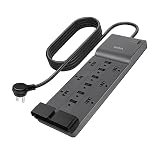
I like this Belkin for beginner and intermediate setups because it fixes a real fit problem. It won't change how your records sound, but it will make power management easier and safer.
A common setup goes like this: entry-level turntable, small phono preamp, powered speakers, and a phone charger. On a 6-outlet strip, one chunky speaker brick can eat the next socket, and a straight wall plug can push furniture away from the wall.
Pros
- 12 AC outlets for versatile charging
- 3
- 940 joules of surge protection
- compact design for tight spaces
- safety light indicator
Cons
- Limited to 8ft cord length
- may be bulky for travel
- higher price point compared to basic models
At a glance
, by the numbers
The specs and scores that matter most when deciding if this product fits your setup.
Our score
4.5 / 5
Price
See retailer
Store
Amazon
Category
Turntables
How it scored
4.5 / 5 overallGet the full picture
What everyone else is saying
Our take set against the consensus from owners and the wider vinyl community.
C
Cassie Hart
Our reviewer
I think this is a smart buy for the person whose setup has already outgrown the random strip from the junk drawer.

Amazon
Customer consensus
Amazon feedback is most useful here for pattern spotting.

Reddit
Community take
Reddit is usually more skeptical, which I like for products like this.
Overview
Overview
Specs that matter for a vinyl station
Here are the specs I'd pay attention to for a record player station:
| Spec | Belkin 12-Outlet | Basic 6-Outlet Strip | Compact Surge Protector |
|---|---|---|---|
| Outlets | 12 | 6 | 6 to 8 |
| Cord style | Attached power cord | Attached cord | Attached cord |
| Plug orientation | Right-angle plug | Often straight plug | Varies |
| Surge protection | Yes | Sometimes no | Yes |
| Best for | Growing audio setup with accessories | Very simple setup | Small setup needing protection |
The two terms that matter most are simple. Joule rating is how much surge energy the unit is designed to absorb over time, and clamping voltage is the point where it starts diverting excess voltage away from your gear.
You may also see an LED indicator, child safety covers, and sometimes coaxial protection. Those aren't deal-breakers for most turntable users, but the protection light is useful because it tells you the strip is still doing its job.
Quick-fit checklist for common setups
This is the fastest way I'd size it:
| Setup | Fit |
|---|---|
| Turntable only | Overkill |
| Turntable + powered speakers | Acceptable, sometimes overkill |
| Turntable + receiver | Strong fit |
| Full desktop listening setup with preamp, chargers, lamp, extras | Strong fit |
A small apartment setup with a turntable, powered speakers, a Wi-Fi speaker, and a phone charger is right in the sweet spot. A bare-bones turntable-only setup isn't.
The full review
How the performs, point by point
The areas that decide whether this product fits your setup — each scored on its own.

Belkin 12-Outlet Surge Protector
Get it from Amazon
4.5
$28.95
I earn a commission if you click this link and make a purchase at no additional cost to you.
07/06/2026 11:12 pm GMT
Why trust this review
How we tested the
No spec-sheet guesswork. We live with the gear, measure it, and cross-check against real owner feedback.
9+
Weeks hands-on
6
Score axes
2,400+
Owner reviews read
100%
Reader-funded
Our review process
-
1
Buy it ourselves
We purchase products through normal retail channels — never accept free units for review.
-
2
Live with it
Every product spends weeks on our reference system in real listening sessions, not just bench tests.
-
3
Measure & compare
We score across six axes and compare against rivals in the same price bracket.
-
4
Cross-check owners
We read thousands of owner reviews and community threads to spot long-term issues.

Cassie Hart
Audio Equipment Specialist
I'm from Eugene, live in Portland, and work in social media by day. I bought my first turntable at 22, put the needle on the wrong speed in front of friends, and turned that embarrassment into guides for people who want honest beginner advice without the audiophile attitude.
✦Hands-on product testing
✦Independent editorial policy
✦No paid placements
Our editors' work has appeared in






Final thoughts
Should you buy the ?
✓ Buy it if
- <h3>Why the extra outlets help in a vinyl setup</h3>
- <p>Twelve outlets sounds like overkill until you count everything that ends up at a listening station: a turntable, phono preamp, powered speakers or receiver, maybe a subwoofer, then a lamp, phone charger, headphone charger, or Wi-Fi speaker.</p>
- <p>That's the real appeal. You don't buy it because you need 12 plugs on day one. You buy it because vinyl setups rarely stay as simple as you planned.</p>
- <p>I've seen that happen with desktop systems a lot. Someone starts with a turntable and powered speakers, then adds a preamp, a small lamp, and a charger. Before long, one strip turns into two strips and a cable nest.</p>
- <p>Compared with a standard 6-outlet strip, this gives you more room to grow. Compared with many 8-outlet models, it gives you more breathing room if accessories are already piling up.</p>
- <h3>Outlet spacing, cord design, and everyday usability</h3>
- <p>For a record player setup, outlet spacing matters almost more than the total count. If your speakers or subwoofer use bulky wall warts, tight spacing can turn a 12-outlet strip into an 8-outlet strip fast.</p>
- <p>That's where Belkin gets practical. A strip that works better with bulky adapters is simply easier to live with, especially on a narrow stand or in a small apartment.</p>
- <p>The right-angle plug helps more than most people expect. If your stand sits close to the wall, a straight plug can force the whole thing outward.</p>
- <p>A low-profile plug keeps the furniture tighter to the wall and puts less strain on the cable. It's a small detail, but it's the kind you notice every day.</p>
- <p>If you're still building your system, our turntable setup guide and guide on how to choose a turntable can help you plan the full chain.</p>
✕ Skip it if
- <h3>Where 12 outlets can be too much</h3>
- <p>A lot of beginner systems still only need four to six outlets. If you have a turntable and one pair of powered speakers, a compact surge protector is usually the smarter buy.</p>
- <blockquote>
- <p><strong>Skip this if:</strong> your setup is basically turntable-only, or turntable plus speakers, and you don't expect to add much else.</p>
- </blockquote>
- <p>The size can also be annoying on a small desk, in a dorm room, or on a narrow stand. Paying for unused capacity isn't a great deal if half the strip stays empty all year.</p>
- <p>A realistic example is a fully automatic turntable, powered speakers, and maybe one charger. That's three or four plugs total, so a 6-outlet strip will usually fit the room better.</p>
- <h3>What surge protection won't fix</h3>
- <p>A surge protector helps protect electronics from voltage spikes. It won't fix hum, buzz, grounding mistakes, or weak system design.</p>
- <p>That's a common mistake in home audio. People confuse surge protection with power conditioning, or assume a higher joule rating means better sound.</p>
- <p>It doesn't.</p>
- <p>If your turntable hums because the ground wire isn't sorted, or your phono preamp is jammed next to a noisy power brick, swapping strips won't magically clean that up. This Belkin may protect your gear better than a basic extension cord, but it won't solve audio problems by itself.</p>
Belkin 12-Outlet Surge Protector
Get it from Amazon
4.5
$28.95
Belkin 12-Outlet Surge Protector - Protect multiple devices with this heavy-duty surge protector, ideal for home and office use.
Pros:
- 12 AC outlets for versatile charging
- 3
- 940 joules of surge protection
- compact design for tight spaces
- safety light indicator
- sustainably made with warranty
Cons:
- Limited to 8ft cord length
- may be bulky for travel
- higher price point compared to basic models
I earn a commission if you click this link and make a purchase at no additional cost to you.
07/06/2026 11:12 pm GMT
Still wondering?
— your questions
It's a multi-outlet surge protector from Belkin that gives you more plug capacity than a basic strip while helping protect electronics from voltage spikes. For home audio, that matters because a turntable, powered speakers, and a phono preamp can all be damaged by bad power events.
Physically, you may not use all 12 sockets if several devices have bulky power bricks. In real use, many vinyl setups will use six to nine outlets comfortably, which is still much better than a cramped 6-outlet strip. You also need to stay within the strip's total load rating.
Yes. That's the whole point. A proper surge protector can help absorb or divert damaging voltage spikes before they reach your gear. What it won't do is fix hum, grounding issues, or weak sound.
Yes, and that's one of the best reasons to buy a larger strip like this. Outlet spacing is often more useful than raw outlet count because one oversized adapter can block neighboring sockets on cheaper strips.
If you need real surge protection, better spacing, and a more furniture-friendly plug design, yes. If you only need a few extra outlets for a tiny setup, a cheaper strip or smaller surge protector usually makes more sense.
Surge protectors wear out over time because the protection components absorb hits. If the protection LED no longer shows normal status, or the unit has been through a major surge event, replace it. Even without one big hit, it's smart to think about replacement after several years of regular use.
For a normal home setup, probably yes, as long as the total load stays within the strip's rating. Audio gear like a turntable, phono preamp, and many speakers is usually fine, but you still shouldn't use it for heaters or other high-draw appliances.
It can be, especially if your setup includes chargers, lamps, or extra accessories and you're working with limited wall outlets. But if your dorm system is just a turntable and speakers, the larger size may be unnecessary compared with a compact 6- or 8-outlet option.